Waratah’s transformer failure made headlines, but the real story is how the world’s most powerful battery kept the grid safe—and what that means for green tech.
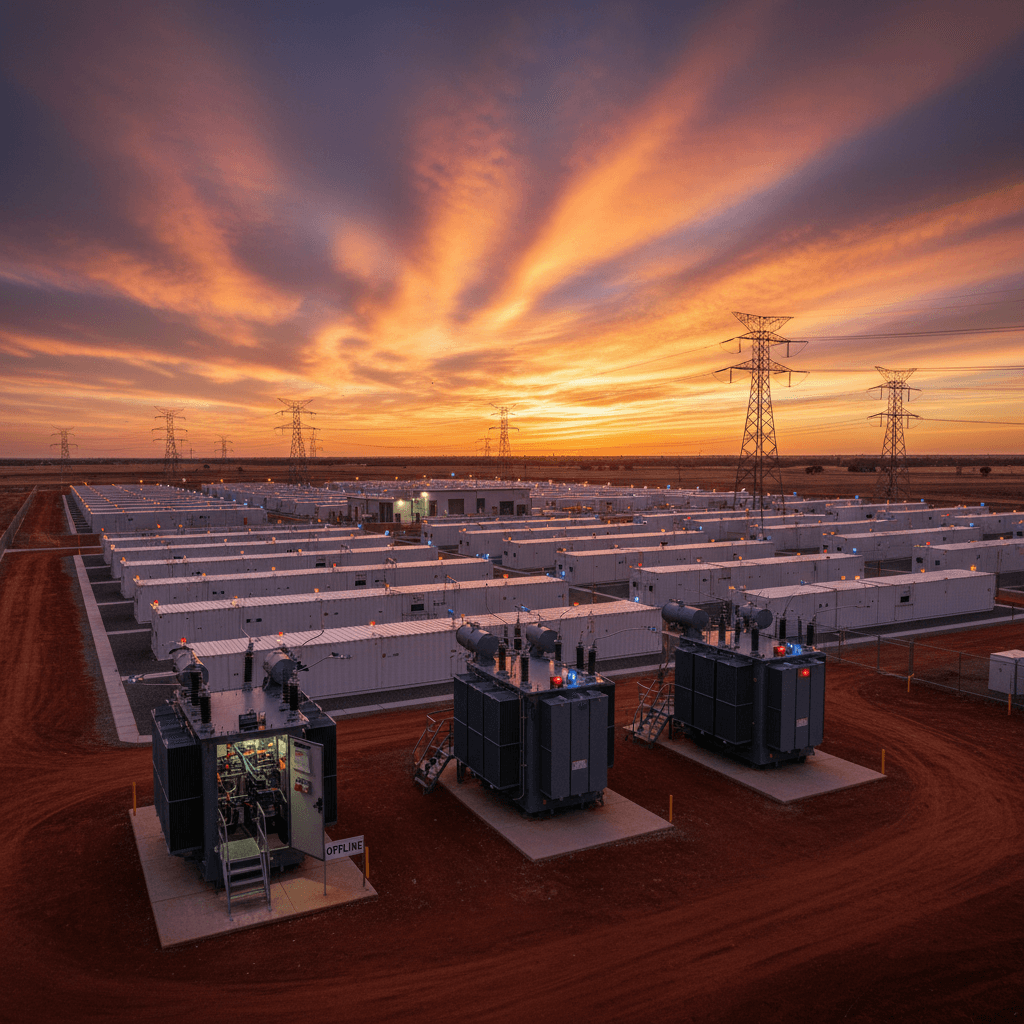
Most people only hear one phrase from this story: “catastrophic failure” at the world’s most powerful battery.
The reality behind the Waratah Super Battery incident in New South Wales is very different – and way more useful if you actually care about green technology, grid-scale batteries and energy security.
Waratah is designed as an 850MW/1,680MWh “giant shock-absorber” for Australia’s National Electricity Market, using advanced controls to protect the grid when transmission lines trip or big generators fail. In late 2025, two of its three transformers were hit by serious faults during testing. Headlines focused on the drama. The grid didn’t.
Here’s the thing about this event: the battery stayed online at 350MW and kept meeting its critical protection obligations. For anybody building, financing or relying on large-scale energy storage, that’s the story that matters.
This article breaks down what actually happened at Waratah, what it reveals about modern green technology, and how AI and smart control systems help big batteries ride through failure instead of causing it.
What happened at the Waratah Super Battery?
The Waratah Super Battery experienced major transformer damage during late-stage testing, reducing its available output from 850MW to 350MW while engineers investigate two of the three transformers.
During “Hold Point” testing – the controlled ramp-up process used to verify full-capacity operation – Akaysha Energy’s team and the market operator identified issues in two transformers. One was described in local reporting as “beyond repair”.
Instead of shutting down, Waratah:
- Stayed connected to the National Electricity Market
- Continued to provide 350MW of capacity, its interim commercial operating level
- Continued to meet its System Integrity Protection Scheme (SIPS) obligations
So yes, the site lost a significant chunk of capacity. But it did exactly what we expect from critical green infrastructure: fail in a controlled way, not a chaotic one.
From a green technology perspective, that’s a proof point – not a reason to panic.
Why the transformer failure didn’t crash the grid
Waratah was purpose-built to handle shocks. Ironically, the first major “shock” it had to absorb was its own hardware failure.
Redundancy in grid-scale battery design
Modern grid-scale battery energy storage systems (BESS) aren’t single monoliths. They’re built as modular systems:
- Multiple transformers
- Multiple inverter blocks and battery containers
- Flexible control software that can reconfigure on the fly
Waratah’s design means losing two transformers is painful, but not fatal. One transformer plus the remaining power electronics can still deliver 350MW of fast-response power.
That’s exactly what you want from green infrastructure that backs up an increasingly renewable grid.
The role of the SIPS “giant shock-absorber” system
The real star of this story is the SIPS control system. It constantly monitors 36 transmission lines in real time and can:
- Detect a fault or line trip in milliseconds
- Send a signal to Waratah to inject power
- Simultaneously tell paired generators to reduce or increase output
Even at 350MW, Waratah can still play this role. The grid doesn’t care about nameplate capacity; it cares that the committed 350MW is there, every time it’s needed.
So when you see “catastrophic failure” in a headline and “no broader system issues or safety faults” in the engineering note, this is the bridge between those two realities: smart, AI-style control and hard-wired redundancy.
What this means for investors, utilities and policymakers
Most companies get this wrong: they see any high-profile fault as a sign that green technology is fragile. Waratah proves almost the opposite.
1. Grid-scale batteries are already engineered like critical infrastructure
Waratah kept:
- Fulfilling its SIPS contract at 350MW
- Supporting grid stability during disturbances
- Generating revenue from grid services, even with reduced capacity
That’s the same mindset used for transmission networks, conventional power stations and data centers: design for partial failure, not perfect uptime.
If you’re funding or permitting green technology, this matters more than PR headlines. You’re not buying perfection; you’re buying systems that keep you out of trouble when something breaks.
2. Local manufacturing and service capacity is a strategic advantage
One under-rated detail: Waratah’s transformers were built by Wilson Transformer, an Australian manufacturer. That changes the risk profile in three practical ways:
- Faster diagnostics – engineering teams are in the same country
- Shorter repair and replacement cycles – less dependence on congested global supply chains
- Better oversight – asset owners can closely track design changes and fixes
For project developers and utilities, this is a strong argument for building local supply chains around green technology whenever possible. It’s not just about jobs or politics; it’s about downtime risk and long-term resilience.
3. Financing models can handle technical hiccups
Waratah’s financing arrangements remain intact. Why?
- The project is still delivering contracted services
- The interim 350MW capacity was already part of its staged commercial plan
- Long-lived grid assets are modeled with contingencies for outages and repair
If you’re a lender or infrastructure fund, this is your takeaway: don’t overreact to early-life technical issues on first-of-a-kind systems. The question isn’t “did anything fail?”, it’s “did the contractual and technical risk buffers work as designed?”. At Waratah, they did.
How AI and smart controls make “giant shock-absorbers” possible
The Waratah Super Battery is a great example of how AI and advanced control systems are quietly becoming the backbone of green technology.
Real-time sensing and automated decision-making
To act as a “giant shock-absorber”, Waratah needs:
- High-speed sensing across 36 transmission lines
- Continuous analysis of grid conditions
- Instant decisions on when and how much power to inject or absorb
While not every control algorithm is branded as “AI”, the pattern is very familiar:
- Ingest massive streams of data (voltage, current, frequency, line status)
- Detect patterns and anomalies in real time
- Trigger precise responses without waiting for human intervention
As these systems mature, we’re seeing more machine-learning-based forecasting, optimization and fault classification layered on top. That means:
- Better prediction of stress on transformers and inverters
- Smarter scheduling of maintenance
- Tighter coordination between batteries, solar, wind and demand response
The Waratah incident highlights where AI can go next: using models trained on thousands of events and failures to spot early warning signs inside transformers and power electronics before they hit the “catastrophic” stage.
Why this matters for the broader green technology story
Our Green Technology series keeps circling the same truth: variable renewables only work at scale when you pair them with intelligence.
Big batteries like Waratah aren’t just giant boxes of lithium cells. They’re:
- Software-defined grid assets
- AI-supervised real-time devices
- Flexible tools for both energy and stability services
That combination is exactly what enables high shares of solar and wind without constant blackout risk. Waratah’s ability to keep functioning under stress is a preview of how next-generation, AI-driven grids will behave: more dynamic, more automated, and more tolerant of hardware hiccups.
Practical lessons for anyone planning large-scale storage
If you’re working on a battery project, running a network, or advising policymakers, Waratah’s transformer failure offers some practical lessons.
Design for graceful degradation, not binary on/off
The Waratah case shows that non-catastrophic outcomes depend on architecture, not luck. When you’re specifying or approving projects, ask:
- What’s the minimum guaranteed capacity if a transformer or inverter block fails?
- Can the control system reconfigure autonomously to a safe, reduced-capacity mode?
- How will contracted services be prioritized under reduced capacity?
If those answers are vague, the project isn’t truly “critical infrastructure ready” yet.
Bake predictive analytics into your asset strategy
I’ve seen too many projects treat analytics as an “add-on module” instead of part of the core design. Waratah underlines why that’s a mistake.
Use AI-driven tools to:
- Monitor transformer temperatures, partial discharge, gas-in-oil trends and vibration
- Correlate operating profiles with failure modes
- Flag anomalies early enough that you can repair, not replace
Is that a silver bullet? No. But over a 20-year asset life, catching even a fraction of issues early can save millions and avoid months of derating.
Strengthen the local ecosystem around your assets
Waratah benefitted from domestic transformer manufacturing and local engineering capacity. When you’re planning assets of this scale, build a similar ecosystem:
- Partner with regional OEMs where feasible
- Develop local repair and test capabilities
- Share fault data with suppliers to improve designs
This is where green technology and industrial strategy intersect. Countries that combine renewables, storage and local manufacturing will have less fragile clean energy systems.
Why Waratah still strengthens the case for green technology
Despite a high-profile transformer failure, Waratah continues to operate, protect the grid and earn revenue. For the broader green technology transition, that’s the headline that matters.
The incident proves three things:
- Grid-scale batteries can behave like mature infrastructure, not experimental gadgets.
- AI and advanced controls are essential to resilience, turning raw battery capacity into real system protection.
- Local supply chains and robust design choices determine how painful a failure actually is.
If you’re evaluating large-scale storage or other clean energy projects, don’t just ask, “What’s the peak capacity?” Ask, “What happens when something breaks?” The best green technology doesn’t pretend failure won’t happen; it makes sure the grid barely notices when it does.
As we move into 2026 with more Waratah-sized projects on drawing boards around the world, this is the standard to aim for: intelligent, resilient, and honest about risk. That’s how green technology grows from promising to unavoidable.