Ireland has opened its wholesale power market to battery storage. Here’s why that’s a big deal for clean energy, and how smart software will capture the upside.
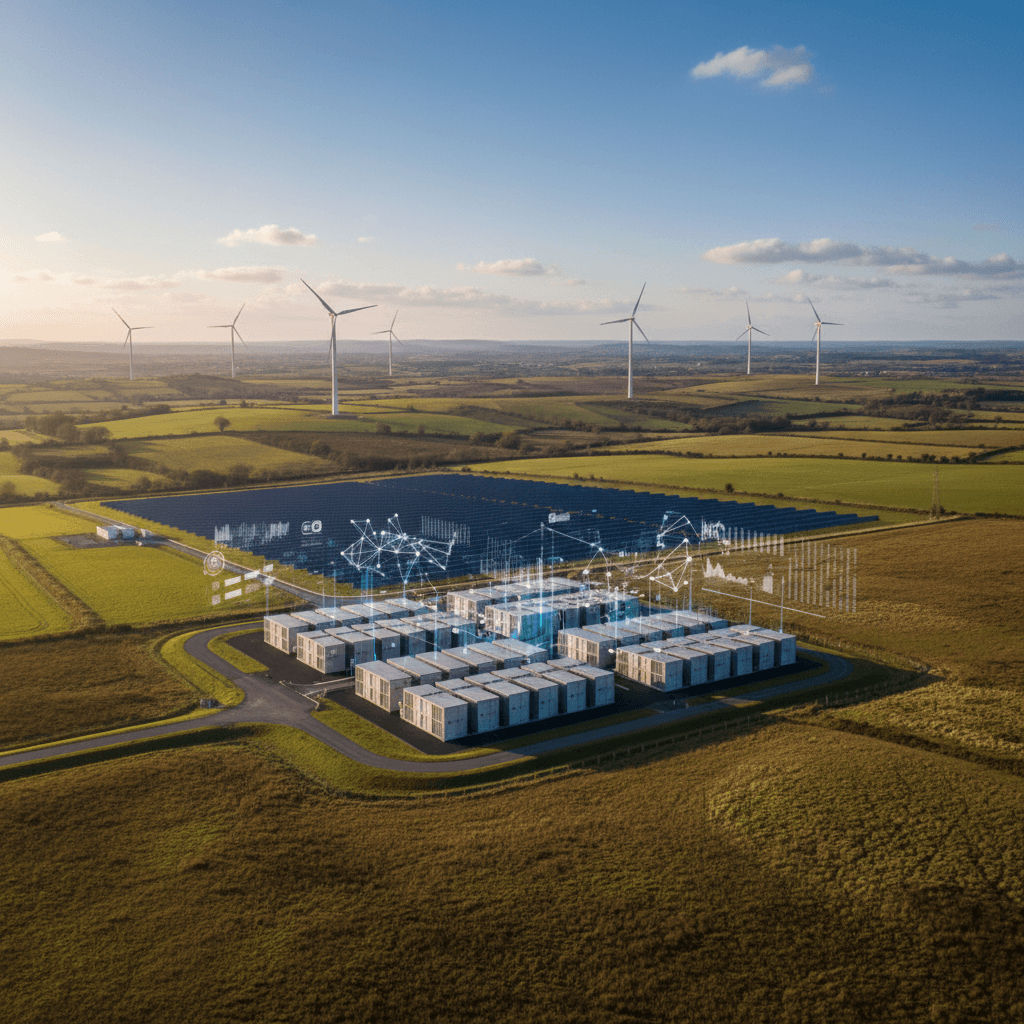
Ireland’s New Battery Rules Are a Big Deal for Clean Power
34.9% of Ireland’s electricity came from renewables in August 2025. That’s impressive — but without flexible storage, a lot of cheap, clean power still gets wasted or curtailed.
Ireland has just taken a major step to fix that. From 11 November 2025, new Scheduling and Dispatch Programme (SDP-02) rules allow grid-scale battery storage systems to participate directly in the wholesale electricity market for the first time. For a country that already depends heavily on wind and is pushing hard on solar, this is more than a regulatory tweak. It’s the start of a different way of running the grid.
For anyone working in green technology, energy investing, or corporate sustainability, this change is a live case study in how markets, software, and storage can work together. It shows what comes next after simply “adding renewables” — and where AI-driven optimisation starts to matter more than hardware.
This post breaks down what’s changed in Ireland, why it matters, and how smart operators will turn these rules into real revenue and real decarbonisation.
What Actually Changed in Ireland’s Battery Market?
Ireland’s grid operators — EirGrid in the Republic and SONI in Northern Ireland — have launched the second stage of the Scheduling and Dispatch Programme (SDP). Under SDP-02, battery storage units (classified as Energy Storage Power Stations, ESPS) can now:
- Bid into the Day-Ahead market
- Trade in the Intraday market
- Participate in Balancing markets in real time
Previously, most battery energy storage systems (BESS) in Ireland earned money almost entirely from DS3 services — fast frequency response and reserve products designed to keep the grid stable as more wind and solar came online.
That model was:
- Largely “set and forget”: commit capacity, get fixed or semi-fixed payments
- Focused on stability services, not energy trading
- Good for early deployment, but limiting for long-term investment
Now, under SDP-02, batteries can actively trade energy, not just provide stability:
- Charge during hours of abundant, cheap renewable generation
- Discharge during high demand, high price periods
- Submit charging and discharging preferences to the system operator
This is classic arbitrage, but at grid-scale and tightly integrated with system operations. The rule change effectively acknowledges that batteries are not just backup devices — they’re flexible, dispatchable resources that can shape demand and smooth supply.
The scale is already meaningful. Ireland has roughly 1.4GWh of operational BESS capacity across 30 sites, about double what it had a year ago. With market access sorted, that figure won’t stay still for long.
Why This Matters for Green Technology — Not Just Ireland
Here’s the thing about clean energy: renewables without flexibility hit a ceiling. You can install gigawatts of wind and solar, but if your system can’t shift energy in time, you end up curtailing cheap green power and firing up fossil plants when the wind drops.
By opening the wholesale market to batteries, Ireland is doing three important things that other countries will end up copying:
-
Turning storage into a first-class market participant
Batteries move from “ancillary services add-on” to core trading asset. That sends a strong signal to developers, operators, and financiers that storage is part of the main event, not a side business. -
Aligning climate goals with commercial logic
The climate, energy and environment minister said it clearly: these rules are about making the grid more flexible, efficient, and sustainable. But the mechanism is hard-nosed: give batteries access to more revenue streams so more of them get built. -
Creating a real-world testbed for AI in energy
Once you give storage access to real-time markets, the old static operating models stop working. You need continuous forecasting, price spread analysis, state-of-charge optimisation, and risk-aware bidding. That’s where AI and optimisation platforms become essential green technology.
Ireland is effectively running a live experiment in software-defined clean energy: hardware on the ground, AI in the cloud, and markets in the middle.
For businesses watching the green technology space — from corporates with net-zero targets to investors looking for bankable assets — this is exactly the kind of signal that de-risks long-term storage plays.
From ‘Set and Forget’ to Active Trading: A New Operating Model
Under the old DS3 structure, a typical battery project could be operated with relatively simple logic:
- Contract capacity to DS3 services
- Meet performance requirements
- Collect revenue with limited need for minute-by-minute decision-making
Under SDP-02, that’s obsolete. GridBeyond’s modelling suggests that a 10MW, 2-hour (20MWh) BESS operating under the new regime could see 12–37% higher annual revenue than DS3-only participation — if it trades smart.
What “active trading” actually involves
For a grid-scale battery, active wholesale trading usually means:
- Forecasting price spreads across Day-Ahead, Intraday, and Balancing markets
- Managing state-of-charge (SoC) to ensure the asset is ready to capture profitable opportunities
- Balancing degradation vs margin: high cycling boosts revenue but shortens battery life
- Automating bids and schedules to respond to rapidly changing prices
Yayu Yang from GridBeyond describes this as needing a “new level of market interaction” that demands continuous analytics and automation. That’s exactly right. Human traders alone can’t react fast enough nor juggle all the technical constraints of a battery.
In practice, the stack for a modern BESS in Ireland (and increasingly everywhere else) looks like this:
- Physical asset: the battery, inverters, and on-site controls
- Site controller / EMS: manages SoC, temperature, safety, and local operations
- Optimisation platform: forecasts, runs trading algorithms, integrates with market systems
- TSO / market interface: submits bids, receives dispatch instructions, tracks settlement
If you’re developing or owning storage, this is where your competitive edge will come from over the next 5–10 years. Not from buying the cheapest battery, but from running it smarter than everyone else.
How AI and Software Turn Irish Batteries Into Flexible Assets
The reality is simpler than it looks: batteries are only as “green” as the software that runs them.
With Ireland’s SDP-02 rules live, a well-optimised battery can:
- Charge almost exclusively when renewable generation is high and prices are low
- Displace fossil generators by discharging when demand peaks
- Provide stability services while also earning from energy trading
AI and advanced optimisation come in at three key levels:
1. Price and renewables forecasting
Good forecasting makes or breaks arbitrage strategies. Platforms typically use:
- Historical market data and weather patterns
- Short-term wind and solar generation forecasts
- Demand forecasts and known events (e.g., industrial loads, holidays)
The output: a probabilistic view of future prices that informs when to charge or discharge.
2. Real-time decision-making
Conditions change quickly. An unexpected wind drop or interconnector issue can flip prices in minutes. AI-driven controllers adjust in real time by:
- Updating expected spreads throughout the day
- Respecting battery constraints (SoC limits, C-rates, temperature)
- Re-optimising dispatch based on live market and grid signals
3. Fleet-level optimisation
Many operators now manage fleets of BESS assets across multiple nodes. Smart software can:
- Allocate risk and opportunity across sites
- Coordinate charging/discharging to minimise congestion or imbalance charges
- Learn from performance to refine strategies over time
For Ireland’s market, this isn’t theoretical. Companies headquartered there are already active traders in the UK, ERCOT (Texas), CAISO (California), and Australia. The Irish rules essentially let them bring global playbooks home.
For the wider green technology space, this is a preview of what’s coming everywhere: decarbonisation powered as much by data science and software as by turbines and panels.
What This Means for Developers, Investors, and Energy Users
Most companies get this wrong. They look at a policy change like SDP-02 as “regulatory news” instead of treating it as a new opportunity design space.
Here’s how different players should be thinking about Ireland’s move.
Storage developers and IPPs
You now have a clearer path to stacked revenues:
- DS3-style stability services
- Day-Ahead and Intraday energy trading
- Balancing market participation
That can support:
- Larger project sizes and durations (e.g., 2–4 hour systems instead of 1 hour)
- More aggressive financing structures, because revenue is less dependent on a single programme
- Stronger cases for hybrid assets (wind + storage, solar + storage)
The trade-off: you can’t treat operations as an afterthought anymore. You need:
- A serious route-to-market partner or in-house trading capability
- High-quality data and forecasting
- Clear strategies for degradation and warranty compliance
Investors and lenders
The rule change removes a key barrier that had been flagged repeatedly: limited wholesale access for storage. That improves the bankability of:
- Merchant-exposed BESS projects
- Portfolios combining DS3 and market revenues
- Long-duration energy storage (LDES) projects, especially as EirGrid consults on an LDES procurement scheme
If you’re assessing deals, your diligence now needs to cover software and optimisation as much as EPC and technology risk.
Large energy users and corporates
For energy-intensive businesses in Ireland and beyond, this shift is a signal:
- Expect more flexible, data-driven tariffs as markets become more dynamic
- On-site or contracted storage becomes more attractive for hedging and decarbonisation
- Corporate PPAs with storage-backed profiles will likely become more common
If you’re serious about net-zero, you shouldn’t just be buying green power certificates. You should be asking how your energy strategy helps stabilise the grid and absorb renewables. Batteries in wholesale markets do exactly that.
The Bigger Picture: Ireland as a Template for Flexible, Low-Carbon Grids
Ireland’s SDP-02 update is part of a broader story we keep coming back to in this Green Technology series: clean energy stops being “ intermittent and difficult” once you give the system the right tools.
Those tools don’t look like a single magic device. They look like:
- Storage that can move energy in time
- Smart markets that reward flexibility
- AI and optimisation platforms that orchestrate everything
Right now, Europe still underuses energy storage relative to its potential, even though deployments and policy support have grown fast. Ireland’s move is one of the clearer examples of how to change that: remove structural market barriers, give flexible assets full access, and make it profitable to support decarbonisation.
If you work in energy, climate strategy, or green tech, watch Ireland closely over the next 12–24 months. You’ll see:
- How revenues for storage assets evolve under combined DS3 + wholesale models
- Whether longer-duration systems gain traction under new procurement schemes
- How quickly software-driven, AI-native asset management becomes the norm
There’s a better way to think about green technology than just “more solar, more wind.” The real shift is more intelligence in how we use, store, and trade energy. Ireland has just given its batteries a bigger role in that story — and other markets won’t be far behind.