Ampyr’s 2,160MWh Northern Battery shows how grid-forming, long-duration storage can replace coal, stabilise renewables-heavy grids, and unlock firm green power.
Most companies talk about the energy transition. A few are literally rebuilding it on the foundations of old coal plants.
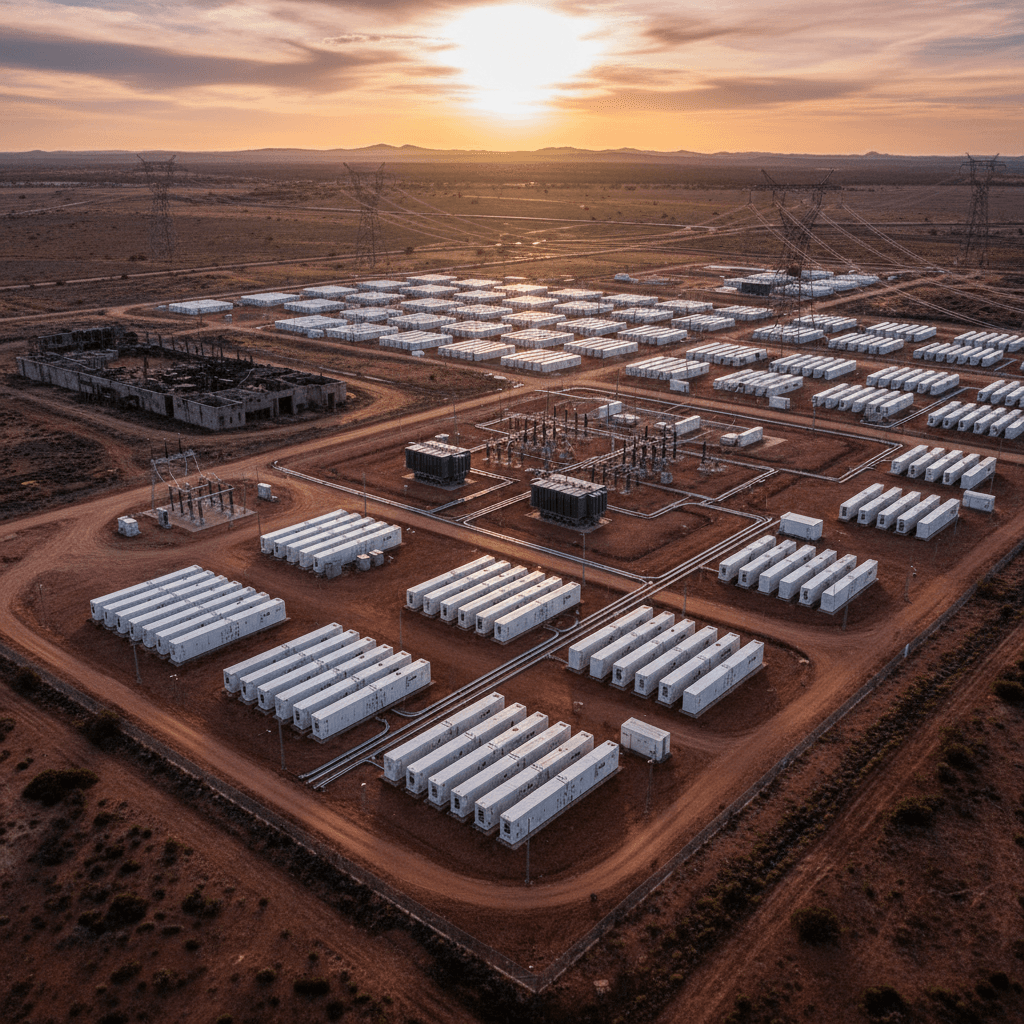
That’s what’s happening in Port Augusta, South Australia, where Ampyr Australia has picked up a 270MW/2,160MWh grid-forming battery energy storage system (BESS) and is turning the site of the former Northern coal power station into a long-duration clean energy hub. For anyone working in green technology, energy, data centres, or heavy industry, this project is a preview of how the next decade of decarbonisation will actually work.
This isn’t just another big battery. It combines long-duration storage, grid-forming technology, and smart market design in a way that directly tackles three problems that keep coming up in this series: reliability, affordability, and the brutal math of net zero.
What is the Northern Battery – and why does it matter?
The Northern Battery is a 270MW, 2,160MWh grid-scale energy storage project in South Australia, capable of storing up to 8 hours of energy. Ampyr acquired the development from Green Gold Energy and will connect it to the National Electricity Market (NEM) from the former 560MW Northern coal power station site.
Why this matters:
- It replaces coal with storage on the same grid node, using existing substation infrastructure instead of building from scratch.
- It’s long-duration by today’s standards: 8 hours is enough to meaningfully cover the evening peak or back up the grid through extended low-wind periods.
- It’s grid-forming, which means it doesn’t just follow the grid – it actively stabilises it.
Ampyr has publicly committed to 6GWh of operational battery storage in Australia by 2030, aiming for 10–20% of the country’s future storage demand. The Northern Battery is one of the anchor projects that turns that ambition into hardware.
For the broader green technology story, this is a textbook example of how we move from “more renewables” to renewables that behave like a proper power system.
Grid-forming BESS: the missing backbone of high-renewable grids
The core upgrade in the Northern Battery is grid-forming inverter technology. This is where the project stops being just “a big battery” and becomes grid infrastructure.
Grid-following vs grid-forming: what’s the difference?
Here’s the simplest way to think about it:
- Traditional (grid-following) inverters: They wait for the grid to set voltage and frequency, then they push power into that existing waveform. They’re passengers.
- Grid-forming inverters: They can create and maintain a stable voltage waveform themselves, like a synchronous generator. They’re drivers.
That means a grid-forming BESS like Northern Battery can:
- Provide voltage and frequency control even when conventional generators are offline
- Support black start and islanded operation in some configurations
- Strengthen system stability in regions dominated by wind and solar
In a high-renewables grid, this is not a “nice to have”. It’s the thing that lets system operators keep saying yes to more solar and wind without sacrificing reliability.
Why long-duration + grid-forming is such a strong combo
You can find 1–2 hour batteries on a lot of networks now. They’re great for:
- Arbitrage (buy low, sell high)
- Frequency control ancillary services (FCAS)
- Short, sharp support during contingencies
But 8-hour, grid-forming batteries move into a different category:
- They can cover whole peaks, not just shave the edges.
- They can ride through multi-hour disturbances, like interconnector trips or low-renewables periods.
- They can anchor weak parts of the grid, especially where coal and gas are retiring.
South Australia is already one of the most renewable-heavy grids in the world, often running at or near 100% renewable generation. The next phase of its transition, as Ampyr’s CEO Alex Wonhas bluntly put it, will be dominated by energy storage, not generation. He’s right. Building more solar into a grid that’s already spilling solar isn’t progress – building storage and smart controls is.
Turning a coal precinct into a clean energy asset
Reusing the Northern Power Station site isn’t just symbolism; it’s smart engineering and economics.
Why repowering coal sites with BESS is so effective
By relocating the project to the old Northern Power Station precinct, Ampyr and Green Gold Energy gain several real advantages:
- Existing grid connection: High-voltage transmission lines and substation assets are already there. This cuts costs, time, and planning risk.
- Proven site and access: Heavy transport access, laydown areas, and industrial zoning are usually in place.
- Community familiarity with energy infrastructure: Locals are already used to a power station on that land, which can reduce visual impact concerns.
From a system planning perspective, this also helps maintain grid strength exactly where a major synchronous generator used to sit. That reduces the risk that new renewables get built far away from strong grid nodes and then stuck behind congestion.
Community and First Nations engagement that actually matters
One thing I pay attention to in these projects is whether the “community piece” is just a brochure paragraph or tied to real money and accountability.
Ampyr has put in place:
- An AU$40,000 Community Benefit Fund for local projects in Port Augusta
- Engagement with Nukunu Traditional Owners to build cultural, economic, and social partnerships around the project
No, AU$40k a year doesn’t change the world on its own. But it’s a direct, structured signal that the project’s benefits aren’t limited to corporate balance sheets and carbon accounts. For green technology to scale politically, this kind of local value-sharing has to be the norm, not an afterthought.
How projects like Northern Battery change the business model of clean energy
The Northern Battery isn’t just an engineering upgrade – it’s a business and market design story. Long-duration, grid-forming BESS open up multiple revenue streams and enable new types of customers.
Multiple value stacks from one asset
A well-operated grid-scale battery in the NEM can stack several services:
- Energy arbitrage: Buy when prices are low (e.g., midday solar surplus), sell during evening peaks
- FCAS and other ancillary services: Fast response for frequency support and contingency events
- System strength and inertia-type services: Especially valuable as synchronous machines retire
- Capacity and firming: Backing up solar and wind contracts to deliver firm, dispatchable supply
When you add grid-forming capabilities, the asset can bid into more technical services and play a more central role in system operations. That’s attractive for both utilities and large energy users.
Why this matters for data centres and energy-intensive industry
Ampyr’s parent, AGP Sustainable Real Assets, isn’t just holding renewable assets. It’s also developing over 860MW of data centre capacity globally and 13GW of clean energy projects. That’s not a coincidence.
Here’s the pattern that’s emerging:
- Hyperscale data centres, AI workloads, and electrified industry want reliable, low-carbon power with predictable costs.
- Grids with high wind and solar share need flexible, fast-response assets to keep frequency and voltage under control.
- Long-duration, grid-forming BESS can sit at the intersection: they stabilise the grid and underwrite corporate decarbonisation.
If you run a data centre, smelter, mine, or large manufacturing load, the question isn’t just “Where do I buy green electrons?” anymore. It’s “Which projects can give me firm, green power at the node I care about, at the times I care about?” Projects like Northern Battery are exactly what that answer looks like in practice.
What other regions and developers can learn
Australia is quietly becoming one of the best real-world labs for grid-forming storage. Alongside Northern Battery, we’ve already seen:
- Neoen’s grid-forming Western Downs (270MW/540MWh) in Queensland
- Neoen’s Blyth Battery (238.5MW/477MWh) in Western Australia
- Additional grid-forming projects from FRV and AGL totalling around 2,200MWh
For developers, policymakers, and large energy users outside Australia, there are a few clear lessons from this wave of projects:
1. Treat storage as core grid infrastructure, not a bolt-on
When storage is sized and controlled as essential grid equipment, it:
- Speeds up renewable connections
- Reduces the need for new gas as “backup”
- Lowers long-term system costs by avoiding overbuild and curtailment
Grid-forming inverters should be treated as strategic assets in weak parts of the grid, not just a technical curiosity.
2. Repower fossil sites where it makes sense
Coal and gas plant retirements are an opportunity to:
- Reuse existing substations and transmission rights
- Maintain system strength where it mattered historically
- Deliver visible, public proof of the energy transition
If you’re a utility or government holding stranded fossil assets, a structured pipeline of BESS repowering projects is one of the fastest ways to hit climate and reliability goals at the same time.
3. Pair storage strategy with customer strategy
The best green technology plays now line up infrastructure, regulation, and customers:
- Developers like Ampyr are designing assets that support both the grid and large end-users.
- Data centre and industrial off-takers get cost-stable, low-carbon supply.
- Regulators get a pathway to high-renewable grids without blackouts.
When these three pieces are aligned, financing follows much more easily.
Where this fits in the bigger green technology story
Across this Green Technology series, there’s a theme that keeps resurfacing: hardware is only half the story. The real shift happens when we combine smart infrastructure, intelligent control (including AI), and new business models.
Grid-forming batteries like the Northern Battery are exactly that blend:
- Hardware: long-duration, high-capacity lithium-based (or similar) storage
- Intelligence: advanced inverters and dispatch software tuned to grid conditions and market signals
- Business model: multi-service, multi-customer assets that support both decarbonisation and reliability
If you’re planning your organisation’s climate strategy, or building products in the green technology space, this project is a strong signal of where things are headed by 2030. Storage isn’t an accessory to renewables anymore. It is the backbone that makes renewables behave like a 24/7 power system.
The practical question now is: will you be buying power from assets like Northern Battery, partnering to build them, or competing with them? Because they’re not hypothetical. Construction in Port Augusta starts in 2026.
If you’re developing large loads, building clean energy projects, or exploring grid-forming and long-duration storage, this is the right moment to map where similar opportunities sit in your own region – especially at retiring fossil sites. The organisations that move first on that mapping will control the best nodes in tomorrow’s low-carbon grid.