Germany’s EVs hit 33.3% of new car sales, with the Skoda Elroq on top. Here’s what that means for green technology, AI, and your business strategy.
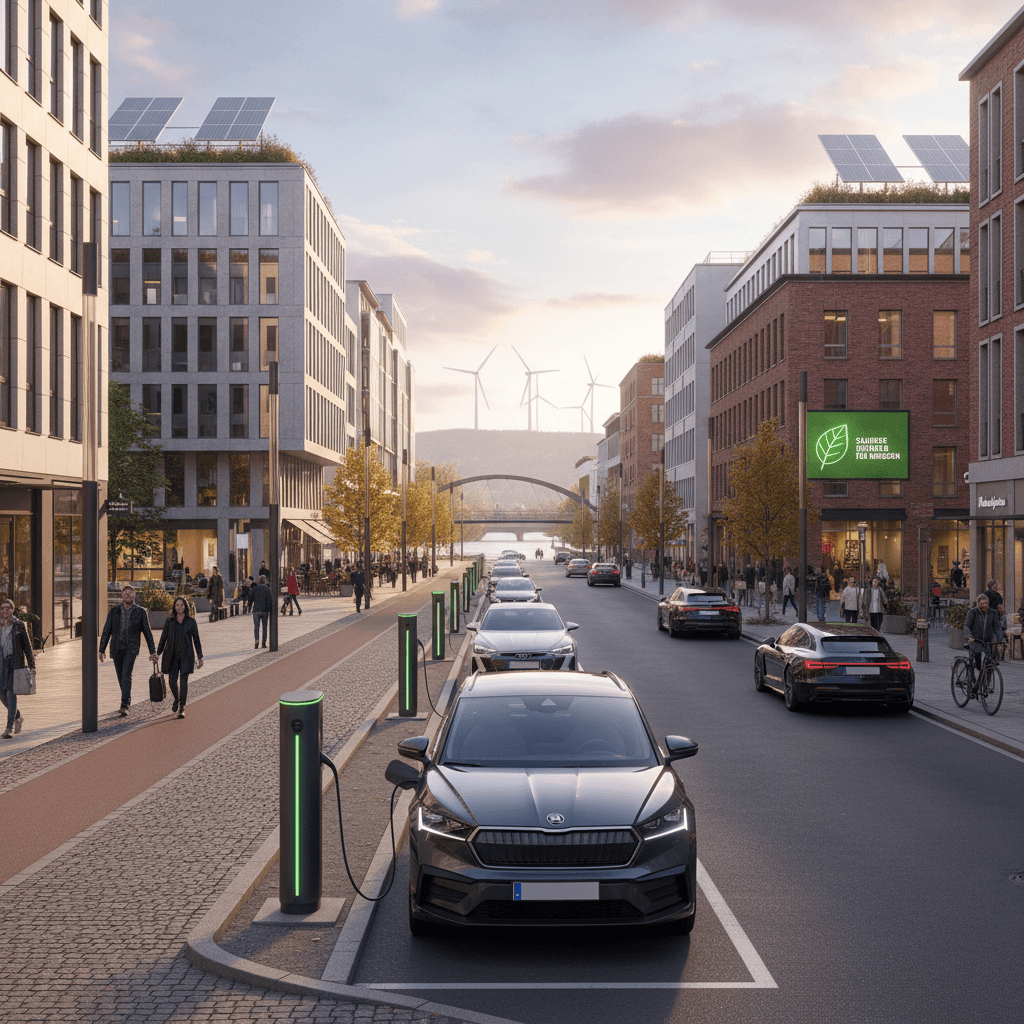
Most companies watching the green technology space look at Norway or China first. But the October numbers from Germany – Europe’s largest auto market – tell a different story about where electric mobility is quietly becoming the new normal.
In October, plugin electric vehicles took 33.3% of all new car registrations in Germany, up from 23.6% a year earlier. Battery electric vehicles (BEVs) grew 48% year-on-year, while plug-in hybrids (PHEVs) grew 60%. Overall car sales were up only 8%. The standout model? The Skoda Elroq, October’s best‑selling BEV.
This matters because Germany is the bellwether for European industry. When one in three cars sold there has a plug, it isn’t a niche anymore – it’s the backbone of the next automotive cycle. And for anyone working in green technology, from fleet operators to software startups, this shift opens real commercial opportunities, not just nice sustainability graphics in an annual report.
Below, I’ll break down what this 33.3% share actually means, why the Skoda Elroq is a bigger signal than it looks, and how businesses can plug into (pun intended) this momentum with smart, AI-enabled strategies.
Germany’s 33.3% EV Share: Why It’s a Turning Point
Germany crossing one-third market share for plugins in a normal sales month is a strong sign that EVs are transitioning from early adopters to the mass market.
Here’s the core shift in the October data:
- Plugin share of new cars: 33.3% (up from 23.6% YoY)
- BEV volume: +48% year-on-year
- PHEV volume: +60% year-on-year
- Overall auto market: +8% year-on-year to 250,133 units
When EVs grow 6–7 times faster than the overall market, you’re not looking at a temporary subsidy bump – you’re looking at a structural transition.
Why this share level matters for green technology
For the broader green technology ecosystem, this 33.3% share in Germany is a demand signal that’s hard to ignore:
- Charging infrastructure needs to scale quickly in both power and intelligence.
- Grid operators must handle more distributed, flexible loads.
- Energy storage and smart home tech become more attractive as EVs double as mobile batteries.
- Software and AI providers get a growing data stream from vehicles, chargers, and buildings to optimize energy use in real time.
The reality? Once a major market sustains ~30–40% plugin share, planning for a fossil-heavy fleet stops making sense. Every new combustion car sold in 2025–2027 will still be on the road in 2040. Germany’s numbers say: that mindset is out of date.
Skoda Elroq on Top: Why a “Normal” BEV Winning Is Big News
The best‑selling BEV in Germany in October was the Skoda Elroq. Not a Tesla, not a premium German brand, but a practical, mainstream model.
That alone tells you where we are in the adoption curve.
From halo cars to workhorses
Early EV growth was driven by halo products: high‑end models with bold designs and headline-grabbing acceleration. Now, the Elroq’s success shows that buyers are choosing EVs for the same reasons they choose any car:
- Practical family size and range
- Reasonable price point
- Familiar brand with a strong dealer network
- Competitive financing and fleet offers
In other words, the emotional barrier of “EVs are exotic” is fading. An Elroq is just “the new company car” or “the family crossover” – and it happens to be all‑electric.
What this reveals about the German EV buyer
From conversations with fleet managers and EV drivers, plus what we see in market data, German buyers increasingly care about:
- Total cost of ownership (TCO) over 4–6 years, not just sticker price
- Reliable charging at home and work, more than flashy public chargers
- Company car taxation and benefits that favor low-emission vehicles
- Residual value stability, where established brands like Skoda have an edge
When a practical BEV tops the charts, it confirms that EVs are winning on fundamentals, not just subsidies or hype.
What’s Driving This EV Acceleration in Germany?
Germany’s EV surge isn’t random. It’s a mix of regulation, economics, and infrastructure catching up with consumer expectations.
1. Policy and incentives are pushing fleets
Company cars and fleets make up a large share of German registrations. For them, EVs now offer:
- Lower benefit-in-kind tax for drivers of low‑emission company cars
- Reduced operating costs via cheaper energy and less maintenance
- Compliance advantages with corporate ESG and CO₂ targets
Most big fleets don’t buy one EV. Once they update policy, they switch whole vehicle categories. That’s how a market can jump from 23.6% to 33.3% plugin share in a year.
2. Economics are finally lining up
Even with recent electricity price volatility in Europe, the math is increasingly clear:
- Electricity per 100 km usually costs 30–60% less than fuel, depending on tariffs
- Service and maintenance costs can be 20–40% lower than combustion vehicles
- Some German cities are tightening access rules and parking benefits for ICE vehicles, adding hidden costs to staying with fossil
Once CFOs see a 4–5 year TCO model, the case for EVs is hard to argue against, especially for predictable-use fleets like sales teams, logistics, and municipal vehicles.
3. Infrastructure is becoming smarter, not just bigger
Raw charger count is no longer the only metric. What matters now is intelligent, well-managed charging:
- Smart chargers that schedule charging for low-tariff or high-renewable hours
- Software that balances loads across depots, offices, and homes
- Vehicle-to-home (V2H) and, eventually, vehicle-to-grid (V2G) pilots turning cars into flexible energy assets
This is where AI in green technology really earns its keep – by orchestrating when and how thousands of vehicles charge, so the grid stays stable and customers save money.
How AI Turns EV Growth into Real Business Value
For businesses, the spike in EV share isn’t just a climate story. It’s a data and optimization story.
AI is rapidly becoming the control layer for EV-centric energy systems. Here’s how organizations in Germany and across Europe are using it.
Smarter fleet electrification
Instead of guessing how many chargers to install or which routes can go electric, leading companies are feeding real data into AI models:
- Historical trip data and GPS traces
- Fuel consumption and idle time logs
- Depot locations and driver schedules
Algorithms then recommend:
- Which vehicles to replace with BEVs first
- Optimal battery sizes and models by route profile
- How many chargers each site needs, and at what power rating
- Charging windows that minimize cost while ensuring availability
I’ve seen fleets cut their estimated EV rollout cost by 20–30% simply by using data-driven planning instead of rules of thumb.
Intelligent charging and energy management
When a third of new vehicles are plugins, charging becomes an energy problem, not just a mobility problem.
AI-driven energy platforms can:
- Forecast load from vehicles, buildings, and machinery
- Shift charging to align with rooftop solar output or low‑carbon grid hours
- Cap total power usage to avoid demand charges
- Prioritize vehicles that need to be ready sooner (e.g., morning delivery vans)
The result: lower energy bills, fewer grid upgrade surprises, and a measurable reduction in carbon intensity per km.
Turning EV data into new services
As EV penetration rises, data from vehicles and chargers enables new green technology business models:
- Predictive maintenance services for fleets and charging networks
- Usage-based insurance products that account for smoother EV driving patterns
- Carbon accounting and reporting tools that use real-time energy mix data
For startups, this is a rich space. For established companies, it’s a chance to move from hardware-only to recurring software and services revenue.
Practical Steps if You’re Planning for an EV Future
If Germany’s 33.3% plugin share tells us anything, it’s that waiting for “maturity” is already late. Here’s a concrete roadmap to act on this trend.
1. Audit your current mobility and energy footprint
Start with data you already have:
- Number and types of vehicles (owned, leased, grey fleet)
- Annual mileage by vehicle category
- Fuel spend and typical routes
- On-site energy contracts, peak demand, and solar assets
You don’t need perfection. A 70% accurate dataset is enough for useful AI‑assisted modeling.
2. Model at least one EV scenario for 2026–2030
Build or commission a scenario that answers:
- What if 30–50% of our new vehicles from 2026 are electric?
- What chargers would we need, and where?
- How does that affect TCO under different energy price assumptions?
Given the German market data, assuming a future where EVs don’t dominate new sales is now the riskier bet.
3. Integrate green technology into core strategy, not CSR
EVs touch operations, finance, HR, facilities, and IT. Treating them as a side project under “sustainability” slows you down.
Put EVs and smart energy into your core business planning:
- Include EV targets in procurement policies
- Involve IT early for data integration and security
- Train finance teams on new cost structures and incentives
4. Use AI tools to reduce complexity, not add it
Good AI tools in this space don’t ask you to become a data scientist. They:
- Plug into existing telematics or fleet management software
- Offer clear recommendations instead of just dashboards
- Simulate different policies (e.g., home charging vs. depot-only)
If a solution can’t show you, in simple numbers, how EVs will impact your cost and emissions, it’s not mature enough.
Germany’s EV Moment and the Future of Green Technology
Germany hitting 33.3% plugin share – with BEVs like the Skoda Elroq leading – is a strong signal to anyone serious about green technology: the transition is no longer theoretical. It’s embedded in Europe’s largest car market.
Over the next few years, this shift will reshape how businesses think about mobility, energy, and data. EVs will be:
- Rolling storage for renewable energy
- Data sources for optimizing operations
- Proof points for credible climate strategies
If your organization wants to stay relevant in this new landscape, the right question isn’t “Should we move toward EVs and smart energy?” It’s “How fast can we do it intelligently?”
Our Green Technology series is all about making that shift practical – from clean energy and smart cities to AI-powered sustainability tools. Use Germany’s EV surge as your wake‑up metric, then start designing systems that treat electric vehicles as core infrastructure, not an optional extra.
Because once one in three new cars has a plug, the future isn’t coming. It’s already parked in the driveway.