America’s water workforce is aging fast. Here’s how AI, green technology, and community training programs can restart the talent pipeline and boost resilience.
Most utilities leaders can tell you two numbers off the top of their head: how old their pipes are, and how old their people are.
In the U.S., more than 2 million miles of drinking water pipes run under our streets. An estimated 240,000 main breaks a year and trillions of gallons of lost water are the visible side of a deeper issue: the people who know how to plan, operate, and fix this infrastructure are retiring faster than we’re replacing them.
This isn’t just a workforce problem. It’s a green technology problem, a climate resilience problem, and a business continuity problem. If we want smart, low‑carbon, climate‑ready cities, we need a water workforce that’s both larger and more digitally fluent — and we need it quickly.
This post looks at how AI and green technology can restart the water workforce pipeline: what’s broken, what’s working, and where utilities, cities, and private partners can act right now.
The water workforce crisis: aging talent, rising climate pressure
The U.S. water workforce is shrinking in experience just as climate risk and regulatory pressure climb.
- The American Society of Civil Engineers has flagged drinking water infrastructure as underfunded, with hundreds of thousands of mains awaiting repair.
- Each year, aging infrastructure contributes to the loss of over 2 trillion gallons of treated water.
- In parallel, major utilities report that around one‑third of their workforce is at or near retirement.
Here’s the thing about water: it’s the quiet backbone of every green technology strategy. You can’t run data centers for AI, cool heat pumps, manufacture batteries, or support dense, transit‑oriented housing without reliable, efficient water systems.
When that workforce thins out:
- Compliance with drinking water standards gets harder.
- Climate resilience — response to floods, droughts, and extreme weather — weakens.
- Public trust erodes when boil notices and main breaks become routine.
From a green technology perspective, every gallon of lost treated water is wasted energy and chemicals. Fixing leaks and running plants efficiently is one of the most cost‑effective forms of climate action a city can take. But you need people — and increasingly, people plus AI — to make that happen.
Why traditional hiring isn’t working anymore
Most utilities still recruit like it’s 1995: job boards, civil service postings, and word of mouth. That approach fails in 2025 for three reasons.
1. Low awareness of water careers
If you ask a typical student to list climate or green technology careers, they’ll mention solar, EVs, maybe climate analytics. Water rarely makes the list.
Yet the sector offers:
- Stable, often unionized jobs
- Strong mission alignment (protecting public health and the environment)
- Increasing use of advanced analytics, sensors, and automation
The gap is brand and storytelling, not substance. The work is meaningful and tech‑forward — but it’s invisible.
2. Shrinking applicant pools for skilled trades
Licensed operators, electricians, instrument techs, and maintenance specialists are in short supply across all industries. Smaller utilities, in particular, can’t simply outbid big cities or private industry on salary.
So if the sector competes only on pay, it loses. Where it can win is on purpose, training, and clear growth paths.
3. Fragmented training paths
A lot of water knowledge lives in:
- On‑the‑job training
- Legacy SOP binders
- The heads of operators who’ve been there 30 years
That’s brittle. It makes it hard for newcomers to ramp up quickly and for utilities to move toward AI‑enabled, low‑carbon operations.
There’s a better way: structured, tech‑infused talent pipelines built in partnership with communities, education providers, and green technology companies.
Building talent pipelines: what’s actually working
The utilities that are getting traction treat workforce development like infrastructure: planned, funded, and collaborative.
Community‑rooted, train‑to‑hire programs
Train‑to‑hire initiatives solve two problems at once: they give underrepresented communities access to stable green jobs and give utilities pre‑vetted, pre‑trained candidates.
Programs modeled on:
- GIS talent cohorts: Young adults learn geographic information systems and digital mapping while working on real asset data. That supports smart city planning and leak detection, and introduces participants to water careers.
- Water operations academies: Short, intensive programs covering treatment basics, distribution, safety, ethics, and customer service, often delivered with community colleges.
For utilities and cities, the pattern to copy is:
- Partner locally with nonprofits, workforce boards, and community colleges.
- Co‑design curricula that include fieldwork at plants and in distribution systems.
- Tie completion to real job opportunities — internships, apprenticeships, or entry‑level roles.
- Layer in green technology skills: sensors, SCADA basics, AI‑assisted monitoring, and digital twins.
This turns “water jobs” from an abstract concept into a concrete, near‑term pathway.
Broad, nontraditional recruiting
To restart the pipeline, utilities should target four groups aggressively:
- Transitioning workers from manufacturing, oil and gas, or logistics who already understand industrial safety and shift work.
- Veterans with experience in utilities, engineering, logistics, or leadership.
- Career changers from IT or data backgrounds interested in climate and public impact.
- Local residents in service areas who already care about their community.
What works in practice:
- Hosting “Green Infrastructure Career Days” at treatment plants.
- Offering paid pre‑apprenticeships that don’t require prior experience.
- Making job postings crystal clear about mission, tech, benefits, and training — not just qualifications.
The reality? Most people don’t reject water careers. They’ve simply never seen them.
How AI and smart water technology change the talent equation
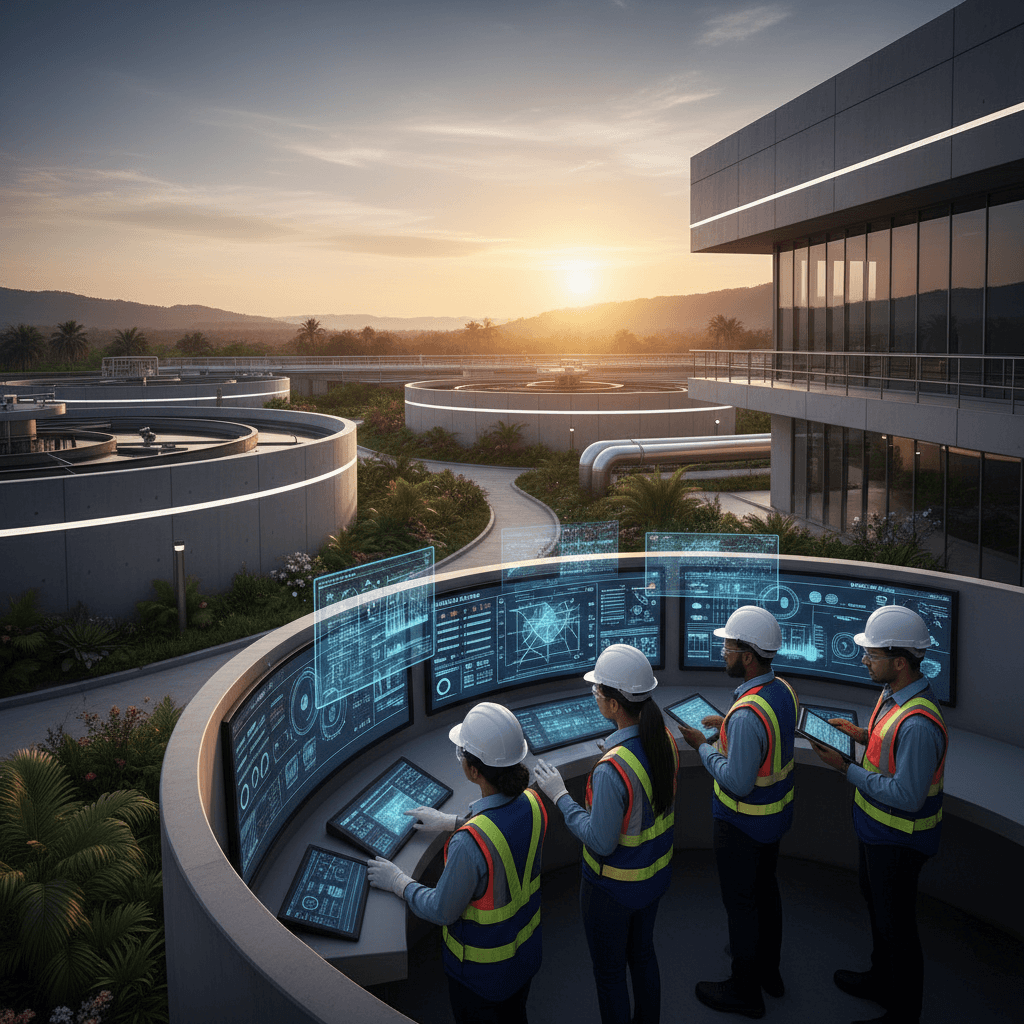
AI isn’t a replacement for the water workforce. It’s an amplifier — and a magnet for the next generation of talent.
Where AI adds real value in water operations
In a modern, green water utility, AI and advanced analytics can:
- Predict main breaks and asset failures by analyzing age, material, soil conditions, and past leaks.
- Optimize pump schedules to cut energy use and emissions while maintaining pressure.
- Detect leaks from acoustic sensor data, flow anomalies, or satellite imagery.
- Monitor treatment quality in real time and flag anomalies before they become compliance issues.
- Automate routine customer interactions, freeing staff to handle complex cases.
Each of these applications reduces wasted water and energy, directly supporting climate goals. But they also change the skills utilities need.
New roles for a green, AI‑enabled water workforce
As AI adoption grows, three categories of roles become increasingly important:
-
Hybrid operator‑analysts
Operators who can read dashboards, interpret predictive maintenance alerts, and adjust operations accordingly. They don’t need to be data scientists, but they do need to be data‑comfortable. -
Field technicians with digital skills
Techs who can configure sensors, update firmware, and validate what AI models are seeing out in the real system. -
Utility data and optimization specialists
Staff who sit between IT, operations, and engineering, tuning models, validating data quality, and translating insights into work orders and capital plans.
Training people into these roles is entirely feasible. Many operators already know the system intimately; AI training simply gives them new tools.
Why AI helps attract younger talent
If you’re trying to appeal to students and early‑career professionals who care about climate and technology, the selling point is simple:
“You’ll use AI and smart infrastructure to protect communities and the environment — and you’ll see the impact of your work every day.”
That’s more compelling than “you’ll read gauges in a plant.” Green technology and AI make the work legible as a modern, future‑proof career.
Practical steps for utilities and cities in 2026
For utilities, cities, and private operators that want to move beyond hand‑wringing, here’s a concrete playbook.
1. Map your workforce cliff
You can’t manage what you haven’t quantified. Start with:
- Retirement eligibility by role over the next 5–10 years
- Critical skills at risk (e.g., top‑level operator licenses, specialized maintenance)
- Geographic hotspots where shortages would hit service hardest
This analysis becomes your workforce resilience plan, just as important as your capital plan.
2. Design green technology career paths, not just jobs
For each priority role, define:
- Entry‑level titles and required baseline skills
- Training sequence, including AI and digital tools
- Clear promotion routes and pay progression
When people can see a path from trainee to operator to supervisor — and into supervisory or optimization roles — they’re far more likely to stay.
3. Embed AI and digital skills into all training
Don’t bolt AI on as an optional module. Make it part of how the work is done.
Examples:
- Operators learn to read energy and emissions dashboards alongside process control.
- Field staff practice validating AI leak alerts and feeding back ground truth data.
- Supervisors use predictive maintenance tools during asset planning exercises.
This normalizes AI as a standard part of a sustainable water utility, not a side project.
4. Partner deeply with education and community organizations
Strong partnerships with community colleges, universities, unions, and nonprofits are non‑negotiable.
Actions that work:
- Co‑creating certificate programs in water technology and green infrastructure.
- Offering guest lectures, site visits, and capstone projects focused on real utility challenges.
- Jointly marketing programs as climate and green technology careers, not just “water jobs.”
5. Measure success on both workforce and climate outcomes
If you’re serious about green technology and resilience, track:
- Time‑to‑fill for critical roles
- Diversity of new hires and promotion rates
- Leak reduction, energy savings, and emissions cut per skill or tech deployment
When leadership can see that investment in people plus AI directly reduces water loss and emissions, funding workforce programs gets a lot easier.
Why this matters for the future of green technology
Every conversation about climate, clean energy, or smart cities eventually runs into the same bottleneck: people who can build and run the systems.
The water sector is a perfect example. It’s under immense pressure from aging infrastructure, climate volatility, and growing urban populations. At the same time, it has a unique opportunity:
- AI and smart water technologies can dramatically cut water loss and energy use.
- Community‑rooted training can bring new talent and diversity into a historically opaque field.
- Clear, tech‑forward career paths can make water a destination sector for climate‑minded workers.
If you’re a utility leader, city official, or green tech company, this isn’t a side issue. Your climate strategy depends on a modern, AI‑literate water workforce.
The next generation is already looking for careers that matter. The question is whether the water sector will show up clearly as one of those options — with real training, real technology, and real impact.
Now is the moment to rebuild that pipeline.