Spider-inspired soft microbots could make gut diagnostics less invasive, using magnetic control and AI to improve navigation, imaging, and early detection.
Spider Microbots: A Softer Future for Gut Tests
A standard colonoscopy can cost patients more than money: it costs time off work, sedation, prep, a ride home, and—often—the nerve to go through with it. That reluctance is a real healthcare problem because early detection is the difference between a treatable finding and a life-changing diagnosis.
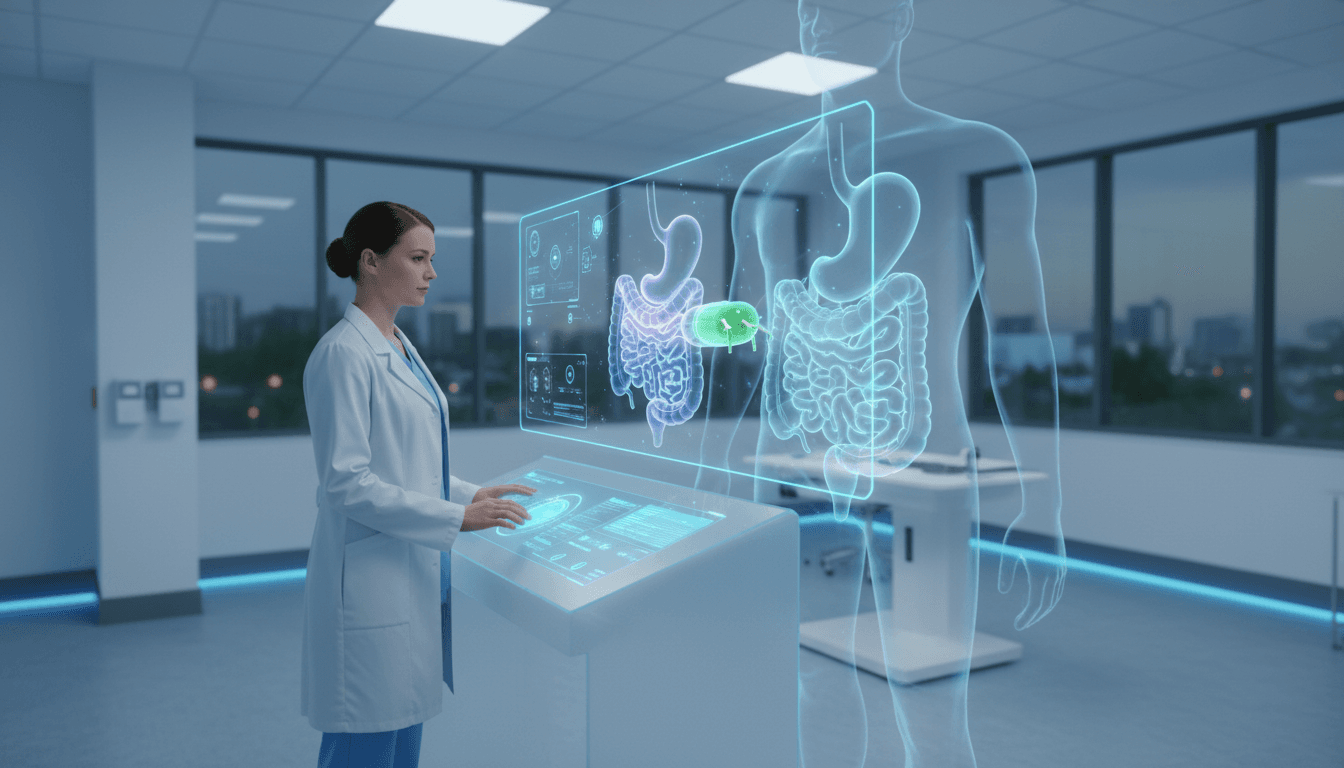
Now add a surprising contender to the “make screening easier” conversation: a soft, magnetically controlled micro-robot inspired by a desert spider that rolls like a wheel. In recent prototype work from the University of Macau, the robot is roughly the size of a vitamin capsule and has already been tested in animal stomachs, colons, and small intestines. The point isn’t novelty. The point is simple: make gut diagnostics less invasive so more people actually show up.
This post is part of our Artificial Intelligence & Robotics: Transforming Industries Worldwide series, and I like this example because it shows what robotics looks like when it leaves the factory floor and enters a very human setting: healthcare. The most interesting story here isn’t “robots are coming.” It’s how AI-powered robotics can remove friction from essential care.
Why invasive gut diagnostics are still a bottleneck
Gut diagnostics still rely heavily on tools that are physically intrusive, operator-dependent, and anxiety-inducing. The workhorse is the endoscope: a flexible tube with a camera, inserted through the mouth or rectum. It’s effective, but it’s also uncomfortable, typically requires sedation, and—if mishandled—can lead to serious complications such as bowel perforation.
That tradeoff creates a predictable behavior pattern: people delay. And delays are exactly what you don’t want when you’re dealing with colorectal cancer, stomach cancers, inflammatory bowel disease, ulcers, or Crohn’s disease.
The hidden cost: missed screenings and late findings
Most discussions about endoscopy focus on clinical performance. The bigger system-level issue is compliance. If a diagnostic path is scary, inconvenient, or painful, fewer people complete it on schedule.
From a healthcare operations perspective, that causes downstream problems:
- Late-stage diagnoses that are harder and more expensive to treat
- Overbooked specialty suites because procedures require sedation, monitoring, and recovery space
- Higher staffing burden (anesthesia support, recovery nurses, escort requirements)
- Uneven access in rural or under-resourced regions
A minimally invasive alternative doesn’t just “feel nicer.” It can shift the economics and throughput of diagnostic care.
Spider-inspired soft microbots: what they are and why the motion matters
The Macau team’s key idea is locomotion: rolling instead of crawling. Their micro-robot borrows from the golden wheel spider, a small spider (about 2 cm wide) known for escaping danger by curling into a wheel and cartwheeling down sand dunes.
Inside the body, there’s no dune slope to roll down—so the robot uses external magnetic actuation. The robot is made from a rubber-like magnetic material with tiny magnets embedded in its legs. A nearby system (described as a dexterous robotic arm with a rotating magnet) generates a magnetic field that interacts with those magnets to drive controlled rolling.
Why rolling beats “cute” in the digestive tract
The digestive tract is a hostile environment for small robots. It’s slippery with mucus, full of folds, has sharp turns, and includes geometry changes that defeat many locomotion styles. The researchers report their prototype navigated obstacles as high as 8 centimeters in animal testing.
Here’s why the spider-style rolling approach is practical:
- Obstacle crossing: Rolling can clear folds and transitions that snag crawling designs.
- Energy efficiency: Rolling generally wastes less energy than repeated stick-slip crawling.
- Stability on slopes and vertical-ish surfaces: The team claims strong stability even on inclined surfaces.
- Reduced tissue interaction forces: Soft materials and rolling motion can reduce abrasive contact.
Other locomotion approaches (crawling, swimming, jumping) have been explored in soft robotics. The point isn’t that those are “bad.” It’s that the gut is not a smooth pipe—and designs that perform on a bench often fail in real anatomy.
“The purpose of the soft magnetic robot is to provide a minimally invasive, controllable, and highly flexible alternative.” — Qingsong Xu (via IEEE Spectrum)
Where AI fits: control, safety, and decision support
A magnetically actuated capsule robot is only as good as its control system. Today’s prototype is driven by an external magnetic field, but moving from “it can move” to “clinicians can rely on it” requires software that understands messy real-world conditions.
This is where AI in medical robotics becomes more than marketing.
AI-assisted navigation and autonomy (the realistic version)
Full autonomy inside the body is a high bar. The near-term win is shared control: the clinician remains in charge, while AI reduces workload and risk.
Practical AI capabilities that fit this use case:
- Pose estimation and tracking: Estimating the capsule’s position and orientation from sensor data and imaging.
- Adaptive control: Adjusting magnetic field strength and rotation in response to changing friction, folds, and peristalsis.
- Collision risk prediction: Flagging when the robot’s trajectory is likely to press into tissue or get stuck.
- “Return-to-safe-state” behaviors: Automated recovery actions when the robot encounters unexpected resistance.
If you’ve worked with robotics outside medicine, this will sound familiar: it’s the same philosophy used in warehouses and factories—tight feedback loops, constraint-aware motion planning, and fail-safes—just in a far more sensitive environment.
AI for image interpretation: better diagnostics, not just nicer procedures
There’s a second AI layer that matters even more: computer vision for detection. A swallowable or magnetically guided robot becomes dramatically more valuable if it can do high-quality imaging and help clinicians spot suspicious lesions.
In practice, that could mean:
- Real-time flagging of polyps or bleeding patterns
- Automated measurement of lesion size and location
- Structured reports generated from the procedure timeline
My take: comfort alone won’t make these systems standard of care. Better detection + better patient experience is what changes guidelines.
Beyond inspection: targeted drug delivery and minimally invasive interventions
Inspection is step one. Intervention is where the platform becomes truly strategic. The Macau team’s images also demonstrate targeted drug delivery, and that’s not a side quest—it’s the business case for many micro-robotics programs.
If a robot can reach a known site and deliver therapy locally, you can potentially:
- Treat ulcers with localized dosing rather than systemic medication
- Deliver anti-inflammatory agents to an active Crohn’s region
- Provide localized chemotherapy adjuncts near tumors (future-facing, but plausible)
A parallel path: the “caterpillar” soft robot
It’s not just one lab pushing this forward. A team from North Carolina State University reported another soft magnetic robot that crawls like a caterpillar using an origami-style structure that contracts under magnetic fields. Their experiments included delivering mock treatment to a mock stomach ulcer.
This matters for the larger robotics-in-healthcare story: we’re watching a design space open up.
- Rolling designs may be superior for obstacle crossing.
- Crawling designs may be superior for controlled station-keeping (stopping precisely at a site).
In the long run, the “winner” might be hybrid locomotion, chosen automatically by an AI controller based on anatomy and task.
What has to be true before capsule microbots replace endoscopy
The hardest part isn’t getting a prototype to move. It’s getting a clinical workflow to trust it. Based on how medical devices typically mature, there are a handful of make-or-break requirements.
1) Safety: soft body, predictable forces, and fail-safe retrieval
For clinical adoption, developers need to demonstrate:
- Consistent low tissue contact forces
- Minimal risk of entanglement in folds
- Robust behavior across patient variability
- A clear plan if the robot stalls (e.g., magnetic extraction, endoscopic retrieval, or natural passage)
2) Imaging quality and coverage
A capsule that’s comfortable but misses lesions doesn’t help anyone. Key performance questions:
- Can it maintain stable camera orientation when needed?
- Can it slow down at suspicious areas?
- Can it cover complex regions that standard endoscopes struggle with?
3) Workflow: who runs it, where, and how long it takes
To reduce costs (and not just shift them), the system has to fit real clinics:
- Setup time must be short.
- Operator training must be reasonable.
- The magnetic control hardware can’t require a research-lab footprint.
A likely early model is specialty centers using the robots for select cases (patients who refuse standard endoscopy, follow-up monitoring, or targeted therapy delivery) before expanding to broader screening.
4) Regulatory evidence: not just “non-inferior,” but clinically meaningful
Xu suggests a timeline of as little as five years to help doctors examine patients’ insides if further animal experiments and human trials go well. That’s ambitious but not crazy—if the device proves both safety and diagnostic value.
Clinically meaningful endpoints could include:
- Higher screening completion rates
- Comparable (or improved) detection sensitivity for polyps/lesions
- Reduced sedation usage
- Lower complication rates
What healthcare leaders and innovators should do now
If you’re building, buying, or budgeting for AI-powered robotics in healthcare, microbots are worth tracking—even if you’re not a GI clinic. They signal where the industry is headed: patient-friendly diagnostics, remote control, and AI-assisted interpretation.
Here are practical steps I’d take right now:
- Map your “fear points.” Identify procedures patients delay due to discomfort or logistics. Those are prime targets for soft medical robotics.
- Build a data strategy early. Imaging + navigation data from robotic procedures will be highly valuable. Decide who owns it, how it’s labeled, and how it’s secured.
- Prepare for hybrid teams. These systems sit between gastroenterology, radiology-style imaging workflows, robotics engineering, and IT security.
- Pilot with narrow use cases. Start where the ROI is obvious: patients who avoid sedation, high-risk monitoring, or localized therapy delivery.
The reality? The hospitals that win with medical robotics won’t be the ones that buy the fanciest hardware. They’ll be the ones that redesign the workflow around it.
A clearer path to earlier detection
Spider-inspired capsule microbots won’t eliminate traditional endoscopy overnight. But they point toward something healthcare badly needs: diagnostics that are easier to accept, easier to scale, and easier to repeat.
As part of the broader Artificial Intelligence & Robotics: Transforming Industries Worldwide shift, this is what progress looks like when it’s done right: not flashier tech, but less friction between patients and care.
If these soft magnetic robots can prove safety, imaging reliability, and clinician control—then “swallow a capsule” could become a normal step in early cancer detection and chronic disease monitoring. And if that happens, what other invasive diagnostics across healthcare are next on the list?