TRON 2 shows why shape-shifting robots are becoming practical for industrial AI. See where modular embodied AI fits in logistics, manufacturing, and pilots.
Why Shape-Shifting Robots Like TRON 2 Matter Now
Factories and warehouses don’t have a “standard” floor anymore. You’ve got mixed inventory, seasonal spikes, tighter labor markets, and facilities that were never designed for robots in the first place. The result is a messy reality: you either buy specialized machines for each task (expensive, slow to scale), or you try to force one robot to do everything (and watch reliability fall apart).
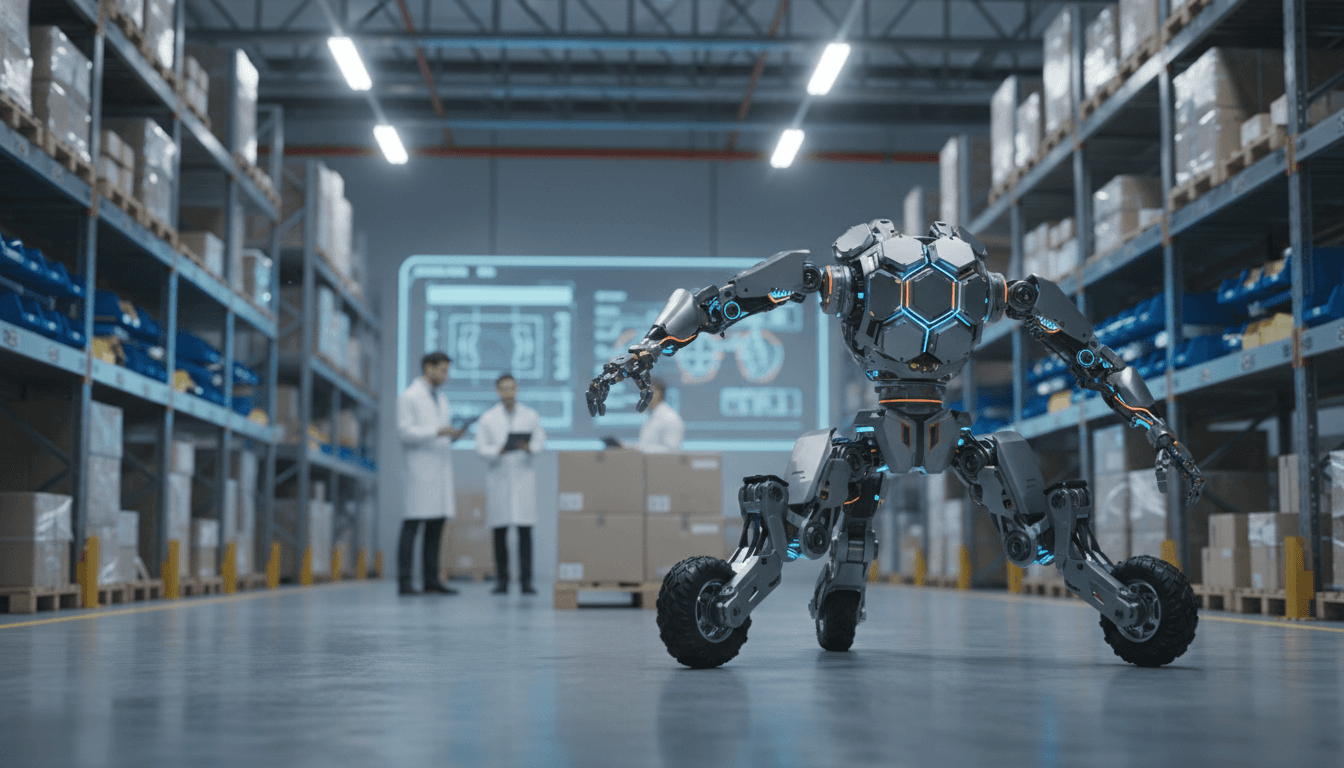
LimX Dynamics’ TRON 2 is an unusually direct response to that problem. It’s a modular embodied AI robot that can be configured as a dual-armed biped torso, a wheeled-leg mobile platform, or a bipedal “sole-feet” walker. That isn’t a gimmick. It’s a bet that the next wave of industrial automation won’t be a single “perfect” robot—it’ll be adaptable robotics paired with AI models that can transfer skills across hardware modes.
This post is part of our “Artificial Intelligence & Robotics: Transforming Industries Worldwide” series, and I’m going to take a stance: shape-shifting platforms like TRON 2 are one of the most practical paths to scalable physical AI—especially for organizations that need to experiment fast, deploy selectively, and avoid long integration cycles.
TRON 2 in plain terms: one platform, three robots
TRON 2 is designed to reduce the number of separate robots you need to evaluate, train, and support. Instead of choosing between a manipulation robot, a mobile robot, and a legged robot, TRON 2 aims to let teams prototype across all three—using one consistent ecosystem.
LimX describes three primary modes:
- Dual-arm configuration for manipulation tasks
- Wheeled-leg configuration for all-terrain mobility and payload transport
- Bipedal (sole-feet) configuration for terrain-specific locomotion such as stairs
Here’s why that matters: the hardest part of automation isn’t usually the demo. It’s what happens after—when the robot faces a different aisle width, a different pallet layout, a different set of SKUs, or a different set of safety rules.
A modular platform doesn’t magically solve those issues. But it does give you a way to test the right form factor without rebuilding your entire software stack from scratch.
The manipulation specs are intentionally “research-friendly”
For manipulation, TRON 2’s dual-arm setup includes:
- 7 DoF per arm with a spherical wrist
- 70 cm reach workspace
- 10 kg (22 lb) dual-arm payload
- 50 ms teleoperation latency
- Front-facing camera for manipulation coverage and data collection
If you’re building industrial AI, that camera + low-latency teleop combo is not a footnote. It’s the basis for how modern robot learning actually ships: collect targeted demonstrations, label/clean data, train policies, validate in sim, then deploy under tight guardrails.
The real story: adaptable hardware is a data strategy
A shape-shifting robot is really a data engine with interchangeable bodies. That’s the deeper implication.
Most companies treat “robot selection” and “AI training” as separate decisions. In practice, they’re intertwined:
- Different bases produce different motion patterns, failure modes, and safety envelopes.
- Different task layouts change what the robot sees, what it can reach, and how it should plan.
- Data collected on one setup often doesn’t transfer cleanly to another.
TRON 2 is positioned as an integrated vision-language-action (VLA) platform with an end-to-end data pipeline: collection, cleaning, annotation, training, and inference. It also offers:
- An open SDK with high- and low-level interfaces
- Python development workflows
- Compatibility with ROS1 and ROS2
- Sim2Real assets such as URDF files for simulation in Isaac Sim, MuJoCo, and Gazebo
- Tutorials for algorithms such as ACT and Pi0.5, plus 1,000+ real-world datasets (as stated by LimX)
That stack is a signal. LimX isn’t only selling hardware—it’s selling a faster loop between:
- Collect real-world data (often via teleop)
- Train embodied AI policies
- Validate in simulation
- Deploy with safety constraints
This matters because the organizations winning with robotics right now aren’t the ones with the flashiest demos. They’re the ones with repeatable data operations.
Where TRON 2 fits in industry: three practical use cases
TRON 2 is most useful where environments change, tasks vary, and teams can’t afford a long redesign cycle. That makes it particularly relevant to manufacturing, logistics, and field-like industrial sites—exactly where AI-powered robotics is expanding fastest.
1) Warehouse “exceptions,” not the easy picks
Wheeled AMRs already handle predictable transport well. The pain is exceptions:
- A dropped carton in an aisle
- A tote jam at a workstation
- An inventory cycle count in a tight rack area
- A temporary obstacle due to peak-season overflow
TRON 2’s wheeled-leg mode targets real-world variability, with:
- 30 kg (66.1 lb) payload in that configuration
- Auto-recharging function
- Adaptive control for non-uniform terrain
A wheeled base is efficient. Legs handle transitions. The hybrid approach is a strong design choice for facilities that have “mostly flat” floors but still include ramps, thresholds, docks, and the occasional messy corner.
2) Manufacturing cells that keep changing
Manufacturing automation often dies by a thousand change orders:
- The product mix changes
- The fixture changes
- The reach needs change
- The line balance changes
A modular platform can let teams start with a stationary dual-arm torso for prototyping manipulation—then later move to a mobile base when it’s time to connect multiple stations.
If you’re a plant engineer, that’s not theoretical. It’s how you avoid buying a robot that’s obsolete the moment the cell is reconfigured.
3) Facilities with stairs and “human-scale” infrastructure
Stairs are a simple test that exposes a lot: perception quality, foothold planning, balance control, and robustness to lighting changes.
TRON 2’s bipedal mode is designed for stair navigation via visual-based motion planning. That’s relevant to:
- Older industrial buildings
- Multi-level maintenance routes
- Security and inspection tasks in mixed-use facilities
Not every operation needs bipedal locomotion. But the moment you do, it’s usually because the facility won’t be rebuilt for robots. A platform that can switch forms lets you pick where legs are worth the complexity.
What “shape-shifting” changes for ROI and deployment
The business value of a modular robot is optionality. You can start with one configuration to prove value, then expand.
That said, optionality only pays off if you manage it with discipline. Here’s what I’ve found works when teams evaluate modular embodied AI platforms.
A practical evaluation checklist (steal this)
- Define your first deployment as a single job-to-be-done
- Example: “Move totes from zone A to zone D” or “Pick and place from conveyor to bin.”
- Pick the configuration that minimizes risk
- Wheeled-leg for transport, stationary dual-arm for manipulation, biped only if you must.
- Demand a data plan, not a demo
- How many hours of teleop are needed? How will data be labeled? What’s the retraining cadence?
- Measure reliability as ‘hours between intervention’
- Not just speed. Intervention time kills ROI.
- Stress-test safety behaviors
- Self-collision avoidance, boundary constraints, and emergency recovery.
TRON 2 includes active safety boundaries (algorithmic constraints to prevent self-collision and damage) and dual redundant power, designed to fold the arms into a secure position during power loss. Those design choices are exactly the kind you want to see when a robot is intended for iterative R&D and industrial adaptation.
Pricing signals who it’s for
LimX lists EDU pricing at:
- $20,000 for dual-arm (EDU Edition)
- $25,000 for 3-in-1 (EDU Edition)
Those numbers matter even if you’re an industrial buyer, because they set expectations: TRON 2 is positioned as a research and application-development testbed first. If you’re trying to accelerate embodied AI inside your organization—especially with a lab-to-pilot pathway—that pricing can make experimentation feasible for more teams.
The bigger trend: embodied AI is moving from single-skill to adaptable automation
Industrial robotics is shifting from “programmed motion” to “trained behavior.” And trained behavior changes the robot selection process.
When your robot’s intelligence depends on data and learned policies, the platform needs:
- A consistent dev environment (SDK, Python, ROS)
- Good simulation hooks (URDF + mainstream simulators)
- Fast data collection (teleop that doesn’t feel laggy)
- Safe failure modes (so you can run experiments without destroying hardware)
TRON 2 checks many of those boxes on paper. The interesting part is the combination: modular kinematics plus a VLA-oriented stack. That combo lines up with where the industry is going—toward human-AI collaboration, where humans demonstrate, supervise, and set boundaries while the robot generalizes.
And that’s the point for this series: AI and robotics are transforming industries worldwide not by replacing everything at once, but by turning more tasks into repeatable “skills” that can be deployed across sites. Adaptable robots widen the set of tasks that can be turned into those skills.
What to do next if you’re evaluating adaptable robots
If TRON 2 (or any modular embodied AI robot) is on your radar, don’t start by asking, “Can it do everything?” Start here: “What’s the one configuration that will produce usable operational data fastest?”
A good next step is to run a short pilot plan on paper:
- One task, one site, one success metric
- A safety and intervention log from day one
- A data budget (hours, labeling effort, retraining schedule)
If you’d like help scoping that pilot—especially for manufacturing or logistics workflows—I can tell you what to document, what to measure, and what questions to ask vendors so you don’t end up with an impressive prototype and no path to scale.
The forward-looking question worth sitting with: as robots become more adaptable, will your competitive edge come from the hardware you buy—or from the task data you collect and the skills you maintain over time?