Robots folding clothes isn’t a gimmick—it’s a sign AI manipulation is maturing. See what these demos prove and how they translate to industry.
Why Robots Keep Folding Clothes (and Why It Matters)
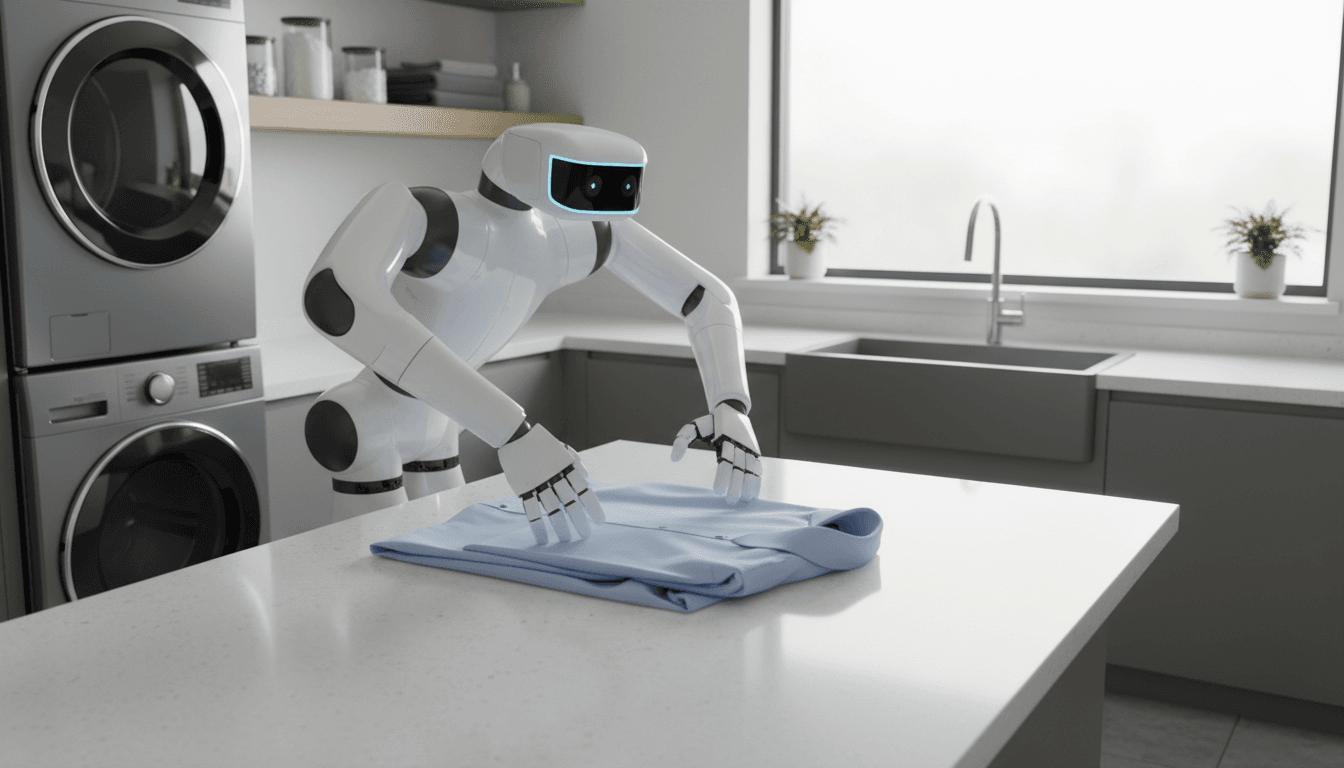
Robots folding T-shirts have become the new “hello world” of modern robotics. If you’ve watched even a few robotics clips this year, you’ve probably seen the same scene: two robot arms, a clean tabletop, a shirt laid flat, and a surprisingly competent fold.
It’s tempting to shrug and say, “Cool demo—call me when it can load a dishwasher.” But I don’t think that’s the right reaction. Clothes folding sits at a sweet spot where today’s AI-driven robot learning actually works, and it creates a clear bridge from home automation to the kinds of industrial automation companies will pay for at scale.
This post breaks down why everyone’s robot is folding clothes, what these demos really prove (and what they don’t), and how the same manipulation skills are quietly shaping logistics, manufacturing, healthcare, and even smart city operations.
Clothes folding is popular because it’s finally feasible
Clothes folding is everywhere for one blunt reason: we couldn’t reliably do it before, and now we can—at least well enough to show repeatable progress.
A decade ago, laundry-folding research existed, but it often depended on tightly controlled setups: fixed lighting, carefully calibrated cameras, specific garments, and brittle logic that worked once for a paper deadline. Even when learning-based approaches were used, models were typically small, data was limited, and generalization was weak.
What changed is less about “better grippers” and more about better learning pipelines:
- Imitation learning at scale: Instead of hand-coding every motion, teams train policies on large sets of human demonstrations.
- Vision-language-action models and larger policies: Bigger models plus stronger perception reduces the need for fragile, hand-designed features.
- Reusable tooling: Shared ecosystems (datasets, training recipes, open-source stacks) reduce the effort needed to get a solid baseline.
The result is a wave of demos from startups and labs—Weave Robotics, Figure, Physical Intelligence, and others—showing cloth manipulation that looks consistent rather than lucky.
Why cloth is a perfect testbed for modern robot learning
Cloth is hard in the physics sense—it deforms, wrinkles, and behaves unpredictably. But cloth folding is forgiving in the product sense.
A folded shirt can be “good enough” even if:
- the grasp point varies by a centimeter,
- the fold line isn’t perfectly straight,
- the shirt ends slightly skewed.
That tolerance matters because today’s learning-based robot policies are powerful, but they’re not precision machines in the way classical industrial automation expects.
The real reason: folding sells the dream of home robots
Clothes folding isn’t just technically feasible—it’s emotionally resonant.
Most people don’t fantasize about a robot that optimizes warehouse pick paths. They fantasize about a robot that removes daily friction: folding laundry, clearing counters, tidying up. If you’re building a consumer-facing narrative (or raising money on the promise of general-purpose humanoids), laundry is an easy way to make the future feel tangible.
There’s also a seasonal angle in late December that robotics teams understand intuitively: people are home, spending time with family, reorganizing, cleaning, and thinking about “fresh starts.” A laundry-folding robot hits that cultural nerve—time back is a compelling promise when schedules are packed.
Here’s the stance I’ll take: the laundry demo is partly marketing, and that’s fine. Marketing isn’t a dirty word when the demo also reflects real progress in robotic manipulation.
Why “home first” is not a distraction
Some critics argue that home robotics is a detour because industry is where ROI is clearest. I disagree.
Home environments are chaotic, varied, and less standardized than factories. If a company can build manipulation that survives in homes, they’re building capabilities that translate strongly into:
- logistics (mixed SKU handling, deformable packaging)
- retail backrooms (re-stocking, returns processing)
- healthcare support tasks (bed linens, supply handling)
- hospitality (towels, linens, table settings)
The home is a brutal training ground. If you can handle laundry, you’re building toward a general manipulation stack that can be repurposed far beyond laundry.
Folding avoids the things robots are still bad at
A lot of these systems are trained with imitation learning, including popular approaches such as diffusion-based policies. The recipe is straightforward:
- Collect many examples of a human performing the task while teleoperating robot arms.
- Train a model to predict the next actions given camera observations.
- Deploy the policy and iterate.
The catch is that demonstration-driven robotics has sharp edges. Clothes folding neatly sidesteps many of them.
1) The task is resettable, which makes data collection practical
When training a policy, you need lots of trials—often many hours of interaction.
If a robot messes up a fold, the fix is simple: pick up the garment, shake it out, lay it down, and try again. That “easy reset” keeps data pipelines moving.
Compare that to tasks like stacking glassware, assembling parts, or working near liquids. A failure can break something, create a mess, or require human intervention that kills throughput.
2) It doesn’t require tight force control
Robots still struggle when they must make firm, precise contact—think snapping a clip into place or inserting a connector with tight tolerances.
Clothes folding involves contact, but typically low-force contact with a flat surface. That reduces:
- damage risk,
- safety constraints,
- the complexity of training signals (force is harder to infer from vision alone).
3) The environment can be controlled to reduce “coverage” needs
A subtle but important point: the clean tabletop and fixed camera angles aren’t just good cinematography. They make learning easier.
Learning systems need coverage of the environments they’ll see in deployment. If you keep the background clean, lighting steady, and camera fixed, you reduce variation—and you need less data to get a compelling demo.
That’s not “cheating.” It’s a rational engineering trade: control what you can while the core capabilities mature.
If a robotics demo happens on a spotless table with a plain background, it’s usually because the team is optimizing for repeatability and sample efficiency—not aesthetics.
From laundry to logistics: what these demos really signal
It’s easy to treat laundry folding as a party trick. I’ve found it’s more useful to treat it as a proxy for three capabilities that industry cares about.
1) Reliable grasping of messy, non-rigid items
Warehouses and fulfillment centers handle plenty of “cloth-like” problems:
- polybags and soft mailers
- flexible packaging
- bundles of apparel
- mixed items in bins
If a robot can locate edges, manage wrinkles, and regrasp without getting lost, you’re seeing the early form of robust pick-and-place for non-rigid objects.
2) Long-horizon behavior (not just one clever move)
Many robotics systems can do one impressive action. Fewer can chain actions for hours.
That’s why long-duration demonstrations—like extended napkin folding runs—matter. Industrial automation depends on uptime. A manipulation policy that runs continuously without accumulating errors is more valuable than one that succeeds once.
3) Generalization across objects and contexts
The real milestone isn’t folding one shirt. It’s folding:
- different fabrics (stiff cotton vs. slippery athletic wear)
- different sizes (child vs. adult)
- different initial states (crumpled, partially folded, inside-out)
Generalization is also the bridge to cross-industry value. A robot that generalizes can be redeployed with less re-engineering—exactly what businesses want when scaling AI-powered robotics.
What businesses should watch (instead of the viral clip)
If you’re evaluating robotics for operations—logistics, manufacturing, healthcare, retail—here are the signals that matter more than a perfect fold.
Evaluation checklist for AI-powered robotic manipulation
Look for these traits when you assess a vendor or pilot:
- Recovery behaviors: Does the robot notice failure and attempt a regrasp, or does it freeze?
- Runtime consistency: Can it run for hours without babysitting?
- Variation handling: Show it items it hasn’t seen. Does performance collapse?
- Setup burden: How much calibration, lighting control, and engineering does it need?
- Data strategy: Can the vendor explain how demonstrations are collected, cleaned, and expanded?
A polished demo is nice. A credible path to operational reliability is what generates ROI.
Practical near-term deployments that rhyme with cloth folding
If folding feels too “consumer,” consider adjacent tasks that are already economically relevant:
- sorting and smoothing polybag shipments
- folding towels and linens in hospitality operations
- organizing medical linens and supplies
- kitting soft goods for manufacturing
These are controlled enough to be feasible now, and they create a stepping stone to messier environments.
What to expect next in home robots—and why it scales outward
Over the next 12–24 months, the most meaningful progress won’t be “faster folding.” It’ll be broader competence around folding:
- handling a wider range of garments and fabrics
- operating under less controlled lighting/backgrounds
- integrating perception with faster, safer motion
- learning new tasks with fewer demonstrations
And when those capabilities land, the impact won’t stop at the laundry basket.
This is a recurring theme across our Artificial Intelligence & Robotics: Transforming Industries Worldwide series: home automation often previews what will later become standard in industry. Homes create demand and storytelling; industry provides scale and clear payback. The best robotics teams are building stacks that can serve both.
If your organization is exploring AI-powered robotics, here’s a simple next step: identify one manipulation task that’s (1) resettable, (2) low-force, and (3) currently labor-intensive. Pilot there, measure uptime and recovery, then expand scope.
The question worth asking now isn’t whether robots will keep folding clothes. They will. The real question is: which company will turn that folding policy into a reliable manipulation platform that works across warehouses, hospitals, hotels, and homes?