Ghost Robotics’ Vision 60 gets an arm—unlocking real mobile manipulation. See what it means for defense robotics, ethics, and global competition.
Military Quadrupeds With Arms: What Changes Now
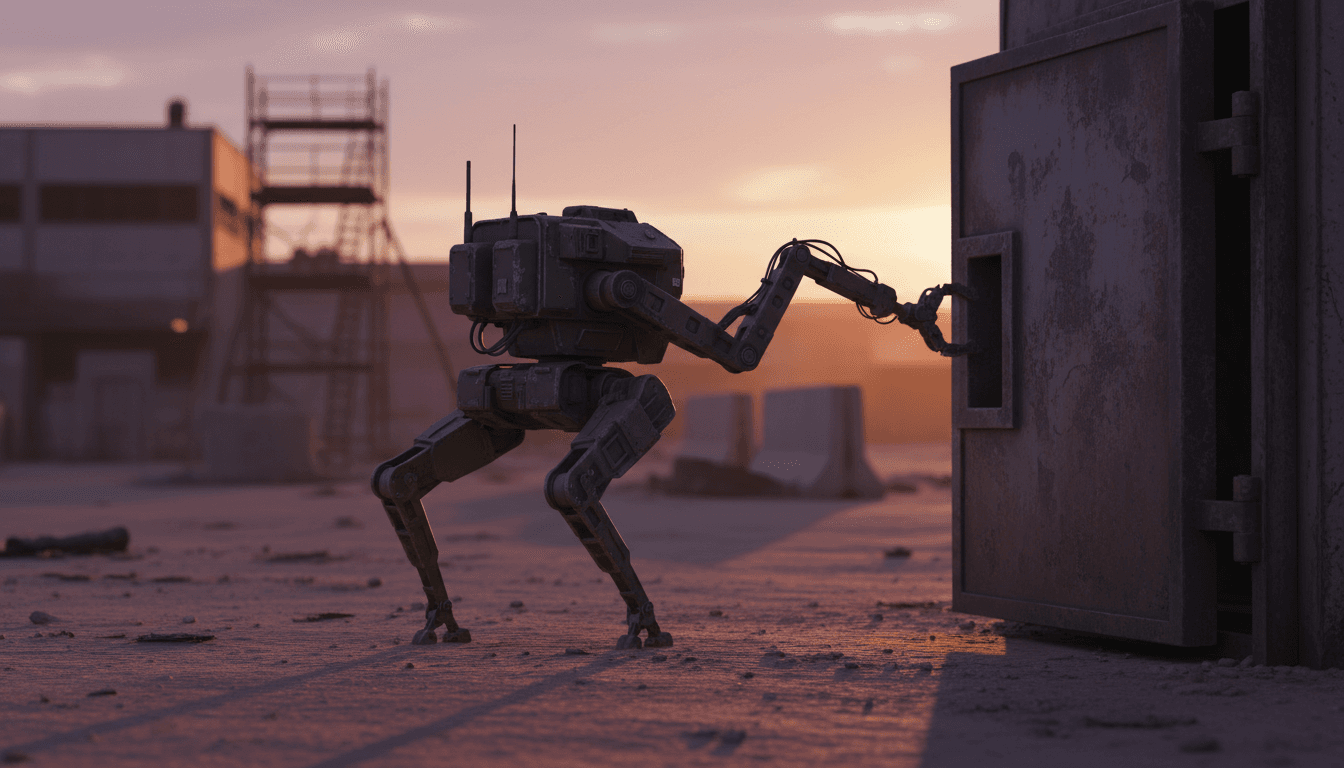
A rifle strapped to a robot dog grabs headlines. A robot dog opening a door, moving debris, or taking a chemical sample is the part that changes operations.
Ghost Robotics’ new 6-degree-of-freedom arm for its Vision 60 quadruped is a practical upgrade that signals where AI-powered robotics is heading in defense—and, just as importantly, where it’s heading in civilian industries that deal with danger, harsh conditions, and labor shortages. This matters because “mobile sensing” only gets you so far. The moment a robot can act on the world, the value jumps.
This post uses Vision 60 as a case study in our “Artificial Intelligence & Robotics: Transforming Industries Worldwide” series. We’ll look at what a manipulator arm really enables, why rugged “whole-body control” is a bigger deal than it sounds, what ethical governance looks like when robots may be weaponized, and why global competition (especially from China) is shaping the entire legged robotics market.
The arm is the difference between watching and doing
A quadruped without an arm is mostly a mobile sensor platform: it goes places people don’t want to go and streams data back. Add manipulation and you get a robot that can change the environment—even in small ways that unlock big mission outcomes.
Ghost Robotics’ Vision 60 arm has six degrees of freedom, which is enough to support common field tasks: reaching around obstacles, orienting an end-effector, and stabilizing during contact. In military and public safety contexts, those are exactly the capabilities that reduce human exposure.
Here’s the simplest way to frame it:
- Sensing answers: “What’s there?”
- Manipulation answers: “Can we do something about it?”
Once you have manipulation, the robot’s usefulness stops being limited by what the cameras can see. It becomes limited by workflow design, operator intent, and the robot’s ability to execute reliably under stress.
The underrated win: using the arm as a “sensor boom”
Ghost’s CEO, Gavin Kenneally, noted something customers did that Ghost didn’t initially anticipate: using the arm as a sensor boom.
That’s not a gimmick. It’s an operations multiplier.
Most quadrupeds see the world from roughly “medium dog height.” Raising a camera a foot or two changes line-of-sight geometry dramatically:
- Peeking over barriers without exposing the full platform
- Looking around corners while maintaining cover
- Getting a more human-like vantage point for teleoperation
If you’ve ever watched a remote inspection where the operator keeps repositioning the robot just to see a label, a valve handle, or a latch, you know why this is valuable. In industrial environments, that same capability maps cleanly to refinery inspections, shipboard checks, and disaster response reconnaissance.
Rugged manipulation isn’t an accessory—it’s a systems problem
Adding an arm to a quadruped sounds like “bolt-on hardware.” In the field, it rarely works that way.
Ghost’s team reportedly tried off-the-shelf arms and found a blunt reality: once a 50 kg robot tips, rolls, or takes a hit, many arms simply don’t survive. In other words, an arm designed for labs and warehouses may fail fast on rubble, mud, stairs, sand, or vehicle ramps.
Kenneally described the design intent in a telling way: the arm is treated “morphologically” as a fifth leg.
That single phrase points to the real technical challenge: whole-body control.
Whole-body control: why the “fifth leg” idea matters
Whole-body control means the robot coordinates legs + arm as one dynamic system:
- The arm can brace or counterbalance while stepping
- The legs can reposition to stabilize during grasping
- The controller can manage contact forces so the robot doesn’t topple when pulling a door
This is where AI and robotics meet in a practical way. The “AI” isn’t just perception; it’s also control policies, state estimation, contact planning, and operator-assist autonomy. Even when a human is giving high-level direction (for example, “open that door”), the robot still needs intelligence in the loop to execute safely.
Ruggedness is a feature customers pay for
Vision 60 is positioned as a rugged field robot, and the RSS summary highlights why that matters:
- More than 3 hours of walking endurance
- More than 20 hours on standby
- Sealed against sand and dust
- Can survive complete submergence in shallow water
- Operates from -40 °C to 55 °C
- Field-swappable legs in minutes
Those specs sound like marketing until you map them to mission economics. A robot that fails mid-task is more than downtime—it’s a retrieval problem, a safety problem, and often a trust problem. In defense, that can be mission failure. In industry, it’s a lost shift and a safety escalation.
Weaponization debates miss the operational center of gravity
The public reaction to a quadruped with a rifle mounted on its back is understandable. The discomfort is real, and in my view, it’s healthy—society should feel friction around the automation of force.
But the operational center of gravity for quadrupeds with manipulation is often more mundane:
- Opening a door to avoid a human entry
- Moving an object to clear a path
- Taking a sample (chemical, biological, radiological)
- Placing or retrieving a sensor
Those are the tasks that keep humans out of harm’s way and also translate directly into civilian uses.
Policy matters more than company pledges
Several legged robot companies pledged in 2022 not to weaponize their general-purpose robots. Yet weaponized quadrupeds have still appeared globally, including a 2024 display by the Chinese military featuring gun-equipped Unitree quadrupeds (Unitree was reportedly a pledge signer).
The hard truth: industry pledges don’t scale like policy does.
Ghost’s position, as summarized in the RSS content, is that decisions about weaponization should be handled “systematically and ethically” at the government policy level. In the United States, the Department of Defense has guidance in Directive 3000.09 (“Autonomy in Weapon Systems”), which includes requirements around human judgment for use-of-force decisions.
A practical takeaway for anyone building or buying AI robotics in high-risk environments: governance can’t be an afterthought. If your product might be used in sensitive contexts, you need:
- Clear human-in-the-loop or human-on-the-loop operating modes
- Audit-ready logs for operator commands and system actions
- Safety constraints that can’t be bypassed casually
- Explicit policies for data retention, access, and remote updates
Trust isn’t built by saying “we’re ethical.” It’s built by showing how the system constrains behavior under pressure.
Global competition: the “DJI effect” is coming for legged robots
Ghost has reportedly sold over 1,000 quadrupeds, yet its CEO is cautious about the market. That caution is warranted.
If you’re advising a buyer, the question always comes up: Why pay 10x more for a U.S./EU quadruped when a cheaper Chinese alternative exists?
Kenneally’s argument is that China is strategically funding legged robotics as a “lynchpin technology,” and that the competitive moat may shrink the same way it did in drones.
DJI became dominant globally—often cited around 90% market share in consumer drones—while governments later tried to restrict or ban certain usage. The sequence matters: adoption first, regulation later.
Meanwhile, Unitree is described as potentially holding around 70% of the global quadruped market, and recent reporting has discussed exploits that could allow unauthorized data transmission.
Whether those figures shift up or down, the pattern is clear: hardware commoditizes fast when manufacturing scale, subsidies, and distribution align.
What buyers should do in 2026 budget planning
If you’re evaluating quadruped robots (military, public safety, energy, logistics, or inspection), you should treat procurement like a risk management exercise—not a gadget purchase.
Use a scorecard that weighs total operational cost and exposure:
-
Cybersecurity and data path
- Where does telemetry go?
- Can the robot function fully offline?
- Are firmware updates controlled and auditable?
-
Sustainment and repair
- Mean time to repair in the field
- Availability of spares (legs, actuators, sensors)
- Training burden for operators and maintainers
-
Ruggedness validation
- Dust/water ingress protection evidence
- Temperature performance under load
- “What happens when it tips?” testing
-
Autonomy roadmap
- Manipulation assist (grasp stabilization, door routines)
- Navigation in GPS-denied environments
- Operator workload reduction targets
The cheapest unit price rarely wins once you price in mission failure, downtime, and security constraints.
Why defense robotics ends up transforming civilian industries
Defense and military operations demand robotics that work in edge cases: extreme temperatures, poor communications, ambiguous terrain, and high consequences for failure. That pressure forces progress in areas that civilian markets also need—just with different stakes.
Here’s where I expect the “arm-on-quadruped” pattern to show up outside defense fastest:
Industrial inspection and maintenance (oil & gas, power, mining)
Mobile manipulation is the difference between “inspect” and “intervene.” Even simple interventions—turning a valve a quarter turn, placing a sensor magnetically, pulling a sample—reduce callouts and improves safety.
Disaster response and public safety
The same tasks that matter in military contexts map cleanly to disasters:
- Clearing light debris
- Opening interior doors
- Delivering radios/medical packs
- Sampling air quality after a fire or chemical event
Logistics in rough environments
Warehouses are structured. Ports, rail yards, and construction staging areas often aren’t. Legged robots with arms can bridge those last few meters where wheels struggle and human labor is expensive or unsafe.
The throughline for our series is simple: AI-powered robotics spreads from the hardest environments outward, and each step toward reliable manipulation accelerates adoption.
Practical “people also ask” answers
Are military quadrupeds autonomous weapons?
Not by default. A quadruped is a mobility platform. Whether it becomes a weapon system depends on payload, control mode, and doctrine. The most important distinction is who makes the use-of-force decision and how accountability is enforced.
Why does adding an arm matter more than adding another sensor?
Sensors inform decisions; manipulation executes them. Manipulation reduces the number of times a human needs to enter a dangerous area to move an object, open a barrier, or collect evidence.
What should ethical deployment look like?
Ethical deployment is measurable: human authorization gates, audit logs, constrained behaviors, clear data governance, and compliance with applicable law and policy. Vague “principles” don’t hold up in real operations.
Where this is heading next
Quadrupeds with arms are a sign that legged robots are moving from demos to operations. The next competitive frontier won’t be “can it walk?”—it’ll be “can it complete tasks reliably under constraints: low bandwidth, bad weather, poor lighting, high dust, and human supervision that’s stretched thin?”
If you’re building a robotics strategy for 2026, take a stance early on three things: manipulation capability, governance, and supply-chain trust. Those choices determine whether your program becomes a durable operational advantage or an expensive pilot that never scales.
Our broader theme in Artificial Intelligence & Robotics: Transforming Industries Worldwide is that robotics adoption is no longer about novelty. It’s about deployment. And deployment demands robots that can do work, not just record video.
Where do you think mobile manipulation will hit first in your industry: inspection, emergency response, or physical security?