Hybrid drones that drive are tackling the last-meter problem in urban logistics. See how multimodal AI and LLM-grounded robot teams are shaping smart-city autonomy.
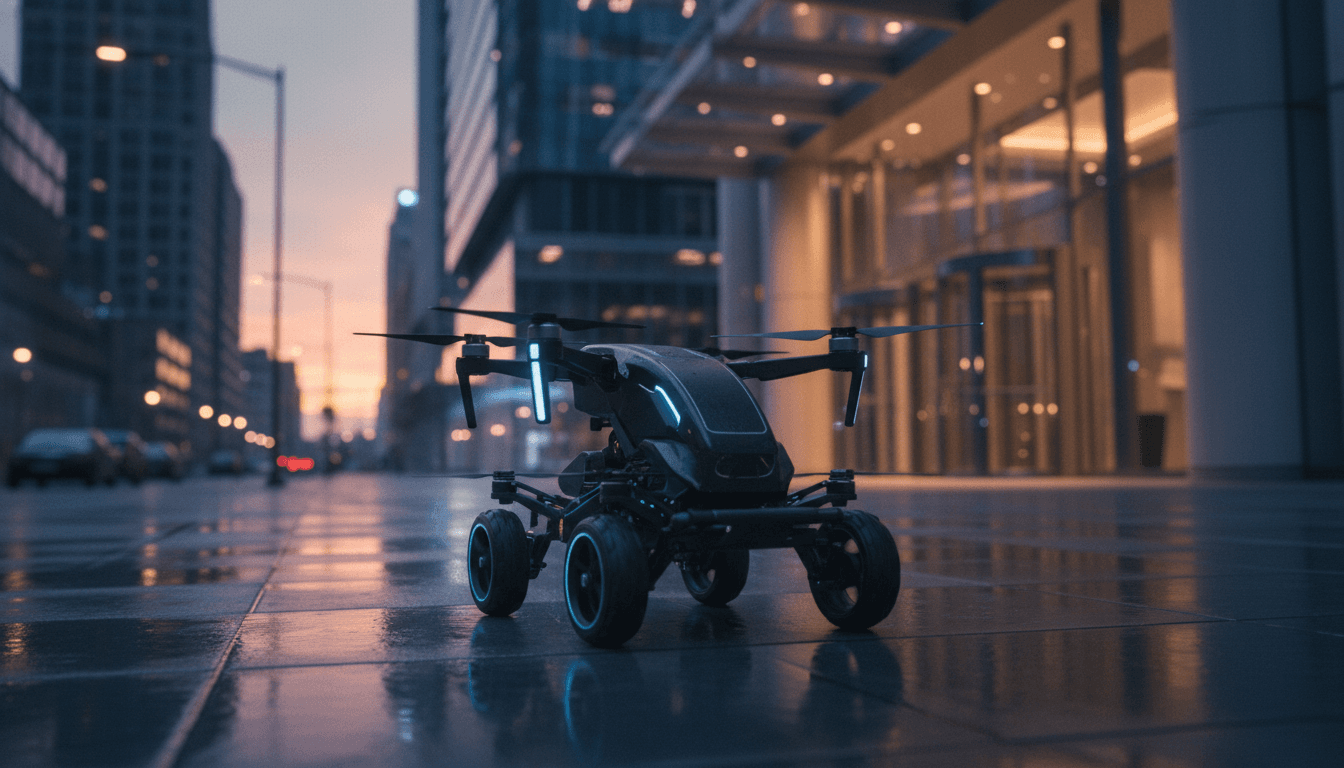
Hybrid Drones That Drive: Smarter Urban Logistics
A quadrotor that can land, fold into “ground mode,” and keep moving without extra motors sounds like a gimmick—until you think about where delivery and inspection robots actually lose time: the last 30 meters.
Most autonomy demos look great in open air or clean lab spaces. Real cities aren’t like that. They’re full of wind tunnels between buildings, GPS dropouts, loading docks, narrow hallways, door thresholds, crowded sidewalks, and “you can’t fly here” zones. That’s why the most interesting robotics videos this week weren’t just flashy—they were signals of where AI-powered robotics is going next: systems that switch modes, share tasks, and reason about the physical world under messy constraints.
This post is part of our Artificial Intelligence & Robotics: Transforming Industries Worldwide series. If you’re evaluating robotics for logistics, facilities, construction, utilities, or smart-city programs, the theme is clear: the winners won’t be “best at one thing.” They’ll be good at transitions—air to ground, vision to touch, single robot to team.
Hybrid aerial-ground robots are built for the “last meter” problem
A robot that can both fly and drive is useful because it reduces the number of times you have to hand off work between platforms.
The featured example from IEEE Spectrum’s Video Friday is Duawlfin, a hybrid drone designed to drive and fly using only its standard quadrotor motors, paired with a differential drivetrain and one-way bearings. The practical point isn’t the clever mechanism (though it is clever). It’s what that mechanism enables: mode switching without a complex stack of extra actuators.
Here’s why that matters in industrial and urban environments:
- Indoor navigation: Flying is great until you hit airflow restrictions, safety rules, or tight spaces. Driving is slower but often allowed.
- Urban logistics: The “drop zone” is rarely the final destination. The robot still has to reach a mailroom, locker, or concierge desk.
- Inspection workflows: Rooftops, catwalks, plant floors, and stair landings each reward different locomotion.
Why “no extra ground propulsion” is a big deal
Hybrid robots often fail in the market for a boring reason: they get heavy, expensive, and maintenance-prone. Adding a second locomotion system (wheels + motors + gearing + controllers) compounds failure points and battery drain.
Duawlfin’s approach—re-using existing motors and smart mechanical routing—pushes in the direction enterprises care about:
- Lower hardware complexity (fewer parts to break)
- More payload budget (because you’re not hauling redundant actuators)
- Simpler certification and safety cases (fewer subsystems to validate)
A hybrid robot is only “practical” if its transitions are boringly reliable.
If you’re planning robotics for smart cities, this is the lesson: autonomy isn’t just perception and planning. It’s also mechanical design that makes mode transitions predictable enough that software can be confident.
Multimodal robot intelligence: when to trust vision vs. touch
Robots don’t struggle because they lack sensors. They struggle because they don’t know which sensor to trust right now.
The RSS summary highlights a familiar human skill: reaching into a backpack, where vision gets you to the opening, but touch does the fine discrimination. In robotics terms, that’s a modality handoff—and it’s a recurring pain point in warehouses, retail backrooms, and healthcare supply rooms.
The described solution is a pattern you’ll see more in 2026-era robotics stacks: separate expert policies per modality (vision-only, touch-only, etc.), then a learned method to combine action predictions at the policy level rather than forcing all sensors through one monolithic network.
What this changes in real deployments
In production settings, sensor streams are often:
- Asynchronous (tactile updates can be sparse but decisive)
- Context-dependent (depth is great until reflective wrap confuses it)
- Operationally constrained (cameras get occluded; gloves and dust interfere)
A policy-level mixture of experts tends to be easier to debug and extend because you can ask:
- “Is the tactile expert failing, or is the arbiter failing?”
- “What happens if I add a new gripper sensor next quarter?”
If you’re buying robotics for fulfillment or light manufacturing, ask vendors a blunt question: How does the system behave when a modality degrades? The answer tells you whether they’ve built for demos or for facilities.
Robot teams with LLM grounding: autonomy that matches real missions
Single robots are impressive. Heterogeneous robot teams are how enterprises actually scale.
The RSS content references SPINE-HT, a framework that grounds large language model (LLM) reasoning in the reality of a mixed fleet—demonstrated with platforms including a Clearpath Jackal, Clearpath Husky, Boston Dynamics Spot, and a high-altitude UAV—reporting an 87% success rate on missions that require reasoning about capabilities and refining subtasks with online feedback.
That’s not just a neat benchmark. It points to the missing layer in many “LLM for robotics” pitches:
- LLMs are good at task decomposition (“search area A, then inspect valve B”).
- Robots need capability grounding (“Spot can climb this; Jackal can’t”).
- Real missions need closed-loop adjustment (“wind is too high; change plan”).
Practical takeaway: stop designing for a single all-purpose robot
In logistics yards, campuses, ports, and large plants, a mixed fleet often wins on cost and uptime:
- A small UGV handles routine indoor transport.
- A legged robot does stairs and rough terrain.
- A UAV handles overhead survey and rapid checkups.
The hard part is orchestration. LLM-grounded frameworks are a promising way to let teams operate from mission intent while staying honest about physics, battery life, payload, and safety constraints.
If you’re building a business case, here’s what to measure:
- Mission completion rate (not individual robot accuracy)
- Recovery time after failure (replanning, not rebooting)
- Operator minutes per mission (true autonomy reduces supervision load)
Training robots to move: curriculum learning is quietly doing the heavy lifting
Athletic robot behaviors (jumping, scrambling, recovering from slips) are less about bravado and more about reliability in unstructured environments.
The RSS summary cites curriculum-based reinforcement learning for the robot Olympus, with reported performance including horizontal jumps up to 1.25 m with centimeter accuracy and vertical jumps up to 1.0 m, plus adaptability toward omnidirectional jumping.
Why it matters for industry: facilities aren’t flat. Even “indoor” spaces include:
- thresholds
- cable ramps
- gaps between dock plates
- grates
- uneven temporary flooring
A curriculum approach—training simpler skills first, then progressively harder variants—maps nicely to how enterprises want robotics delivered:
- Start with safe, repeatable tasks.
- Expand the operating envelope.
- Keep performance predictable as complexity rises.
What to ask your robotics team (or vendor)
If dynamic mobility is part of your roadmap (construction, utilities, emergency response), push for specifics:
- What’s the fallback behavior when a jump/step fails?
- What’s the maximum tolerated surface uncertainty (wet, sandy, uneven)?
- How much of performance is sim-to-real vs. learned on hardware?
Those answers determine whether your robot is a field tool or a lab athlete.
Humanoids, industrial arms, and “useful now” robots
Humanoids get the headlines, but I’m more interested in what’s deployable at scale.
The RSS roundup includes everything from humanoid platforms (like NEO) to industrial heavy lifters (KUKA’s KR TITAN ultra rated up to 1,500 kg payload) and practical non-humanoid systems positioned as safe, useful, and likely cost-effective.
Here’s the stance I’ll defend: The near-term value is in task fit, not human shape.
- In warehouses and plants, industrial robots win because they’re predictable, serviceable, and already integrated into procurement and safety workflows.
- In human environments (retail backrooms, hospitals, hotels), humanoid robots are attractive because they match the world’s geometry—but only if perception, manipulation, and safety are robust.
The CMU RI seminar topic—toward generalist humanoid robots using real-world, synthetic, and web data—captures the real challenge: generality demands massive data and careful grounding. ChatGPT-level fluency doesn’t automatically translate into “pick up the right object safely when your camera is occluded and someone walks by.”
A practical roadmap for buyers in 2026 planning cycles
If you’re setting budgets for 2026 (ICRA is in Vienna, 1–5 June 2026), here’s a pragmatic way to sequence investments:
- Automate repeatable flows first (tugging carts, pallet moves, simple inspection)
- Add multimodal manipulation where errors are expensive (sorting, kitting, replenishment)
- Expand to hybrid mobility (drive/fly; legged/wheeled) when environments are mixed
- Invest in fleet-level reasoning (LLM-grounded orchestration) once you have more than one robot type
The through-line: autonomy scales when it’s designed as a system—mechanics, sensing, learning, and operations.
How to evaluate hybrid autonomy for logistics and smart cities
Hybrid aerial-ground robots and AI-coordinated fleets are exciting, but pilots fail for predictable reasons. A good evaluation focuses less on demo polish and more on operational truth.
A short checklist for real deployments
- Transition reliability: How often does air-to-ground (and back) fail over 1,000 cycles?
- Navigation under constraints: What happens in GPS-denied corridors, elevator lobbies, and RF-noisy zones?
- Human interaction model: Does the robot yield, signal intent, and handle unpredictable foot traffic?
- Maintenance plan: What’s the mean time to repair for drivetrain parts, bearings, or landing gear?
- Security and compliance: How are logs stored, who can teleoperate, and what’s the audit story?
If you only remember one line: A smart-city robot is an operations product, not a robotics project.
Where this is heading next
Hybrid drones that drive, multimodal policies that know when to “feel,” and LLM-grounded robot teams all point in the same direction: robots are becoming adaptive operators in complex environments, not single-purpose tools stuck in ideal conditions.
If you’re exploring AI and robotics for logistics, facilities, or smart-city programs, now’s the time to pressure-test your assumptions. Don’t ask whether a robot can fly, drive, or manipulate. Ask whether it can switch—modes, sensors, plans, and teammates—without drama.
Want to sanity-check a robotics initiative before you spend six figures on a pilot? Map one mission end-to-end (including handoffs, exceptions, and safety signoffs) and identify where hybrid mobility or heterogeneous teams would remove the most friction. Which transition in your workflow causes the most downtime right now?