Heavy-lift drones and humanoid robots are moving from demos to deployments. See what the DARPA Lift Challenge signals—and how to plan robotics ROI.
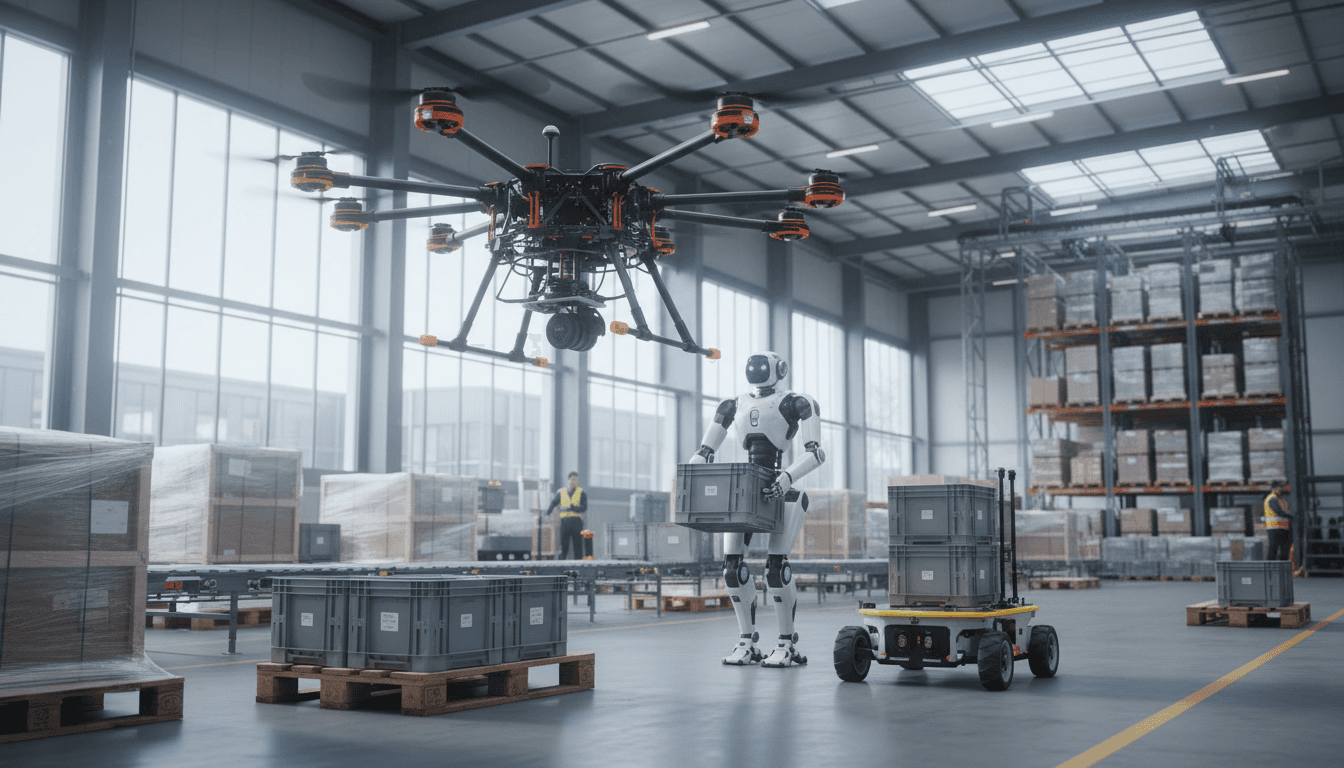
Heavy-Lift Drones and Humanoids: Real Robotics ROI
A payload-to-weight ratio of 1:1 is the quiet ceiling holding a lot of drone automation back. Most multirotor drones can lift roughly what they weigh—useful for inspection cameras and small parcels, but not for the messy, expensive work in logistics and industry.
That’s why the DARPA Lift Challenge is such a big tell. It isn’t chasing prettier quadcopters. It’s pushing for drone designs that can carry more than four times their own weight. If that target gets hit reliably, the conversation shifts from “cool demos” to “new operating models” across warehouses, farms, construction sites, and emergency response.
This post is part of our Artificial Intelligence & Robotics: Transforming Industries Worldwide series, and I’m going to take a stance: the most important robotics story right now isn’t a single viral humanoid video—it’s the growing pile of evidence that robots are becoming deployable infrastructure. Heavy-lift drones, warehouse “virtual conveyors,” language-guided robot teams, and foundation-model-style control policies are all pointing to the same outcome: automation that’s cheaper to deploy, faster to scale, and easier to reconfigure when your business changes.
DARPA’s heavy-lift drone push is really about throughput
Answer first: The DARPA Lift Challenge matters because heavy-lift drones turn “air robotics” from niche tasks into a serious throughput tool for logistics and industrial operations.
The limitation with current multirotor drones isn’t that they can’t fly—it’s that their economics don’t work for heavy, frequent moves. If your drone can only carry a small payload, you need more trips, more charging cycles, more fleet management overhead, and more risk exposure per unit delivered.
A 4:1 payload-to-weight target forces designers to rethink almost everything:
- Airframe efficiency: You don’t get to brute-force lift with bigger motors forever; you have to chase aerodynamic and structural efficiency.
- Propulsion and energy: Better rotors, better power electronics, and smarter energy management become core differentiators.
- Stability under load: Lifting heavy payloads isn’t just “more thrust.” It’s center-of-gravity management, oscillation control, and safe failure modes.
Where heavy-lift drones actually earn their keep
Heavy-lift drones aren’t just for dramatic “deliver a refrigerator” stunts. The practical wins show up where ground movement is slow, dangerous, or infrastructure-heavy:
- Yard logistics and plant operations: moving parts, tools, or urgent components across large sites without tying up forklifts and drivers.
- Disaster response: rapid delivery of water, medical supplies, batteries, radios, and temporary communications gear when roads aren’t usable.
- Construction and maintenance: lifting items to hard-to-reach locations (think remote towers, bridges, or offshore work).
- Agriculture: hauling supplies across fields or between remote farm locations where vehicles compact soil or waste time.
If you run operations, here’s the lens that matters: payload-to-weight ratio is a proxy for cost per move. Increase the ratio, and you change the math on whether drones can compete with trucks, carts, forklifts, and people.
“But aren’t drones already delivering packages?”
Answer first: Yes, but mass adoption is constrained by payload limits, regulation, weather tolerance, and operational complexity.
Most real operations don’t need a drone that can fly on a sunny day with a lightweight box. They need predictable performance across a schedule, with repeatability and maintenance plans. Heavy-lift research helps because it tends to bring along improvements in stability, control, and safety engineering—things you need for compliance and insurability.
Humanoid robots are shifting from prototypes to supply chains
Answer first: When you can ship hundreds of humanoid robots (as UBTECH claims with Walker S2 deliveries), the story becomes commercialization and lifecycle support—not just motion demos.
Mass delivery is a signal that manufacturing, QA, and logistics are catching up to the ambition. It also creates a new pressure: once a company has units in the field, customers start asking the questions that determine whether humanoids become durable tools or expensive experiments:
- What’s the mean time between failures on joints, hands, and sensors?
- How fast can parts be shipped, and who services them?
- What does the training pipeline look like for new tasks?
- How do you handle safety certification around people?
I’m optimistic about humanoids, but I’m picky about where they fit. In the near term (late 2025 into 2026), the strongest use cases are the boring ones: material handling, kitting, tote movement, line feeding, and supervised tasks in structured environments.
Hands aren’t the point—capability per dollar is
One video riff in the RSS summary jokes about using a lasso instead of hands. Funny, but it highlights something operational teams should take seriously: dexterity is expensive.
Robots don’t need human-like hands to deliver value. They need the cheapest end-effector that accomplishes the job with acceptable error rates. Sometimes that’s a gripper. Sometimes suction. Sometimes a hook, a clamp, or a custom tool. The “right” manipulation strategy is the one that:
- reduces perception complexity,
- simplifies failure recovery,
- and keeps cycle times stable.
Humanoid form factors can help when environments are built for humans, but you still win by minimizing complexity wherever you can.
The warehouse proof: “virtual conveyors” beat full rewires
Answer first: Deployments like Robust.ai’s Carter matter because they automate material flow without forcing a facility rebuild.
Saddle Creek’s use case (tote delivery across multiple lines and 20+ drop-off points) is the kind of operation where traditional automation can be painful. Fixed conveyors and tight integrations are great when your process doesn’t change. In the real world, processes change all the time—especially in retail, beauty, and seasonal fulfillment.
A mobile robot that acts like a non-integrated virtual conveyor is a practical compromise:
- You get automation benefits without ripping up the floor.
- You can re-route workflows when a line changes.
- You can add capacity by adding robots.
What ROI looks like in plain language
Answer first: Robotics ROI in fulfillment often comes from throughput stability and labor risk reduction, not only labor elimination.
If you’re evaluating industrial robotics, ask for numbers that map to your P&L and service levels:
- Touches per order reduced (how many times a tote/parcel is handled)
- Travel distance eliminated (meters per shift per worker)
- Peak staffing reduction (especially relevant right now, heading into year-end peaks)
- Mis-sort / mis-route rate improvements
- Time-to-reconfigure a workflow (hours/days, not weeks)
Here’s what works in practice: start with one constrained lane (one family of SKUs, one flow). Automate the movement. Measure reliability for 4–6 weeks. Then expand.
AI is the multiplier: language, vision, and “foundation” policies
Answer first: The most durable robotics advantage is shifting from hard-coded behaviors to AI policies that generalize across tasks.
Two research directions highlighted in the RSS summary point to where the industry is heading:
- Language–vision hierarchies for long-horizon tasks (a UAV + quadruped team using only 2D cameras)
- Behavioral Foundation Models (BFMs) like BFM-Zero, which aim to encode motions, goals, and rewards into a shared representation so one policy can be “prompted” to do multiple downstream tasks
If you lead operations, the translation is simple: you want robots that don’t require a bespoke software project every time the process changes. The more your robotics stack can accept high-level intent (language) and interpret messy environments (vision), the less you pay in integration and retraining.
What “promptable robotics” means for business
Answer first: Promptable robotics means you specify tasks at a higher level, and the robot fills in the low-level steps—within safety constraints.
Don’t confuse this with typing “pick all the items” and walking away. Real deployments will stay gated by safety systems, task boundaries, and verification steps.
But even partial progress is valuable. If a robot can:
- understand “bring totes from labeling to packing,”
- recognize exceptions (“this tote is damaged”),
- and recover (“reroute to inspection”),
…then you’ve reduced both training time and the operational burden on supervisors.
Where this goes next (and how to prepare in 2026)
Answer first: Heavy-lift drones, humanoid production, and AI-driven control are converging on one outcome: automation that scales like software but touches the physical world.
ICRA 2026 (June in Vienna) will likely show more of what we’re already seeing in late 2025: robots that can do longer sequences, in less controlled environments, with less bespoke engineering per task. That’s great news—and also a warning. Teams that wait for “fully general robots” usually end up doing nothing. Teams that start with narrow, measurable workflows build the muscle to adopt bigger capabilities later.
Here’s a practical way to move:
- Pick a workflow with clear pain: high travel, high injury risk, high churn, or peak-season volatility.
- Set acceptance metrics: uptime, cycle time, error rate, recovery time, and safety incidents.
- Design for exceptions: the robot’s job isn’t just success cases; it’s what happens when things go wrong.
- Plan your data loop: logs, video, and exception labels are what make AI-driven robotics improve over time.
The DARPA Lift Challenge is a headline, but the bigger story is underneath it: the heavy-lift bottleneck is being treated like an engineering problem with measurable targets. Combine that with industrial deployments like Carter and the fast-maturing AI stack behind perception and control, and you get a roadmap for real operational change.
If you’re deciding where to place bets in AI-powered robotics, start here: choose systems that reduce infrastructure dependencies, adapt to process change, and improve through data. The next 12–18 months will reward the companies that treat robotics as an operational capability—owned, measured, and iterated—rather than a one-time pilot.
What would happen to your operation if moving goods internally became as flexible as rerouting packets on a network?