Wisk’s Gen 6 autonomous eVTOL first flight shows what scalable, safety-focused AI robotics looks like—and what leaders should demand from autonomy vendors.
Wisk Gen 6 Shows What Autonomous Air Taxis Need
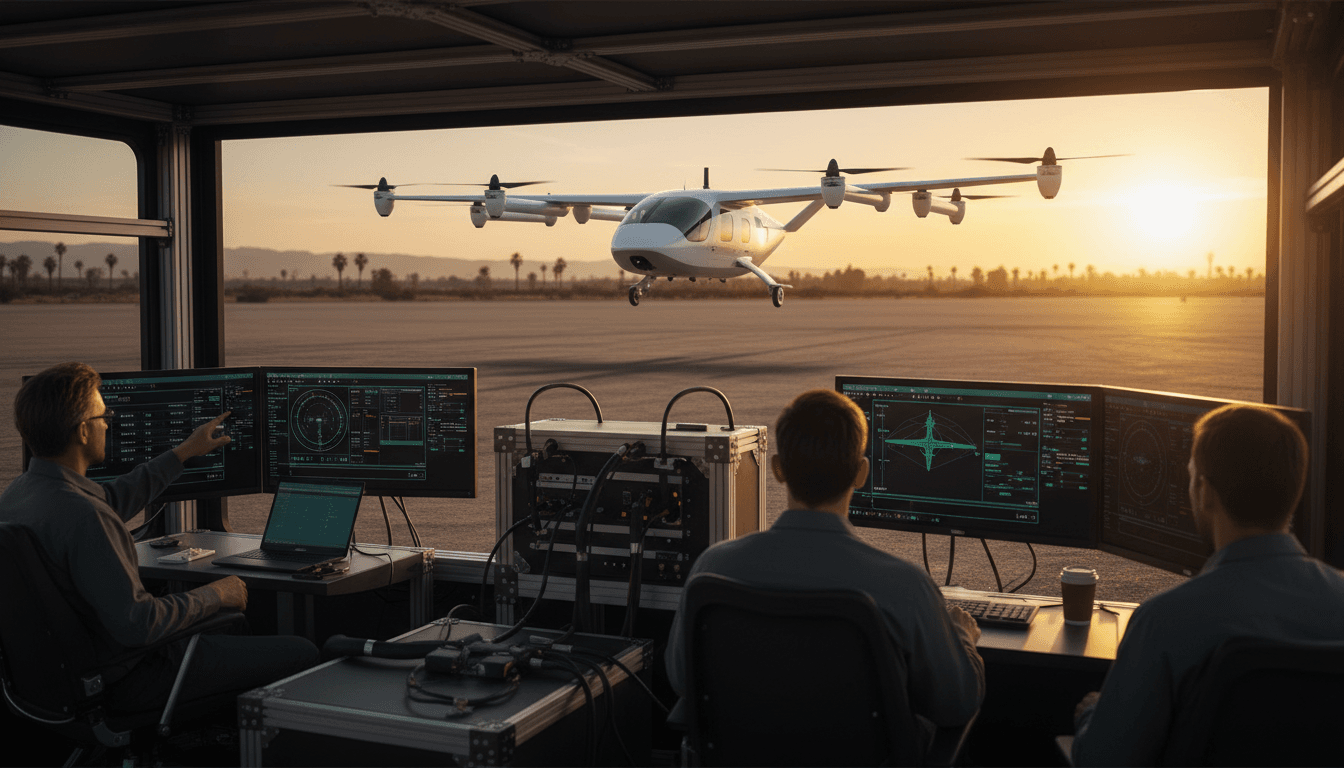
Wisk Aero just crossed a line that a lot of “future of flight” demos never reach: a real aircraft, built for certification, completing a controlled first flight (vertical takeoff, hover, stabilized maneuvers) at its test facility in Hollister, California.
Here’s why I’m paying attention. Most autonomous mobility stories get stuck at one of two places: cool prototypes that don’t scale, or safety arguments that don’t hold up under regulators’ scrutiny. Wisk’s Generation 6 (Gen 6) eVTOL is interesting because it’s aimed squarely at the hardest version of the problem—autonomous passenger flight—and it’s being developed inside a certification process with the FAA, backed by Boeing.
This post is part of our “Artificial Intelligence & Robotics: Transforming Industries Worldwide” series, and it’s a great case study in what happens when AI stops being a lab demo and starts becoming a regulated, operational system that has to work every day.
Why Wisk’s Gen 6 first flight matters for AI robotics
A first flight isn’t a product launch, but it is a proof of integration. In robotics, the milestone that matters isn’t “we built a model” or “the sim worked.” It’s “the whole stack ran in the real world without falling apart.” For an autonomous eVTOL, that stack includes electric propulsion, batteries, flight controls, sensing, navigation, and decision-making logic—plus failure handling.
Wisk says Gen 6 incorporates lessons from five prior generations and more than 1,750 test flights. That number matters because autonomy improves when the team has seen a wide range of conditions, failures, and edge cases. In aerospace, you don’t get to ship and patch like a consumer app; you earn confidence by testing, instrumenting, and documenting.
The other reason this matters: Wisk isn’t positioning autonomy as a “nice-to-have.” The company’s operating model is autonomous flight with human oversight from a ground-based Multi-Vehicle Supervisor. That’s not just a design choice—it’s a scalability bet.
Myth-busting: autonomy isn’t about removing humans
The practical goal is better human-to-robot ratios, not zero humans. A ground supervisor who can manage multiple aircraft changes the economics of air taxi operations. It also changes how you design interfaces, alerts, escalation paths, and procedures.
If you’ve worked in robotics deployments (warehouses, hospitals, factories), this should feel familiar:
- Robots handle the repetitive control loop
- Humans handle exceptions, approvals, and recovery
- The winning systems are the ones that make handoffs fast and unambiguous
Air mobility is the same pattern—just with stricter safety expectations.
The safety case: what “autonomous passenger aircraft” really requires
Autonomous passenger flight lives or dies on safety engineering, not marketing. Wisk highlights failsafe battery and propulsion systems and states that it’s designing to meet or exceed commercial aviation safety standards. That’s the right framing because regulators don’t certify ambition; they certify evidence.
When an autonomous aircraft claims it can fly passengers, there are a few non-negotiables that separate serious programs from flashy prototypes.
1) Redundancy that’s designed in, not bolted on
In aviation-grade autonomy, you assume things will fail—sensors, actuators, communications, even parts of the compute stack. The question is whether the system degrades safely.
In practice, that means:
- Redundant power paths and propulsion tolerance
- Independent monitoring (so the monitor doesn’t share the same failure mode)
- Deterministic behavior under fault conditions (no “creative” AI improvisation)
2) “Detect-and-avoid” is the real autonomy cliff
Wisk mentions ongoing work on autonomy technologies including detect-and-avoid and navigation systems. That’s the heart of the challenge.
Detect-and-avoid is hard because it forces an autonomous system to:
- Perceive other aircraft/obstacles reliably
- Predict trajectories under uncertainty
- Choose maneuvers that satisfy safety margins and airspace rules
- Prove it does all of that consistently
In robotics terms, it’s not just perception. It’s perception plus verified decision-making.
3) Certification forces discipline (and that’s good)
Wisk’s Gen 6 is the subject of its type certification application and ongoing certification project with the FAA. Certification is frustratingly slow—but it’s also why commercial aviation is as safe as it is.
For business leaders evaluating AI robotics, this is a useful reminder: regulated autonomy is the strongest test of operational AI. If a company can make autonomy work under FAA-level scrutiny, it tells you something about their engineering maturity.
From hover tests to real operations: what the flight test plan tells us
Wisk’s next phase—expanding the hover regime before higher speeds and transitions—is exactly how mature robotics programs reduce risk. The company says it will focus on takeoffs, landings, and low-speed stability, then expand into higher speeds and altitudes and more complex maneuvers (including longitudinal transition, lateral transition, and pedal turns).
That progression matters because it mirrors a disciplined autonomy validation loop:
- Validate core control loops in constrained conditions
- Confirm the simulation model matches reality (or fix it)
- Expand the envelope incrementally
- Stress the system with compound maneuvers
- Keep tightening the safety case with real-world evidence
Why simulation still isn’t enough
Simulation is essential in autonomy, but it’s also where teams fool themselves.
Real flight tests reveal issues that are invisible in sim:
- Vibration and sensor artifacts
- Unexpected coupling between aerodynamics and control laws
- Thermal and power effects that shift performance
- Edge-case timing issues in real compute and comms
I’ve found that the best autonomy teams treat simulation as a hypothesis engine, not a truth machine. Flight testing is where hypotheses go to either survive or get rewritten.
The bigger industry shift: autonomy is moving into “boring” infrastructure
Urban air mobility only works if it becomes boring—predictable, scheduled, measurable. That’s why Wisk’s approach is relevant beyond aviation. It’s a template for how AI-powered robotics enters real infrastructure:
- Defined routes and constrained operating environments first
- Heavy emphasis on safety cases and formal validation
- Integration with regulators and airspace/traffic systems
Wisk says launch markets include Houston, Los Angeles, and Miami. Those choices make sense because they’re large metro areas with traffic pressure and enough demand density to justify new mobility networks.
What this means for logistics (yes, even if this is “passenger”)
Even if Wisk’s near-term focus is passenger service, the enabling tech directly benefits logistics and transportation automation.
Here’s the connection: once you can certify autonomous flight for passengers, you’ve proven systems engineering that can translate into cargo operations and broader aerial robotics:
- High-reliability electric propulsion management
- Fleet supervision and dispatch software
- Predictive maintenance driven by operational telemetry
- Airspace coordination with other stakeholders
For logistics operators, the near-term opportunity isn’t “replace trucks.” It’s add a new layer of capacity for time-sensitive movement—medical items, critical parts, high-value shipments—especially in congested regions.
Practical takeaways for leaders adopting AI and robotics
Autonomous aircraft may feel far from your business, but the playbook is the same. If you’re deploying AI robotics in transportation, warehouses, manufacturing, or field operations, Wisk’s milestone reinforces a few rules that consistently separate success from expensive pilots.
Use this checklist when evaluating autonomous systems
-
Ask for a safety case, not a slide deck
- What failure modes are assumed?
- What happens when comms drop?
- What is the minimum-risk condition?
-
Look for evidence of iteration at scale
- Wisk cites 1,750+ test flights across generations. In your domain, the analog is logged autonomous hours, mission completions, and controlled failures.
-
Demand clear human-oversight design
- Who supervises?
- How many systems per supervisor?
- What triggers intervention?
- What’s the training plan?
-
Verify the simulation-to-reality feedback loop
- How often do they reconcile sim models with field data?
- What’s their process when reality disagrees?
-
Treat certification/standards alignment as a feature
- Even outside aviation, alignment to recognized standards signals maturity in documentation, testing discipline, and change control.
A stance worth taking: autonomy will be won by operators, not inventors
The companies that win won’t just build smart machines. They’ll build operational systems—maintenance, fleet management, incident response, compliance, and customer experience.
That’s why Wisk emphasizing multi-vehicle supervision, safety standards, and structured test expansion is more meaningful than flashy flight footage.
What to watch next in autonomous air taxis
The next meaningful milestones won’t be press releases—they’ll be expanded flight envelopes, repeatability, and regulator-aligned progress. For Gen 6 specifically, keep an eye on:
- Transition maneuvers (where many eVTOL designs get complicated)
- Demonstrated fault handling during flight tests
- Continued maturation of detect-and-avoid
- Evidence that their autonomy model supports scalable supervision
Autonomous passenger aircraft are one of the strictest tests of AI robotics on the planet. If the sector gets it right, it won’t just change how people move around cities. It will raise the bar for what “production-grade autonomy” means across industries.
If you’re building or buying AI robotics systems in 2026 planning cycles, a good question to ask your team is simple: Are we designing for demos—or for operations that regulators, customers, and staff can trust every day?