AI weather forecasting is improving fast—but data gaps still cause surprises. See how robotic balloons and transformer models deliver safer, more accurate forecasts.
AI Weather Forecasting with Robotic Balloons That Save Lives
Hurricane Milton’s rapid intensification in October 2024 was a brutal reminder that forecast accuracy isn’t just a science problem—it’s a data-collection problem. Milton became one of the fastest-growing Atlantic storms on record, killing 15 people and causing about US $34 billion in damages as it crossed Florida. Meteorologists weren’t alone in being surprised; communities were, too.
Most companies get this wrong: they treat weather forecasting as a “better model” challenge. But the hard truth is simpler—you can’t predict what you can’t observe. And the most dangerous weather often forms in the places we observe the least: far out over oceans, in sparsely instrumented regions, and inside storms where sending humans is risky.
This is why the WindBorne approach matters for our “Artificial Intelligence & Robotics: Transforming Industries Worldwide” series. It’s a clean case study of how AI + robotics can reduce human exposure to danger, increase operational tempo, and turn raw sensor streams into real-time decisions that industries can actually use.
The real bottleneck in forecasts: missing data where it counts
The core constraint in weather prediction is straightforward: forecast skill rises and falls with observation quality. Today’s mainstream system—physics-based numerical weather prediction (NWP)—assimilates observations from satellites, radar, ground stations, and conventional weather balloons. In the U.S., the Global Forecast System runs multiple times daily and can extend forecasts to roughly two weeks.
But global coverage is uneven. Standard weather balloons typically fly for a few hours, then burst, capturing essentially one vertical profile before they’re gone. That leaves huge gaps over oceans and remote regions—exactly where many storms start.
Why hurricane “surprises” keep happening
Rapid intensification is hard because it depends on fine-scale interactions—temperature, moisture, wind shear, ocean heat—often evolving faster than traditional observation cycles.
When the atmosphere is under-sampled, forecasters can see the “shape” of a storm but miss the details that determine whether it strengthens, weakens, or veers. That’s one reason forecast cones can swing dramatically day to day.
A blunt but accurate rule: if your sensors don’t go there, your model can’t learn it.
Robotic weather balloons: a safer way to gather storm-grade observations
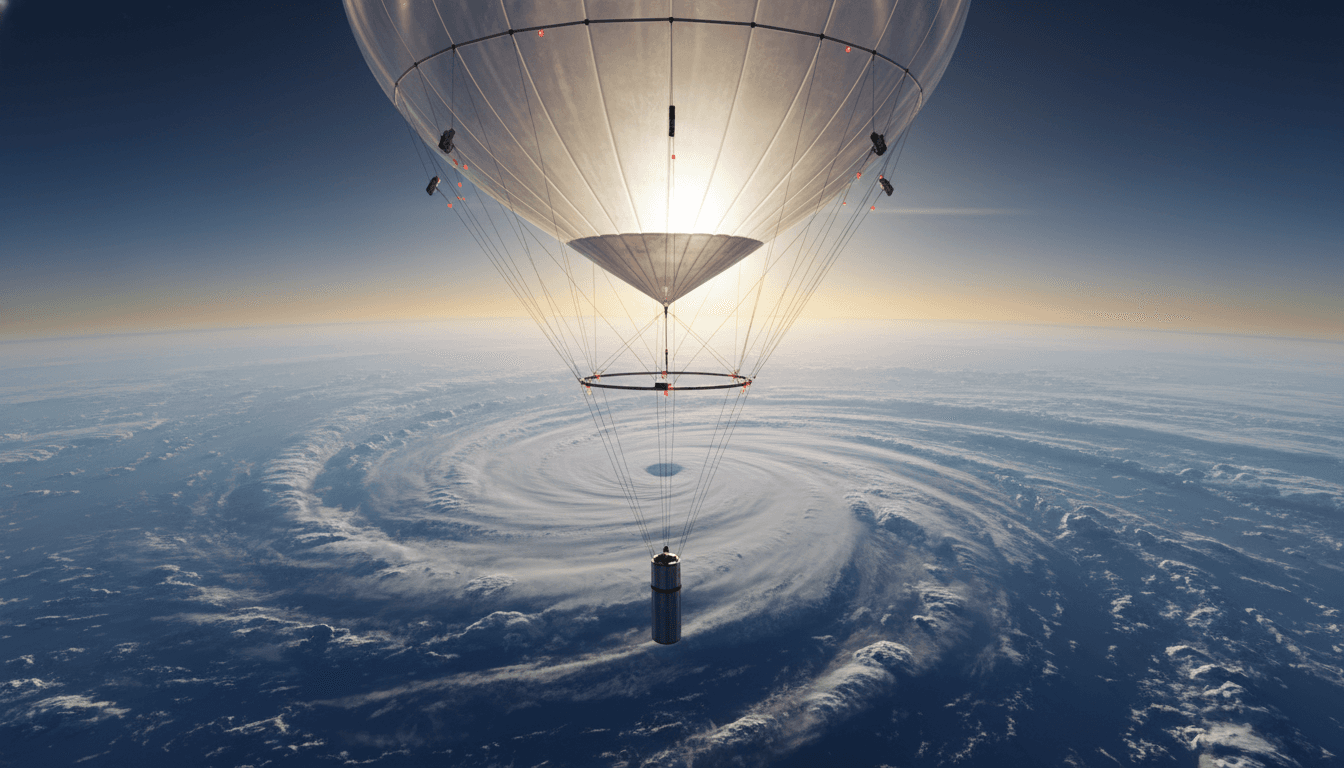
WindBorne’s Global Sounding Balloons (GSBs) tackle the observation gap with an idea that feels obvious in hindsight: make balloons last longer, steer them, and treat them like a robotic sensing fleet.
These balloons are lightweight (the envelope film is about 20 micrometers thick, less than half a human hair) and typically weigh under 2 kilograms. They can stay aloft for 50+ days and operate from near ground level to roughly 24 kilometers altitude.
How “steering” works without engines
The balloons don’t fly like drones. They surf wind layers.
- To rise: they can drop ballast (for example, releasing sand)
- To descend: they vent gas
- To translate laterally: they change altitude to catch different winds at different heights
That combination—autonomous control plus atmospheric navigation—turns balloons from disposable probes into persistent robotic platforms.
The Milton experiment: dropsondes without risking pilots
Here’s the pivotal moment from the RSS story: WindBorne launched six GSBs ahead of Hurricane Milton from Mobile, Alabama. Within about 24 hours, balloons entered the hurricane and deployed dropsondes measuring:
- temperature
- pressure
- humidity
- wind speed and direction
This was notable for two reasons:
- It demonstrated dropsonde deployment by weather balloon, not crewed aircraft.
- It showed a path toward scaling storm observation without scaling human risk.
That robotics theme matters across industries: remove humans from the most dangerous part of the workflow, then increase frequency and coverage. Weather is just one of the clearest examples.
Weather forecasting AI is improving fast—but hardware still wins
AI weather prediction has moved from “interesting” to “operationally unavoidable” in just a few years. Models like Huawei’s Pangu-Weather, DeepMind’s GraphCast, and the ECMWF’s AIFS proved that AI can produce high-quality global forecasts far faster and cheaper than classic NWP.
WindBorne’s bet is sharper: pair a strong AI model with a data-collection system built for the places where data is scarce.
That pairing is the point. AI doesn’t magically solve data scarcity. If anything, AI can amplify it: a model trained on well-observed regions may generalize poorly when it encounters poorly observed conditions.
WeatherMesh in plain language
WindBorne’s WeatherMesh uses a transformer-based architecture (the same broad family of models used in large language models) with an encoder–processor–decoder design:
- Encoder: compresses raw atmospheric variables into a latent representation
- Processor: steps that representation forward in time
- Decoder: converts predictions back into physical weather variables
It’s a practical design choice: transformers can handle huge spatiotemporal datasets efficiently once trained.
Cost and speed: why businesses should pay attention
WindBorne trained early WeatherMesh versions using a cluster of Nvidia RTX 4090 GPUs at a cost of about $100,000, reporting that cloud training would have cost about 4× more. They also report using substantially less training compute than major competitors (for example, less than GraphCast and Pangu-Weather in their comparisons).
This matters for any organization building AI that must run continuously:
- Lower compute cost means more frequent updates
- More frequent updates means better control loops (for navigation, operations, and alerts)
- Better control loops means fewer surprises in high-stakes environments
In WeatherMesh-4, WindBorne reports producing a full forecast every 10 minutes, compared with the 6-hour update cadence typical of many traditional global models.
“The organizations that win with AI aren’t the ones with the fanciest model. They’re the ones with the fastest, most reliable feedback loop.”
What “end-to-end AI + robotics” looks like in the real world
Lots of companies say they’re building “platforms.” WindBorne is describing something more specific: a closed loop.
- Robotic balloons collect in situ observations.
- An AI forecasting model ingests the data and produces new forecasts.
- The AI produces high-level navigation targets to fill the next most valuable data gaps.
- The robotic fleet moves to collect the next round of observations.
That loop is exactly what many industries are trying to build right now:
- autonomous inspection robots + predictive maintenance AI
- warehouse robots + demand forecasting
- agricultural drones + crop stress models
- security sensors + real-time threat detection
Weather just happens to be a near-perfect proving ground because nature is relentless, global, and expensive when we get it wrong.
“Planetary nervous system” is more than a metaphor
WindBorne frames its goal as a “planetary nervous system”: continuous sensing plus an AI “brain.” I like the metaphor because it forces a hard question:
Where are your blind spots, and how quickly can your system sense and respond?
If you work in operations-heavy industries, that’s not philosophical—it’s budget, risk, uptime, and safety.
Where improved forecasts translate into revenue (and fewer disasters)
Better weather forecasts aren’t only for meteorologists. They’re operational inputs for industries that make time-sensitive decisions.
National defense and security operations
Weather drives flight plans, maritime routing, sensor performance, and mission timing. Higher-resolution, more frequently updated forecasts reduce uncertainty and improve planning—especially in regions where observation is limited.
Renewable energy and grid operations
Wind and solar forecasting affects:
- day-ahead energy pricing
- grid balancing and reserve requirements
- turbine curtailment decisions
- maintenance scheduling
More accurate wind forecasts at 100 meters (a height WeatherMesh-4 reports predicting) can directly impact wind farm profitability. Even small percentage improvements can be meaningful when multiplied across gigawatt-scale portfolios.
Agriculture and food supply chains
Farm decisions depend on precipitation timing, heat stress, frost risk, and humidity. Higher-resolution forecasts can support:
- irrigation planning
- pesticide/fungicide timing
- harvest scheduling
- yield risk management
Logistics, aviation, and insurance
- Logistics: fewer weather-driven delays and better routing
- Aviation: safer turbulence and storm avoidance
- Insurance: improved catastrophe modeling inputs and earlier warning windows
If climate change continues increasing the frequency and cost of extreme weather, the value of an extra 12–24 hours of warning grows fast.
Practical lessons for leaders building AI + robotics programs
This story is about weather, but the blueprint travels well. If you’re evaluating AI-powered robotics for your organization, steal these principles.
1) Treat sensors as a product, not a procurement item
The balloons are not “supporting infrastructure.” They’re the competitive advantage. Many AI programs fail because they treat data as something they’ll “figure out later.”
2) Build closed loops, not dashboards
A forecast is useful. A forecast that changes what the system does next is far more valuable. Closed loops create compounding returns.
3) Optimize for update cadence, not just accuracy
A model that updates every 10 minutes can outperform a slightly more accurate model that updates every 6 hours—because decisions are made continuously.
4) Keep physics in the loop
WindBorne explicitly argues AI and physics-based models will coexist. That’s the right stance.
For high-stakes use cases, physics constraints:
- reduce pathological AI outputs
- improve behavior under rare extremes
- provide sanity checks for governance and auditability
What comes next: scaling from “better forecasts” to continuous observation
WindBorne’s stated ambition is to scale Atlas (its balloon constellation) to 10,000 balloons in the air, launched from about 30 sites worldwide—roughly 300 launches per day. They believe near-continuous global observation could be achievable by 2028, and they’ve already demonstrated a 104-day balloon flight.
If they’re even partially right, weather forecasting shifts from periodic sampling to something closer to real-time environmental monitoring.
That’s the broader theme of this series: AI and robotics are pushing industries from “react after the fact” to “sense, predict, act.” Weather is simply one of the most human examples, because the outcome can be measured in lives and homes, not just margins.
If you’re leading operations in energy, agriculture, logistics, insurance, or public-sector resilience, the question to ask isn’t “Will AI improve forecasting?” It already has.
The better question is: What would your business do differently if you trusted a higher-frequency, higher-resolution forecast—and could get it for the places you operate least safely?