AI-powered robotics is moving from theme parks to job sites. See what Disney, logistics humanoids, and construction robots reveal about 2025 adoption.
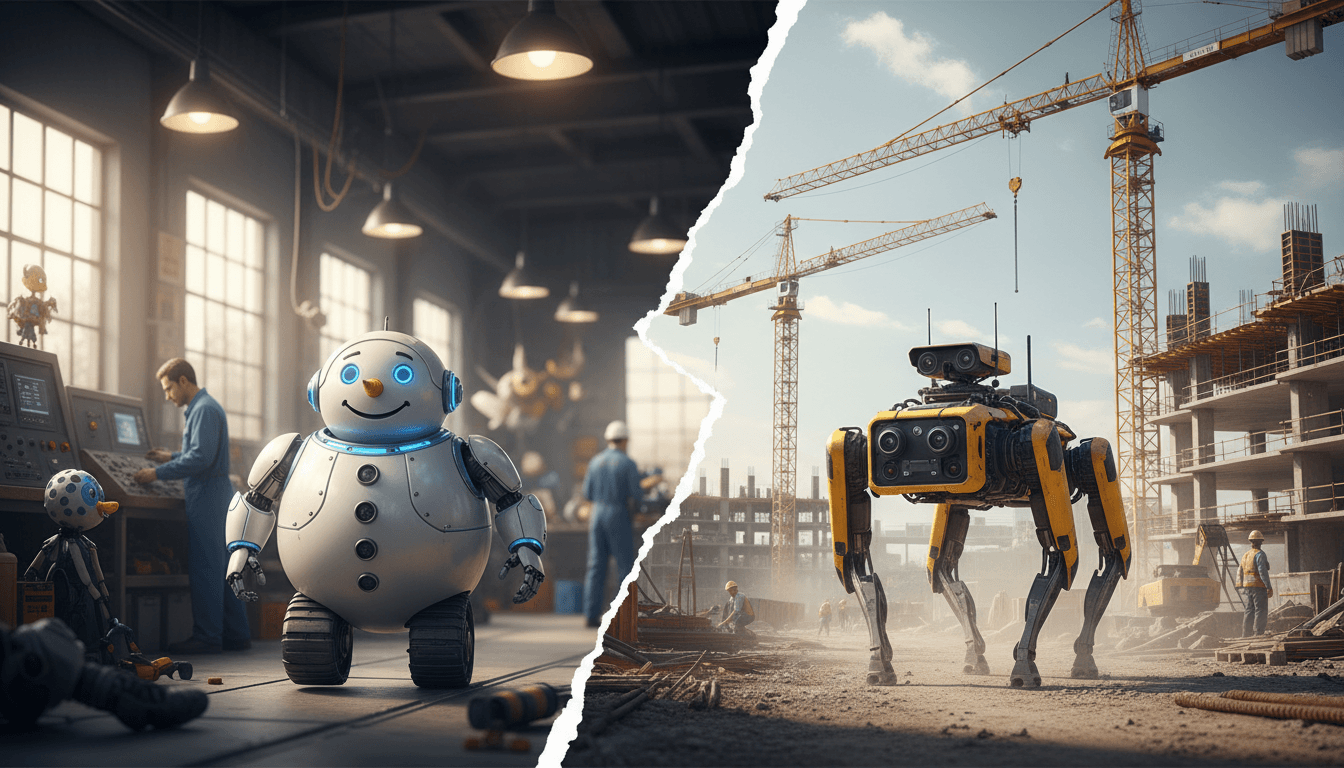
Robotic Olaf to Job Sites: AI Robotics in 2025
Disney built a self-walking Olaf. That sentence sounds like theme-park trivia—until you notice what’s underneath it: reliable locomotion, expressive motion control, safety systems that work around families, and a production pipeline that has to run every day without drama.
That’s the through-line of AI-powered robotics in late 2025. The most interesting robots aren’t the ones that look futuristic; they’re the ones that keep operating—in parks, warehouses, construction sites, and emergency-response simulations—while humans walk around them expecting normalcy.
This post is part of our “Artificial Intelligence & Robotics: Transforming Industries Worldwide” series, and I’m going to take a stance: the big story right now isn’t “humanoids are coming.” It’s that robotics teams are finally getting good at the unglamorous stuff—uptime, coordination, sensing, and recovery—across wildly different industries.
Disney’s Robotic Olaf shows what “production robotics” really means
A self-walking character like Olaf is a masterclass in commercial robotics under constraints. Entertainment robotics has to hit a bar most factories don’t: it must be safe, delightful, and dependable in public.
When Disney Imagineering showcases robotics, AI, and immersive tech behind attractions and characters, it’s not just about animatronics looking nicer. It’s about building systems that:
- Move in close proximity to guests with strict safety envelopes
- Perform expressive motion that reads as personality, not mechanics
- Operate continuously with predictable maintenance cycles
- Recover gracefully from small failures (a sensor glitch can’t ruin the show)
Why entertainment robotics matters outside entertainment
Here’s what many business leaders miss: theme parks are essentially high-variance “human environments.” Kids run, crowds form, lighting changes, noise spikes, and staff rotate. If a robot can function there, you’ve learned lessons that transfer directly to:
- Retail and hospitality service robots
- Airport and campus mobility robots
- Public-facing inspection and security robots
And there’s another underrated point: Disney has always treated robotics as part of storytelling. That mindset is now showing up in enterprise adoption, too. If you want people to accept robots at work, you need more than ROI slides—you need clear roles, predictable behaviors, and interfaces that reduce anxiety.
Snippet-worthy take: The fastest path to robotics adoption isn’t perfect autonomy—it’s predictable behavior that humans trust.
From Olaf to logistics: coordinated humanoids are getting practical
A standout example from the same robotics roundup is a demonstration of multiple humanoid robots completing a real logistics task: moving 32 boxes from eight piles to storage racks at different heights, autonomously, over an uninterrupted 18-minute run.
That detail—18 minutes, uncut—is the point.
Most robotics demos are short because real autonomy is messy. An extended run suggests the team has invested in the hard parts:
- Stable biped locomotion under repeated turns and stops
- Robust grasping that tolerates variation in box placement
- Task allocation between robots (who grabs what, when)
- Recovery behaviors when an action doesn’t go perfectly
The real value: repeatability, not “human replacement”
Warehouses don’t buy humanoids because they’re cool. They buy outcomes:
- Reduced ergonomic strain for workers (lifting, reaching, repetitive walking)
- More consistent throughput during peak season (yes, even right now in December)
- Flexibility when SKUs, packaging, or layouts change
Humanoids could be a fit when facilities are built for people—stairs, narrow aisles, mixed-height shelving. But I’m skeptical of “humanoids everywhere” narratives for 2026. What I do believe is happening faster: hybrid automation, where robots take the worst physical tasks and humans handle exceptions.
Practical question: What should you measure in a pilot?
If you’re evaluating AI-powered robotics for logistics, don’t start with “Can it pick a box?” Start with these metrics:
- Mean time to recovery (how long after a failure until it’s productive again)
- Intervention rate per hour (hands-on human help required)
- Task completion rate under variation (different box sizes, rack heights, lighting)
- Changeover time (how long to adapt to a new workflow)
Snippet-worthy take: Autonomy isn’t binary. What matters is how expensive it is to keep the robot productive.
Safety and triage robotics: human-robot teaming is the real headline
One of the most telling clips in the roundup comes from a defense-oriented triage challenge setting, where human medics and robotic systems work in the same scenario. The broader message applies far beyond military use: the near-term win is human-robot teaming, not robot-only operations.
In high-stakes domains—healthcare, emergency response, industrial safety—teams need machines that can:
- Extend situational awareness (vision, mapping, detection)
- Carry supplies or equipment through hazardous zones
- Provide decision support without overwhelming the operator
Why “human-in-the-loop” is still the winning architecture
A lot of AI robotics marketing pretends humans are the problem. I disagree. Humans are the adaptation layer.
When environments are uncertain—smoke, debris, crowded corridors, or poor connectivity—full autonomy becomes brittle. Human-in-the-loop control and supervision scales better than you’d think when paired with smart autonomy primitives (navigation, stabilization, object detection, safe manipulation).
This also mirrors what’s happening in enterprise robotics deployments: companies succeed when they design workflows where humans and robots each do what they’re good at.
Tactile sensing is quietly becoming the next competitive advantage
Vision-based robotics gets the attention. Touch is what makes robots reliable.
A research highlight in the roundup describes a tactile sensing system for a quadruped that can carry unsecured cylindrical objects on its back by using a network of tactile sensors and real-time feedback to continuously adjust posture and movement.
Why should a construction, logistics, or industrial leader care?
Because most “robot fails” are contact fails:
- The object slips
- The gripper pinches too hard or too softly
- The robot bumps an obstacle and can’t recover
- The payload shifts and destabilizes gait
What tactile sensing unlocks in the real world
Tactile sensing improves:
- Handling of variable objects (soft, reflective, dusty, irregular)
- Force-controlled tasks like insertion, alignment, and fastening
- Safety through better contact awareness
If you’re planning a robotics roadmap for 2026–2027, I’d put tactile capability high on the evaluation checklist. It’s often the difference between a lab demo and a system your ops team doesn’t hate.
Construction robotics is maturing: autonomy for surveying and data collection
A concrete business example from the roundup: a major construction firm deploying autonomy software on a quadruped robot to improve daily surveying and data collection.
This is where AI and robotics are transforming industries worldwide in the most measurable way: construction is information-starved, and manual data capture is slow, expensive, and inconsistent.
The ROI case is straightforward
On active job sites, progress tracking, site walks, and documentation can consume hours per week for skilled staff. Automating parts of that work can drive:
- Higher inspection frequency (daily instead of weekly)
- Faster issue detection (clashes, rework, safety hazards)
- Better records for compliance, disputes, and handover
The robot doesn’t need to “build” to be valuable. In many firms, the fastest payback is site reality capture—consistent photos, scans, and measurements mapped to time and location.
What to ask before you deploy robotics on a job site
If you’re considering an AI-powered robot for construction operations, ask these questions early:
- What’s the capture-to-insight pipeline? Data collection is useless if insights arrive late.
- Who owns exceptions? Mud, stairs, rebar, temporary fencing—someone needs a plan.
- How will it operate around crews? Site acceptance depends on predictable routes and clear signaling.
- What’s the integration plan? Scheduling tools, BIM coordination, punch lists, and reporting.
Snippet-worthy take: The robotics bottleneck on job sites isn’t mobility—it’s turning data into decisions before the next crew arrives.
Humanoids, quadrupeds, and “make existing robots better”: a smarter bet
One comment from the roundup nails a trend I’ve been seeing across vendors and buyers: you don’t always need to build a new humanoid robot; you can make existing humanoids a lot better.
This is the practical path forward. Many deployments will be won by:
- Better fall detection and recovery
- Sitting and resting behaviors to save energy and improve stability
- Faster battery service workflows (battery swapping matters more than press photos)
- Improved teleoperation interfaces for edge cases
The market is moving from “Can it walk?” to “Can it work for a full shift with minimal babysitting?” That shift is healthy.
People Also Ask: Is 2025 the year robotics finally became mainstream?
Mainstream doesn’t mean every company has robots. It means robots are now being purchased for specific workflows with clear owners, metrics, and integration plans.
What’s new in 2025 is not a single breakthrough. It’s the accumulation of:
- Better AI perception and planning
- More robust hardware (actuators, batteries, protection)
- Improved sensing (especially tactile)
- Stronger deployment playbooks (training, safety, maintenance)
What leaders should do next (if you want real leads, not hype)
If you’re responsible for innovation, operations, or digital transformation, here’s what works in practice:
- Pick one workflow with high pain and clear measurement. Examples: nightly site capture, box transfer between zones, inventory scans.
- Design the human role upfront. Who supervises? Who intervenes? Who signs off?
- Demand long-run demos. Short clips hide failure modes. Ask for 30–60 minutes of continuous operation in realistic conditions.
- Plan for maintenance like it’s a product, not a project. Spares, cleaning, battery logistics, and software updates.
- Audit your data pipeline. If insights don’t reach the field team fast, automation won’t stick.
If you want help identifying the right starting point, I’ve found that a short “workflow readiness” assessment (process mapping + environment constraints + ROI model) prevents months of expensive wandering.
Robotic Olaf is fun. But it’s also a signal: robots are moving from spectacle to infrastructure. The companies that win in 2026 won’t be the ones with the flashiest robots—they’ll be the ones that choose the right tasks, integrate them cleanly, and earn trust on the ground.
What’s your organization’s most “robot-ready” task—the one where doing it more often, more safely, or more consistently would change outcomes next quarter?