AI-powered customer experience is the most reliable growth lever in 2026. Learn how small businesses can use AI to build consistent journeys that retain customers.
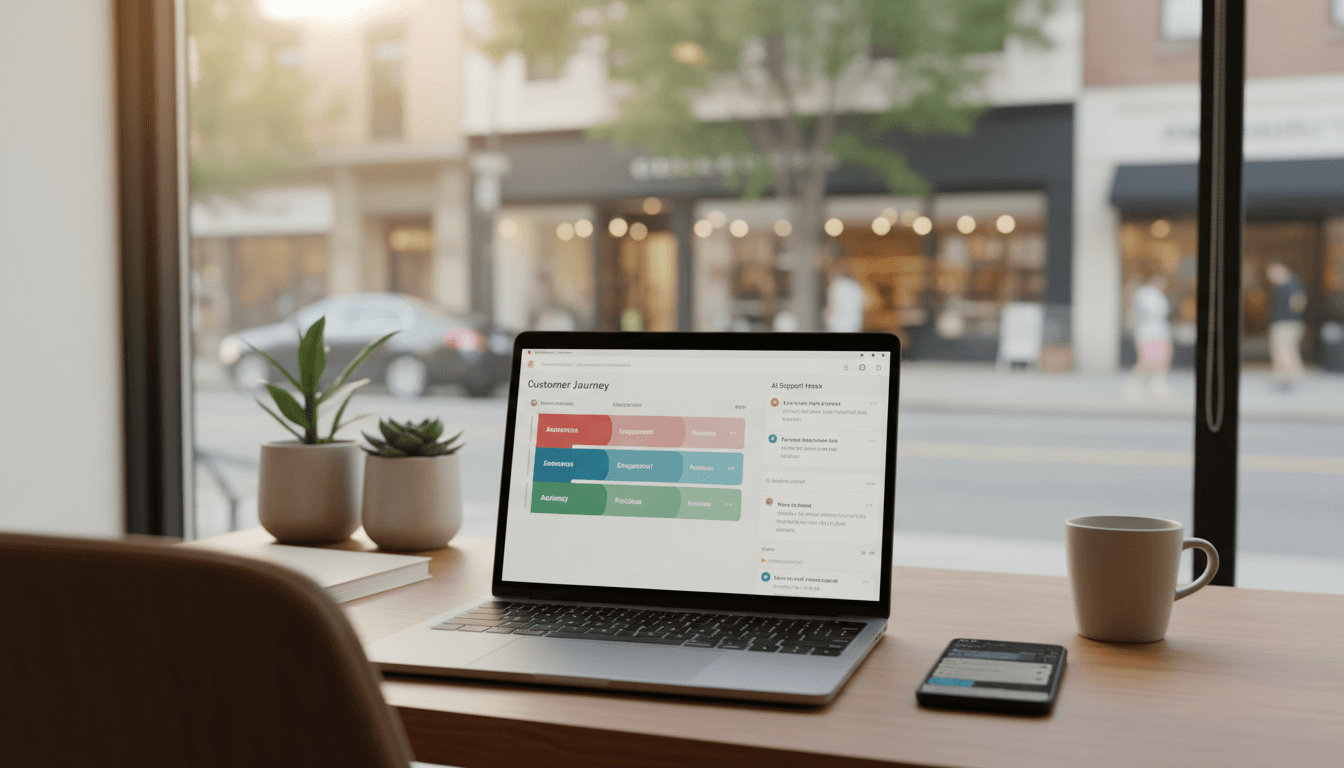
AI-Powered Customer Experience Growth Playbook (2026)
A 2025 survey by PwC found 32% of customers will walk away from a brand they love after just one bad experience. That number keeps showing up in boardrooms for a reason: it’s cheaper to keep trust than to rebuild it.
For U.S. small businesses, 2026 is the year customer experience (CX) stops being “nice to have” and starts acting like a profit-and-loss line item. Customers are more selective, comparison is instant, and AI has reset expectations for speed and relevance. If your reply takes a day, your competitor’s chatbot answers in 30 seconds. If your follow-up email is generic, theirs reflects what the customer actually looked at.
This post is part of our “AI Marketing Tools for Small Business” series, so I’m going to stay practical: what CX really means in 2026, how AI supports it (without turning your brand into a robot), and a simple operating model you can run even with a lean team.
Customer experience is a system, not a channel
CX in 2026 is the sum of every interaction a customer has with your business—before, during, and after purchase. Treating email, social, ads, your website, and support as separate “projects” is the fastest way to create a fragmented experience.
Here’s the thing most companies get wrong: they optimize the parts and ignore the whole. The customer doesn’t experience “your email program.” They experience your business. If your Instagram says “friendly and fast,” but your checkout is confusing and your support inbox goes dark for two days, the brand promise collapses.
Consistency beats novelty (especially for small brands)
Many small businesses think they need constant surprises: new campaigns, new channels, new creative every week. I don’t buy it. Consistency is what customers reward because it reduces mental effort.
A consistent CX looks like:
- The same offer terms everywhere (no “wait, is that only on Facebook?”)
- One clear next step (not three competing CTAs)
- Familiar tone and expectations across marketing and support
- Predictable response times (even if they’re not instant)
Predictable doesn’t mean boring. It means the experience makes sense.
Map journeys the way customers actually behave
Real customer journeys include messy realities: clicking an ad, getting distracted, asking a friend, reading reviews, coming back weeks later, buying on mobile, then needing help after delivery.
Instead of mapping by internal departments (marketing → sales → support), map by customer intent:
- Discovery: “Is this for me?”
- Consideration: “Can I trust you?”
- Decision: “Is it easy to buy?”
- Onboarding/first use: “Did I make the right call?”
- Support/returns: “Do you stand behind it?”
- Repeat/advocacy: “Should I come back or tell someone?”
You don’t need to perfect every touchpoint. Pick the moments that decide loyalty: checkout, first-use, support handoffs, subscription changes, and returns.
AI makes CX scalable when your data stops living in silos
AI-powered customer experience works when your systems share a coherent view of the customer. If your “customer data” is split between an email tool, a POS, a CRM spreadsheet, and DMs in Instagram, AI can’t help much beyond surface-level personalization.
Small business reality: you probably don’t have a data engineering team. That’s fine. You still need a basic data plan—because the win isn’t “more data.” It’s usable data tied to decisions.
Start with three CX decisions your data should improve
If you want AI to drive business value, define the decisions first. Here are three that matter for most SMBs:
- Who needs attention today? (lead scoring + prioritization)
- What message should they get next? (next-best-action recommendations)
- Where should support requests go? (intelligent routing)
Then define:
- Who owns the decision (marketing, owner, support lead)
- How fast it needs to happen (real-time vs. daily)
- What “good” looks like (conversion, retention, reduced handle time)
This is the difference between “we added AI” and “we improved the business.”
Personalization that doesn’t creep people out
Personalization is now table stakes, but privacy and trust are part of the experience. Customers are paying more attention to how their data is used, especially as AI becomes more visible.
A practical rule I like:
If a customer would be surprised you know it, don’t use it in messaging.
Better personalization focuses on:
- Context (what they’re trying to do right now)
- Preferences (what they explicitly told you)
- Lifecycle stage (new vs. repeat vs. at-risk)
And it pairs that with clear value exchange: “Tell us your size so we can recommend the right fit,” not “We saw you hovering on that page at 11:42 PM.”
Omnichannel CX isn’t “be everywhere”—it’s “play clear roles”
Omnichannel customer experience means your paid, owned, and earned channels work together toward one coherent journey. It doesn’t mean posting on seven platforms because someone said you should.
Most channel chaos happens when every channel tries to do everything:
- Ads try to close the sale immediately
- Emails repeat what ads already said
- Social posts contradict support policies
- SMS comes too often and feels spammy
Assign each channel a job
A clean omnichannel plan gives each channel a purpose:
- Paid ads: Introduce and qualify interest
- Website: Explain, prove, and convert
- Email: Nurture, onboard, retain
- SMS: Time-sensitive updates and high-intent nudges
- Social: Community, product proof, customer stories
- Support (chat/email/phone): Resolve, reassure, retain
When channels have jobs, your experience feels intuitive. When they don’t, customers feel repetition and friction.
A concrete SMB example (local service business)
Say you run a HVAC company in Ohio.
- A homeowner clicks a Google ad for “furnace repair same-day.”
- They land on a page with two options: “Book now” or “Get a call in 10 minutes.”
- AI in your CRM flags them as high-intent (urgent keyword + service area match).
- Your AI phone assistant (or routing rules) gets them to the right dispatcher.
- After the job, an automated email sends care instructions and asks for a review.
- Thirty days later, a maintenance reminder goes out only to customers with older units.
That’s not flashy. It’s consistent, fast, and confidence-building.
The best AI for CX in 2026 focuses on prediction, prioritization, and routing
AI adds the most CX value when it helps you anticipate needs and reduce effort—before customers complain. Surface-level personalization (like inserting a first name) isn’t where the money is anymore.
Three high-impact AI use cases for small businesses
1) Predictive “at-risk” and “ready-to-buy” segments
Even simple models can outperform gut instinct when you feed them the right signals:
- No repeat purchase within typical timeframe
- Abandoned checkout + no return visit
- Support ticket + negative sentiment
- Subscription downgrade behavior
Your action could be as simple as: a personal outreach, a better onboarding sequence, or a targeted offer with clear terms.
2) Journey optimization (finding the friction)
AI can summarize patterns humans miss:
- Where people rage-click or drop off
- Which FAQ topics spike before refunds
- Which ad promises correlate with support complaints
The point isn’t to “optimize everything.” It’s to fix the few breakpoints that create most of the churn.
3) Intelligent support routing and assisted replies
For many SMBs, support is the new marketing because it’s where trust is won or lost.
AI can:
- Classify tickets by urgency and topic
- Route VIP or time-sensitive issues first
- Draft replies that agents edit (faster, not fully automated)
Over-automation is a trap. Customers can tell when you’re hiding behind a bot. Use AI to speed up the human, not replace the human.
Measure CX like a growth leader, not a dashboard collector
CX is only a growth strategy if you can tie experience signals to revenue outcomes. Likes and open rates don’t pay rent.
The metrics that actually connect CX to growth
For most small businesses, I’d start with:
- Retention rate (or repeat purchase rate)
- Customer lifetime value (LTV)
- Time to first response (support)
- First-contact resolution rate
- Refund/return rate (and reasons)
- Conversion rate by journey stage (not just overall)
Then add one “experience” metric you can operationalize:
- CSAT after support interactions, or
- NPS quarterly, or
- Product review rating trend
The win is not tracking more metrics. The win is agreeing on one shared scoreboard across marketing and customer support.
A simple CX measurement formula
If you want something concrete to bring to a team meeting:
- If retention goes up 5%, profits can rise materially because acquisition costs don’t repeat on retained customers. (This is widely referenced in marketing literature; results vary by business model.)
So your CX question becomes: Which 1–2 experience fixes will most likely move retention by even a single point this quarter?
CX fails in the org chart before it fails in the market
Silos create fragmented CX by default. Small businesses aren’t immune—they just have different silos: the owner handles marketing, a manager handles operations, and support lives in an inbox no one reviews consistently.
The “one owner” operating model that works for SMBs
You don’t need a CX department. You need one accountable owner and a weekly cadence.
- Assign a CX owner (often the marketing manager or operations lead)
- Hold a 30-minute weekly CX review
- Review:
- Top 10 support topics
- Top drop-off page or funnel step
- One sample of customer feedback (call, review, email)
- Pick one fix to ship this week
Consistency compounds. Random acts of marketing don’t.
The three CX traps to avoid in 2026
- Over-automation without strategy: fast responses that don’t solve the problem
- Inconsistent promises: ads and social set expectations your operations can’t meet
- Treating CX like a campaign: doing a “CX push” for a month, then moving on
CX is an operating model. That’s why it drives durable growth.
A 30-day plan to improve AI-powered customer experience
If you want a short, realistic sprint:
- Week 1: Pick your “moment that matters.”
- Checkout? First appointment? Onboarding? Returns?
- Week 2: Fix one friction point and update your scripts.
- One clearer page, one better confirmation email, one improved support macro
- Week 3: Add one AI assist.
- Ticket classification, lead prioritization, or review-response drafting
- Week 4: Tie it to one business metric.
- Repeat purchase rate, refunds, time-to-first-response, booked calls
If you can’t measure the outcome, don’t automate it yet.
Where this is heading for U.S. small businesses
AI is powering technology and digital services across the U.S. economy, but the practical impact is simple: customers expect fast, consistent, relevant experiences—even from small brands. The businesses that win won’t be the ones with the most tools. They’ll be the ones who design a clean journey, connect the basics of their data, and use AI where it saves time and protects trust.
If you’re building your stack for 2026, put AI-powered customer experience on the shortlist next to lead generation. It’s the same problem. Leads don’t matter if the experience pushes people away.
What’s the one “moment that matters” in your customer journey that you know is leaking revenue right now—and are you willing to simplify it before you automate it?