CEVA’s acquisition of Fagioli spotlights heavy-lift logistics—where AI forecasting, routing, and asset planning reduce delays and risk.
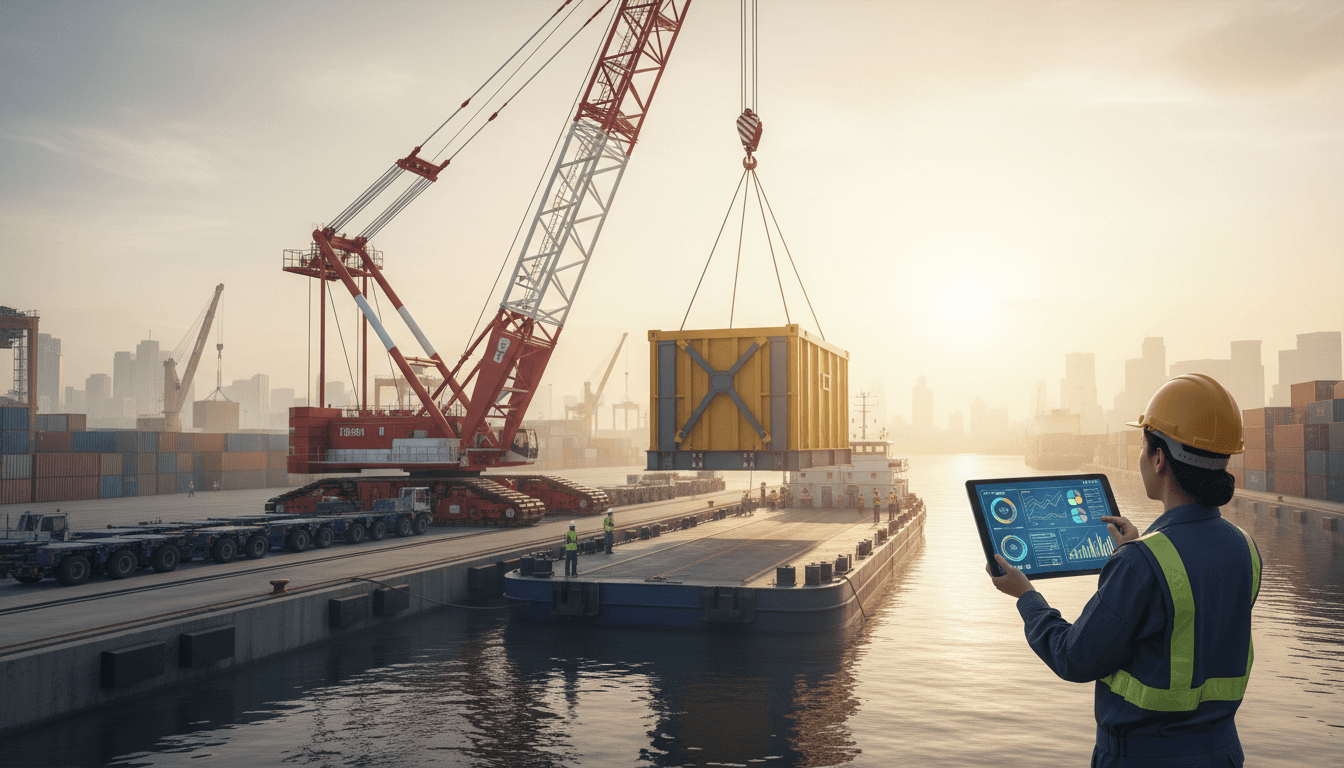
AI + heavy-lift logistics: what CEVA’s deal signals
A 3PL doesn’t buy crawler cranes, strand jacks, and SPMTs because it’s trendy. It does it because big industrial projects are back on the agenda—and because the hardest part isn’t “moving something big.” It’s coordinating engineering, permits, ports, escort vehicles, weather windows, risk, and dozens of subcontractors without losing weeks (or millions) to a single missed constraint.
That’s why CEVA Logistics’ plan to acquire Italy-based Fagioli Group caught my attention. Fagioli reported $254 million revenue in 2024 and brings deep specialization in design, engineering, specialized hauling, heavy lifting, and hoisting—plus thousands of owned and leased assets (cranes, tower systems, strand jacks, SPMTs, barges, ballasting pumps). The deal also adds roughly 450 employees to CEVA’s 1,000+ project logistics and freight forwarding experts.
For this series—„Изкуствен интелект в логистиката и транспорта“—the interesting part isn’t just the M&A headline. It’s what happens after. When a logistics giant expands physical capability, AI in logistics becomes the multiplier: better planning, fewer surprises, tighter execution, and clearer decisions when something inevitably goes off-plan.
Why heavy-lift project logistics is where AI actually pays off
Heavy-lift logistics is a perfect stress test for AI because the work is constraint-heavy and delay-sensitive. You’re not optimizing “the fastest route.” You’re optimizing a feasible plan.
A typical heavy-lift move has constraints like:
- Dimensional and weight limits by road segment, bridge, and turning radius
- Permit lead times and restricted travel windows (night moves, weekends)
- Tide and draft constraints for barges and port approach
- Crane selection and lift engineering (capacity, radius, ground bearing pressure)
- Crew, escort, and subcontractor availability
- Weather thresholds (wind limits for lifts, sea state for transport)
Most companies get this wrong: they digitize paperwork and call it transformation. The real value comes when you use AI-driven predictive analytics to answer operational questions early enough to matter:
- What’s the probability we miss the window if permit approval slips by 5 days?
- Which route is not only shortest, but least likely to be blocked by constraints?
- Do we have the right crane in the right region, or will repositioning kill the margin?
In other words, AI doesn’t replace heavy-lift expertise. It makes that expertise scalable.
What CEVA gains from Fagioli—and why that matters for AI strategy
CEVA’s stated logic is end-to-end coverage across the project logistics value chain—from early-stage development to final delivery. Fagioli’s capability set fills a common gap for global 3PLs: owning (or tightly controlling) execution for the high-risk physical steps.
Execution control creates better data (and better models)
AI systems are only as good as the feedback loop. A global forwarder that mostly coordinates vendors sees partial data. A provider that also executes lifts and specialized moves sees richer operational signals:
- Actual lift durations vs. planned
- Incident and near-miss patterns
- Utilization of cranes/SPMTs across project types
- Weather impact by geography and season
That’s the dataset you need to build reliable forecasting for project logistics—especially in heavy-lift where “average transit time” is meaningless.
Asset intensity changes the optimization problem
Fagioli’s fleet (cranes, SPMTs, barges) turns planning into an asset-allocation problem: where to position equipment, when to maintain it, and how to avoid idle time.
This is where AI in transportation becomes concrete:
- Fleet and asset optimization: repositioning plans that minimize deadhead moves and idle days
- Predictive maintenance: scheduling service based on usage patterns and failure risk, not generic intervals
- Margin protection: pricing informed by true capacity and risk, not just “market rates”
A heavy-lift crane sitting unused isn’t like an empty pallet location. It’s a capital sink.
Where AI fits in heavy-lift operations (practical use cases)
The fastest way to make AI valuable is to focus on decisions that happen weekly or daily—not “someday” innovation.
1) Constraint-based routing and permit planning
Standard route optimization is about distance and time. Heavy-lift routing is about feasibility.
AI can support planners by:
- Scoring alternative routes by likelihood of permit approval and restriction conflicts
- Recommending permit submission sequences based on historical lead times by authority
- Flagging segments with high disruption risk (construction cycles, seasonal closures)
The deliverable isn’t a pretty map. It’s a plan that survives contact with reality.
2) Lift planning support with risk scoring
Engineers will always own lift plans. AI can help them prioritize risk and focus review time.
Examples of what works:
- Predicting probability of schedule overrun by lift type, crew, and site conditions
- Identifying patterns behind near-misses (wind, lighting, communication issues, terrain)
- Recommending checklists dynamically based on lift complexity
A snippet-worthy truth: In heavy-lift, the best AI systems reduce variance more than they reduce averages.
3) Project schedule prediction across the whole chain
CEVA’s ambition is end-to-end. That means the schedule depends on handoffs: port to barge, barge to SPMT, SPMT to crane, crane to foundation.
AI-driven predictive analytics can:
- Forecast critical path risk using real-time updates from each leg
- Simulate “what-if” scenarios (weather delays, permit delays, asset breakdowns)
- Recommend buffer placement where it’s cheapest (time buffers vs. capacity buffers)
This matters because heavy-lift project delays often cascade into EPC penalties and construction idle time.
4) Visibility that’s actually useful
“Track-and-trace” isn’t enough for project cargo. Stakeholders need answers like:
- Is the lift window still viable given forecast wind speeds?
- If the barge ETA slips 12 hours, do we lose the crane slot?
- Which alternative staging site keeps ground bearing pressure within limits?
AI helps by turning raw events into decision-ready alerts.
Integration challenge: M&A doesn’t automatically produce “smart logistics”
CEVA has been active in expanding capabilities and geographies (including recent moves in Turkey and earlier expansion in East Africa, plus a project logistics joint venture in Saudi Arabia across the GCC). The hard part is integrating operations across regions and service lines.
Here’s the stance I’ll defend: If the operating model stays fragmented, AI will stay stuck in pilots.
What to standardize first (so AI can scale)
If you’re building AI for project logistics, standardization beats fancy modeling. Start with:
- A shared data model for assets and jobs
- One definition of a “move,” “lift,” “permit status,” and “asset availability”
- Operational timestamps that people trust
- Planned vs. actual for key milestones (arrival, rigging start, lift start, lift end)
- A single source of truth for constraints
- Bridge limits, travel windows, port restrictions, weather thresholds
The goal is simple: planners and site teams must believe the system, or they’ll route around it.
The people angle: AI won’t fix a skills gap
Late 2025 conversations in logistics keep circling back to skills. Project logistics is already specialized, and heavy-lift even more so. AI should be designed to make experts more productive—not to “automate the expert away.”
Practical approach:
- Pair AI recommendations with transparent reasons (“permit lead time risk +14 days”)
- Capture expert overrides as training data (“ignored because bridge works confirmed”)
- Create playbooks that embed both engineering rules and learned patterns
What shippers should do now (especially for 2026 project pipelines)
If you’re a shipper moving turbines, reactors, modules, transformers, or oversized industrial equipment, the CEVA–Fagioli move is a signal: providers are building end-to-end muscle. You should respond by tightening your own requirements.
A shipper’s AI-ready project logistics checklist
Ask prospective partners (or your current 3PL) for specifics:
- Risk forecasting: Do you provide probabilistic ETAs and schedule risk, or just dates?
- Scenario planning: Can you run “what-if” simulations (permit delay, weather, asset swap)?
- Asset transparency: Can you show asset allocation logic (crane/SPMT availability) and conflicts?
- Exception playbooks: What happens when the lift window collapses—who decides, how fast?
- Data sharing: Will you share planned vs. actual milestones so your team can learn and improve?
If the answers are vague, you’ll be paying for surprises.
What logistics providers should copy from this playbook
Even if you’re not acquiring a heavy-lift specialist, the strategic lesson applies across transport and logistics: combine physical capability with AI-driven decisioning.
Three moves I’ve found consistently effective:
- Pick one high-stakes workflow (permits, routing, or asset allocation) and make it AI-assisted end-to-end.
- Measure variance reduction, not just average performance.
- Treat data capture as operations, not IT.
That’s how AI optimization becomes part of execution—especially in complex, heavy-lifting environments.
Where this goes next for AI in logistics and transport
The acquisition strengthens CEVA’s ability to execute complex moves. The next competitive edge will come from how well they coordinate across regions, assets, and constraints—at speed.
For the broader „Изкуствен интелект в логистиката и транспорта“ narrative, heavy-lift logistics is a clear next frontier: it forces AI to handle messy, real-world constraints where a simple dashboard won’t cut it.
If you’re planning major project cargo for 2026, here’s the forward-looking question worth asking internally: Do we want visibility, or do we want decisions we can trust before the window closes?