Mussel-shell abrasives could bring safer, circular denim finishing to Bangladesh—especially when paired with AI for QC, process control, and audit-ready reporting.
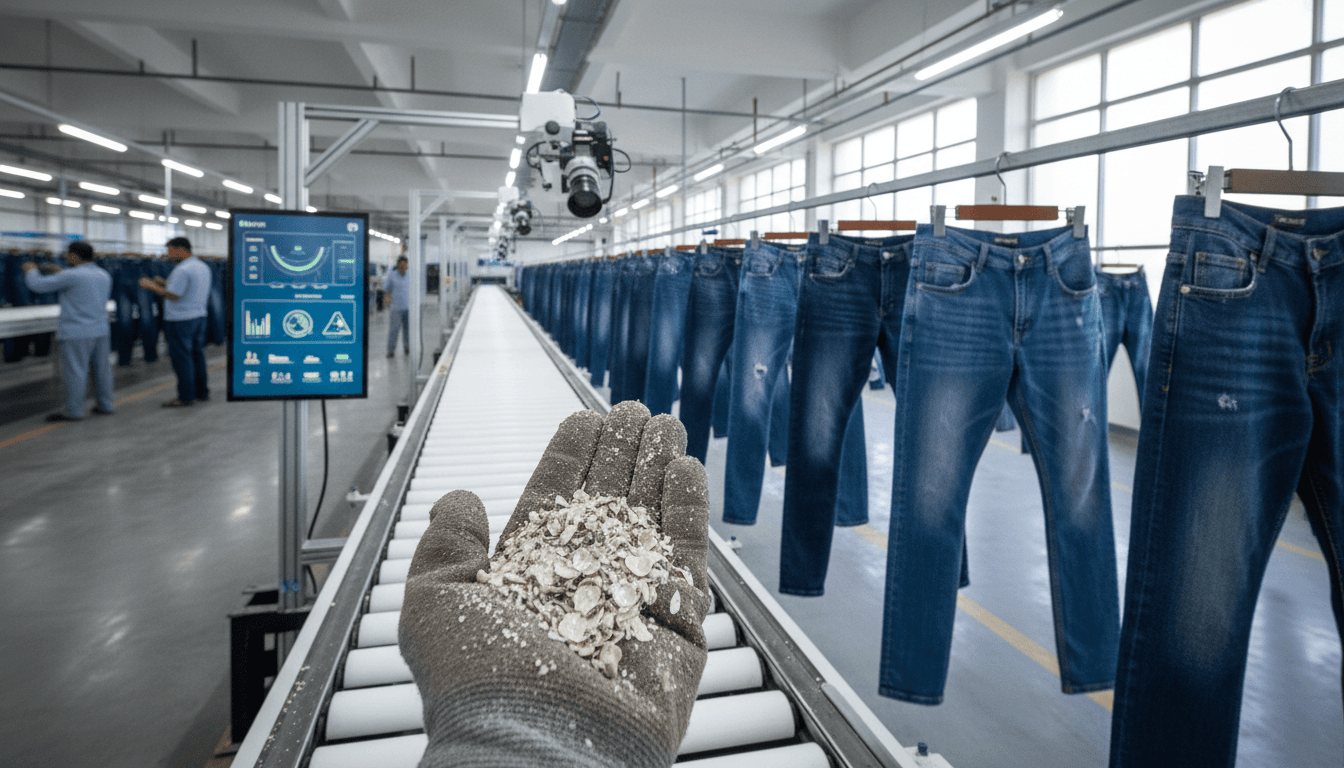
Mussel Shell Denim: Bangladesh’s AI-Ready Finishing Shift
For years, denim finishing has had an uncomfortable truth: the most “authentic” distressed looks often came from processes that were unsafe, hard to audit, and ugly from an environmental standpoint. Sandblasting is the obvious example—banned or heavily restricted in many supply chains because silica dust exposure caused devastating worker health outcomes.
Now a very different input is entering the conversation: discarded mussel shells turned into high-performance blasting grit. The idea sounds almost too simple—seafood waste becomes a finishing material—but it’s exactly the kind of pragmatic innovation Bangladesh’s denim industry needs in 2026: improvements that raise compliance performance, protect workers, and still satisfy premium buyers.
This post sits inside our series on how artificial intelligence is changing Bangladesh’s textile and garment industry. Because here’s the connection many factories miss: material innovation (like mussel-shell abrasives) doesn’t compete with AI. It becomes much more scalable and controllable when AI is used to standardize recipes, monitor exposure risks, optimize re-use cycles, and prove compliance with clean data.
Why mussel-shell abrasives are being taken seriously
Answer first: Mussel-shell grit matters because it offers a non-silica pathway to physical abrasion that can be run on existing equipment, while potentially reducing consumable waste through reusability.
The source story highlights joint research by the University of the Basque Country and MIT, converting shell waste into controlled grit sizes. The big promise is straightforward:
- No silica exposure (the central occupational hazard that made sandblasting infamous)
- Durability and lower fracture rate compared with common alternatives like garnet
- Smoother surface finishes and repeatable effects
- Reusability, which can reduce abrasive consumption per garment
Denim brands have spent the last decade trying to balance three competing demands:
- Worker safety (no shortcuts)
- Aesthetic authenticity (premium buyers still want “vintage” character)
- Sustainability compliance (audits, wastewater limits, chemical restrictions, circularity pressure)
Laser finishing and chemical abrasion helped in many cases, but they come with trade-offs: energy use, chemical handling risks, and limitations in replicating certain looks at scale. Mussel-shell abrasives don’t “go backwards” to old sandblasting—they re-engineer the process with a different, safer input.
What this could mean for Bangladesh’s denim value proposition
Answer first: If commercialized at scale, mussel-shell blasting can help Bangladeshi denim producers offer premium finishing with a stronger compliance story—especially when paired with AI-driven process control.
Bangladesh is already a major denim exporter, and finishing/washing remains one of the most scrutinized stages in audits. Buyers aren’t only checking whether a factory has a “safe process.” They’re looking for proof—repeatable results, exposure controls, documentation, training records, waste tracking, and CAPA closure.
If mussel-shell abrasives become commercially available, they can support a tighter offer to brands:
- Controlled abrasion without silica → easier occupational health positioning
- Reduced reliance on aggressive chemical distressing → fewer chemical hazards and potentially cleaner effluent profiles
- Lower solid waste per garment through abrasive re-use → stronger resource efficiency metrics
- Circular economy alignment → a clean story for EU-facing buyers who increasingly ask “Where did the input come from, and what happens after?”
But the most valuable shift isn’t the shell itself. It’s that this kind of innovation creates a “data problem” factories must solve: once you adopt a new abrasive, you need to stabilize quality and prove safety. That’s where AI stops being a buzzword and becomes operational.
The hybrid finishing reality: physical + digital
Most premium denim programs are moving toward hybrid finishing: laser for precision and repeatability, and physical abrasion for texture, depth, and authenticity.
Mussel-shell grit fits neatly into that direction. Think of it as another tool in the finishing toolbox—one that could reduce pressure on harsher chemicals while keeping the “hand-crafted” look buyers pay for.
Waste-to-value is good. Waste-to-value with AI is better.
Answer first: Mussel-shell abrasives become far more scalable when AI is used to control grit lifecycle, blasting parameters, QA inspection, and audit-ready reporting.
Globally, the article cites around 1.5 million tonnes of mussel shells discarded per year. Turning that stream into an industrial input is a classic circular move—waste becomes value.
In practice, though, circular inputs create variability risks:
- Shell composition can vary by source and processing
- Grit size distribution affects finish consistency
- Re-use cycles change particle shape and performance
If a factory can’t control variability, the innovation dies in sampling.
Here are four specific AI-adjacent ways Bangladeshi denim laundries can make this kind of innovation workable.
1) AI recipes for blasting parameters (not “operator intuition”)
A denim wash floor often runs on tacit knowledge: who is on the shift, how experienced they are, what they “feel” is right. That’s expensive.
With an abrasive like mussel-shell grit, factories can standardize:
- Nozzle distance
- Air pressure
- Exposure time
- Garment position sequence
- Grit flow rate
- Re-use batch ID
AI doesn’t need to be fancy to help. Even a supervised model or rules-based optimization can recommend parameter ranges per style.
Snippet-worthy truth: The fastest way to lose buyer trust is inconsistent finishing across sizes and lots.
2) Computer vision for shade and abrasion uniformity
If you’re investing in safer abrasion, you also need to cut rework. Rework burns labor hours, utilities, and capacity.
Computer vision systems (camera + model) can score:
- Whisker symmetry
- Abrasion intensity mapping across the garment
- Patchiness and over-blast zones
- Shade deviation against a digital standard
This is exactly the kind of AI adoption Bangladesh is accelerating: QC automation that reduces subjectivity and creates evidence trails.
3) Predictive maintenance and dust-control monitoring
Even if silica is removed, blasting is still a dust-generating process. Factories should treat this as a health-and-safety engineering problem, not a compliance checkbox.
AI-enabled monitoring can help:
- Detect declining extraction performance (filters, ducts)
- Predict maintenance intervals based on pressure drops and runtime
- Flag “process drift” where dust levels rise due to equipment wear
This matters because audits increasingly look at systems, not slogans.
4) Circularity reporting: from “claim” to “proof”
Buyers now ask for measurable sustainability. If mussel-shell grit is reusable, a factory should be able to say:
- How many cycles a batch was reused
- How much abrasive was consumed per style
- How much solid waste was generated per order
AI-supported dashboards (even simple analytics) turn those numbers into routine reporting. And routine reporting is what wins repeat orders.
A practical adoption roadmap for Bangladeshi factories
Answer first: Treat mussel-shell abrasives like a controlled process change—pilot, measure, standardize, then scale with AI-backed QA and documentation.
If I were advising a denim laundry in Bangladesh evaluating this innovation, I’d push for a structured path rather than an “R&D corner” approach.
Step 1: Define success metrics before the pilot
Most pilots fail because no one agrees what “good” means.
Set targets such as:
- Finish quality scores (brand standard or internal scorecard)
- Rework rate reduction (e.g., from 8% to 5%)
- Abrasive consumption per garment
- Worker exposure controls (ventilation checks, housekeeping, PPE compliance)
- Cost per garment impact (including disposal)
Step 2: Run a limited style pilot (3–5 SKUs)
Choose a mix:
- One high-volume core style
- One premium “vintage” style that needs depth
- One fashion style with aggressive abrasion zones
Collect data per batch. Don’t rely on memory.
Step 3: Build a “digital recipe card” system
Even a lightweight system works: each style gets a documented recipe and acceptance band.
Include:
- Grit size
- Re-use count range (e.g., batch cycles 1–3)
- Machine settings and sequence
- Visual inspection checklist
- Photo references for pass/fail
Once this exists, AI can be layered on top. Without it, AI has nothing reliable to learn from.
Step 4: Add computer vision inspection where it pays back fastest
Start at the choke point: final inspection for high-value denim lots. If the model reduces rework and disputes, it funds itself.
Step 5: Prepare an audit-ready narrative
Auditors and buyers respond to clarity:
- What changed, and why
- How risks were assessed
- What training was done
- What monitoring is in place
- What the data shows month-to-month
This is where Bangladesh can stand out: not just “we tried a sustainable abrasive,” but we operationalized it.
People also ask: can mussel-shell blasting bring back sandblasting?
Answer first: It can reintroduce physical blasting without silica, but it shouldn’t be treated as the old process returning; it should be treated as a new, controlled finishing method.
The reputational issue around sandblasting wasn’t the aesthetic. It was the exposure risk and the lack of controls. If the abrasive is non-silica and the factory runs strong engineering controls, training, monitoring, and documentation, the conversation becomes different.
Still, brands will be cautious. Expect them to demand:
- Material safety documentation
- Evidence of worker protection systems
- Repeatable quality at scale
- Clear waste handling practices
That’s another reason AI matters: data is what turns caution into confidence.
Where this fits in Bangladesh’s AI transformation story
Material innovation like mussel-shell abrasives is a reminder that Bangladesh’s competitive edge won’t come from one big technology bet. It will come from stacking practical improvements: safer inputs, cleaner processes, and smarter control systems.
AI is the glue that helps those improvements stick. It standardizes finishing, automates quality checks, strengthens compliance reporting, and reduces the “hero operator” dependency that causes inconsistency.
If your factory is exploring AI for quality control or production optimization, denim finishing is a smart place to start—because it’s where buyer scrutiny is highest and where small improvements quickly show up in cost, compliance, and lead times.
What would happen if Bangladesh became known not just for denim capacity, but for audit-proof, data-driven, circular finishing? That’s a stronger story for 2026 than any single machine upgrade.