ASX flat doesn’t mean quiet. See how AI-driven insights track sector rotations, energy shocks, and tech rebounds—plus a practical workflow for 2026.
AI Signals for ASX Volatility: Energy Down, Tech Up
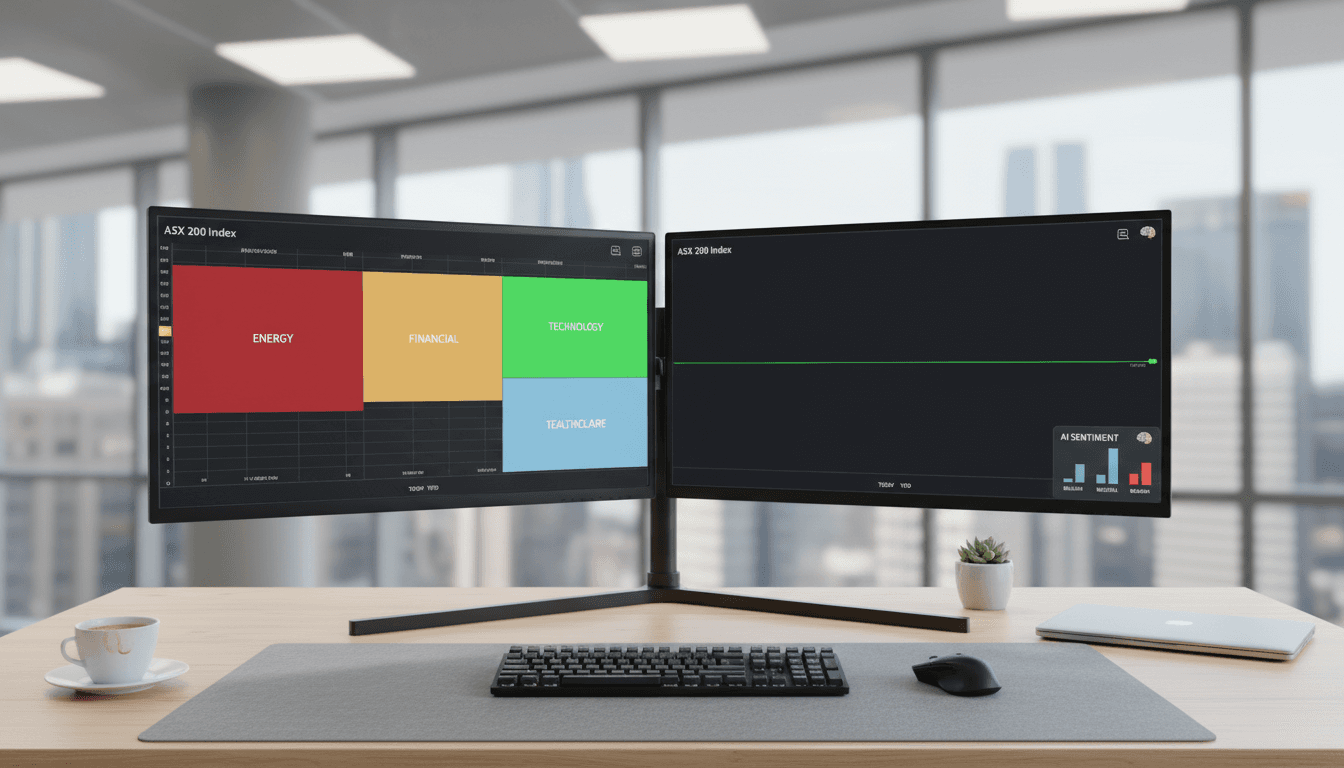
A flat day on the ASX can still be a loud day—if you’re watching the right signals. On Thursday, the S&P/ASX 200 added just 3 points to 8588.20, finishing almost exactly where it started. Yet under that calm surface: Woodside fell 2.7% on a CEO exit, tech names rebounded, NextDC slid 4.4%, and US markets were rattled by another leg down in AI-linked stocks.
This is the kind of tape that frustrates humans and flatters machines. Not because AI can “predict the market” (it can’t, reliably), but because AI-powered financial tools are unusually good at monitoring dozens of moving parts at once, quantifying what matters, and turning noise into decisions you can actually defend.
In this edition of our AI in Finance and FinTech series, I’m using this ASX session as a practical case study: what changed, why it mattered, and how to set up AI-driven investment insights, market sentiment analysis, and risk modelling so your process holds up when markets stop being tidy.
What Thursday’s ASX session really said (beyond “flat”)
The direct answer: the ASX didn’t “do nothing”—it rotated.
Seven of 11 sectors finished higher, but the index barely moved because leadership was mixed and heavyweight sectors pulled in opposite directions. That’s a classic end-of-year pattern: thinner liquidity, larger reactions to company-specific news, and more abrupt factor rotations.
Here’s what stood out:
- Energy dragged: Woodside dropped 2.7% after announcing CEO Meg O’Neill’s resignation to run BP. Leadership transitions create immediate uncertainty, even when the long-term fundamentals haven’t changed.
- Tech showed relative strength: WiseTech +1.6%, Xero +2.5%, Technology One +1.2%—despite US tech weakness overnight. That divergence is information.
- AI infrastructure wasn’t immune: NextDC -4.4%. When “AI trade” sentiment wobbles globally, data centre and infrastructure names often get hit early.
- Banks were directionless: CBA +0.5% while Westpac -0.5%, NAB -0.6%, ANZ -0.2%. When a sector that’s over a third of the index can’t pick a lane, the index struggles to trend.
- Governance and compliance mattered: ANZ recorded a 32.3% vote against its executive pay scheme (a second “strike”), and Austrac opened an investigation into Bendigo and Adelaide Bank.
If you manage portfolios, build fintech products, or advise clients, the practical lesson is simple:
When the index is flat, the opportunity (and risk) shifts to sector, factor, and event-level decisions.
That’s exactly where applied AI earns its keep.
Why AI stock slumps on Wall Street hit Australia fast
The direct answer: because global risk appetite travels through a small set of crowded positions.
Overnight, US markets fell again: the S&P 500 -1.2%, Nasdaq -1.8%. The pain was concentrated in artificial-intelligence-linked names: Nvidia -3.8%, Broadcom -4.5%, Oracle -5.4%, CoreWeave -7.1%.
Even if you don’t own US stocks, this matters for the ASX because:
- Narratives are global, portfolios are global. When large funds de-risk “AI exposure,” they often sell proxies across regions (including Australian tech and AI infrastructure).
- Correlation spikes happen suddenly. In calm markets, local fundamentals dominate. In risk-off bursts, correlations rise and “good stocks” fall with “bad stocks.”
- Macro meets micro. The US sell-off was tied to a recurring worry: whether AI spending will produce enough profit and productivity—and whether debt-funded capex will become a problem.
This is where market sentiment analysis is more than a buzz phrase. If your process only watches price charts, you’ll react late. If your process tracks sentiment and positioning indicators, you’re more likely to anticipate when a theme is wobbling—before it hits your local holdings.
A practical AI setup for sentiment you can trust
The direct answer: combine three inputs—text, price, and positioning—then force the model to explain itself.
If you’re deploying AI in a finance team (or choosing a fintech tool), look for workflows that:
- Ingest news, earnings call transcripts, broker notes, and social data
- Classify sentiment by topic (e.g., “AI capex,” “data centre demand,” “bank compliance”) rather than a single overall score
- Map sentiment changes to abnormal returns (moves beyond what volatility would predict)
- Provide traceable “why” outputs: top phrases, sources, and confidence bands
If the tool can’t show why sentiment shifted, it’s not decision-grade.
Energy shocks aren’t just about oil prices—events matter
The direct answer: energy stocks move on leadership, geopolitics, and policy as much as they move on spot prices.
Woodside’s decline wasn’t triggered by a sudden collapse in oil. It was an event-driven move tied to management change. Meanwhile in the US, oil prices actually rose after President Trump ordered a blockade of “sanctioned oil tankers” into Venezuela, lifting crude about 1.7% (US crude to $US56.06, Brent to $US59.90).
So why didn’t that macro tailwind dominate the ASX energy tape? Because event risk can outweigh macro in the short run.
This is where AI-based predictive analytics is genuinely useful—not to forecast oil, but to quantify the distribution of outcomes around events.
How AI risk modelling handles energy event risk
The direct answer: it turns “story risk” into probability-weighted scenarios.
A practical event-risk model for energy and resources typically includes:
- Event detection: leadership changes, project delays, litigation outcomes, regulator decisions
- Similarity matching: compare to prior events (same company, sector peers, global analogues)
- Scenario library: base/upside/downside outcomes with expected drawdown and recovery time
- Portfolio impact: expected contribution to VaR/ES, drawdown sensitivity, and correlation under stress
That last step matters most. A 2–3% single-name drop is manageable—until it’s correlated with your other “AI theme” holdings, your cyclical exposures, and your currency risk.
Banks, compliance, and the AI opportunity hiding in plain sight
The direct answer: governance and AML issues are now market-moving, and AI can reduce both cost and risk—if it’s implemented responsibly.
Thursday’s newsflow had two signals finance teams shouldn’t ignore:
- ANZ’s second strike (32.3% against pay) underscores governance pressure and the market’s low tolerance for missteps.
- Austrac investigating Bendigo and Adelaide Bank reinforces that AML/CTF compliance is not a back-office afterthought; it’s a valuation issue.
In Australian banking and fintech, AI is already widely used for fraud detection and transaction monitoring, but the next wave is about quality and defensibility:
- Better detection of complex laundering patterns across networks
- Fewer false positives (which reduces investigator workload)
- Clear audit trails that satisfy regulators
My stance: any bank pitching “AI-powered AML” without strong model governance is asking for trouble. Regulators don’t care that your model is accurate if you can’t explain decisions, manage drift, and document controls.
What “responsible AI” looks like in AML and credit scoring
The direct answer: strong controls beat clever models.
Whether you’re using AI for AML, credit scoring, or collections, insist on:
- Explainability appropriate to the use case (customer-facing decisions need more than internal tooling)
- Bias testing and ongoing drift monitoring
- Human-in-the-loop escalation for high-impact outcomes
- Model risk management documentation that can survive an audit
You’ll ship slower, and you’ll sleep better.
Turning a choppy ASX tape into an AI-assisted investing process
The direct answer: use AI to decide what to pay attention to, not what to buy.
When the market is rotating—energy down, tech up, banks mixed—your edge comes from speed, coverage, and consistency. AI helps most when it acts like an always-on analyst that never gets tired.
A simple weekly workflow (that actually gets used)
The direct answer: build a repeatable loop around monitoring, signals, and review.
-
Monitor (daily)
- Sector moves vs index
- Company event alerts (exec changes, regulator actions, settlements)
- Sentiment shifts by theme (“AI capex”, “oil geopolitics”, “bank compliance”)
-
Score (daily)
- Volatility-adjusted abnormal moves
- Correlation regime changes (what started moving together?)
- Liquidity flags (especially in late December)
-
Decide (weekly)
- Rebalance exposures by risk budget, not headlines
- Add hedges where correlations are rising
- Trim crowded themes when sentiment turns and breadth narrows
-
Review (monthly)
- Compare AI alerts vs outcomes
- Track false positives/negatives
- Retune thresholds and retrain where drift is obvious
Notice what’s missing: “the model said buy.” That’s intentional.
Where algorithmic trading fits (and where it doesn’t)
The direct answer: use algorithmic trading for execution quality, not prophecy.
For many portfolios, the cleanest fintech win is AI-assisted execution:
- Smarter order slicing to reduce market impact
- Venue selection to improve fill quality
- Short-term liquidity prediction
Execution AI is measurable: you can compare slippage and implementation shortfall. Predictive alpha is harder, noisier, and easier to oversell.
The end-of-year reality check: liquidity can lie
The direct answer: December price action can exaggerate conviction.
This article’s timing matters. It’s late December, and markets often behave oddly:
- Lower participation can amplify single-name reactions
- Rebalancing and tax positioning can distort sector flows
- Headlines can move prices more than fundamentals
AI tools help here by tracking liquidity conditions and flagging when moves are likely flow-driven rather than information-driven. That’s valuable for advisers explaining volatility to clients, and for fintech teams designing alerts that don’t cry wolf.
Next steps: use this ASX session as your test case
A flat ASX session that hides sharp sector moves is a perfect sandbox for evaluating AI in finance. Energy fell on a leadership surprise. Tech found a bid even while US AI names sold off. Banks drifted while governance and compliance risks stayed front-page.
If you’re building or buying fintech tools, your bar should be simple: does the product help you react faster, with better evidence, and with fewer emotional decisions? If not, it’s a dashboard, not a capability.
I’d start with one concrete move: run a pilot that combines market sentiment analysis and event detection for your top 30 holdings (or your investable universe). Measure whether it surfaces risks earlier and reduces time-to-decision. Then expand.
The next time the ASX “does nothing,” will your process notice what actually changed—and act on it?