AI-generated imagery is a workflow story. Learn how Zara’s approach maps to finance-grade governance and practical AI adoption in AgriTech.
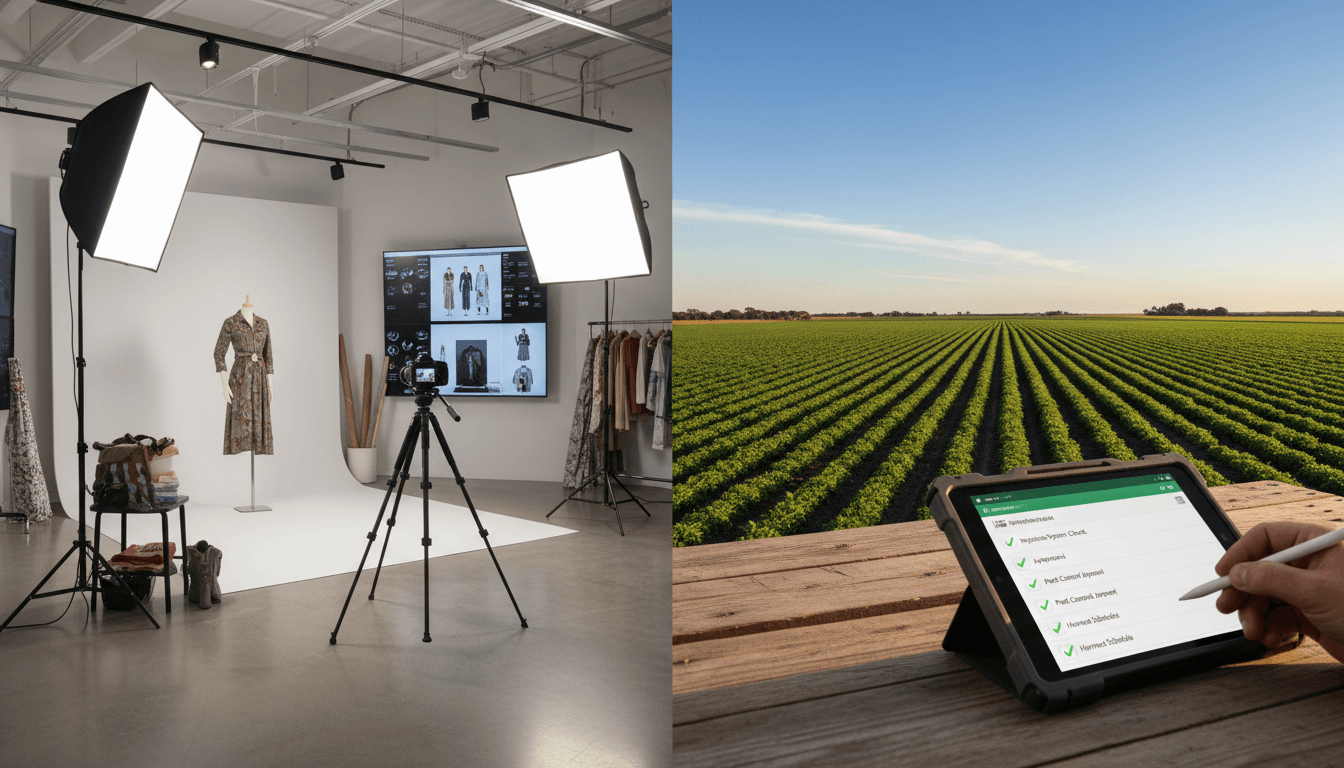
AI-Generated Imagery: A Playbook for Regulated Teams
Zara’s move to use AI to create new images of real-life models in different outfits isn’t a “fashion story”. It’s a workflow story. When a global brand can generate compliant, on-brand creative faster—without rebooking talent, studios, and crews—you’re watching the same productivity equation that’s already reshaping financial services, and (closer to home for this series) Australian agri-business.
And December is the perfect time to notice it. Year-end campaigns are live, budgets are tight, teams are exhausted, and everyone wants more content with fewer bottlenecks. That pressure exists whether you’re selling jackets, mortgages, or grain contracts.
What I like about Zara’s example is how plain the lesson is: generative AI becomes valuable when it reduces “repeat work” while keeping humans in the approval loop. In finance that might mean faster customer comms and marketing variants; in AgriTech it might mean quicker product datasheets, seasonal advice content, or farm-facing training materials. The hard part isn’t generating pixels—it’s controlling risk.
What Zara’s AI imagery shift really signals
Zara’s approach—editing images of real models using AI to show different items—signals a broader trend: companies are standardising “synthetic production” to compress time-to-market.
The reporting indicates Zara (via Inditex) positions AI as a complement, not a replacement. That’s a familiar line, but it’s also a sensible operating model. You don’t adopt generative AI because you dislike creatives. You adopt it because:
- Reshoots are expensive, slow, and geographically constrained.
- Campaigns require dozens of variants across channels and markets.
- Brand teams want speed and consistency.
- Legal and reputational risk is now part of content production, not an afterthought.
The “AI clone” concept is spreading for one reason: throughput
H&M has discussed AI clones of models; Zalando is using AI to produce imagery faster. These aren’t isolated experiments. They’re responses to a simple KPI: content throughput per dollar.
The parallel in financial services is obvious. Banks and fintechs are using AI for:
- Customer personalisation (offers, onboarding nudges, retention messaging)
- Fraud detection (pattern recognition across transactions)
- Operations automation (document handling, call summarisation)
Different outputs, same underlying driver: more decisions and more content, produced faster, at acceptable risk.
The real risk isn’t “AI vs humans” — it’s consent, provenance, and controls
The most important line in the Zara coverage is about collaboration with models and mutual agreement, with compensation aligned to industry practice. That’s not PR fluff. It’s the beginning of a governance framework.
For regulated industries (finance) and safety-critical industries (agriculture and food supply chains), governance is the whole ball game.
Three control questions every AI content workflow must answer
- Consent: Do you have explicit permission to create variants of a person, product, or property?
- Provenance: Can you prove where the source assets came from and how the output was generated?
- Controls: Who can generate, approve, publish, and audit outputs?
If any of those are fuzzy, the technology isn’t your biggest problem.
A practical rule: if you can’t explain how an AI asset was made, you can’t defend it when something goes wrong.
Why this matters in finance—and why it matters in AgriTech too
In financial services, “model consent” looks like customer data permissions, marketing compliance, and fair treatment obligations. In agriculture, it often looks like:
- Use of farm imagery (properties, staff, contractors)
- Use of agronomic data and yield maps (ownership, sharing rights)
- Supplier and co-op branding (who can publish what, where)
Australia’s agriculture sector is increasingly data-rich. Precision agriculture tools capture imagery, sensor streams, and operational records. That’s valuable—and sensitive.
From fashion shoots to farm ops: the same AI operating model
Here’s the bridge that makes this relevant to the AI in Agriculture and AgriTech series: both fashion and farming rely on seasonal cycles, tight margins, and distributed workforces. AI wins when it shortens cycle times.
Where generative AI shows up in AgriTech (beyond the hype)
Generative AI can support precision agriculture programs without touching the tractor or drone. It helps with the “boring middle” of operations:
- Turning agronomy notes into consistent farm recommendations
- Generating training visuals for equipment maintenance
- Creating multi-language safety and induction materials
- Producing marketing assets for direct-to-consumer farm brands
The lesson from Zara: treat AI as a variant engine—not a creativity replacement.
A finance-grade workflow applied to agriculture
Financial services has already built patterns for controlled automation. Agri-businesses can borrow them.
A solid operating model looks like this:
- Source library (approved photos, brand templates, agronomy factsheets)
- Generation layer (AI creates drafts/variants)
- Policy checks (claims, safety statements, chemical use, disclaimers)
- Human approval (agronomist/marketing/legal sign-off)
- Audit log (who generated what, when, with which inputs)
That “audit log” step is where most AI pilots fall over—until a customer dispute, regulator question, or reputational issue forces the upgrade.
The efficiency case: where the money is (and where it isn’t)
AI imagery in retail reduces the cost of producing variations of existing assets. That’s the highest ROI pocket for many organisations.
The biggest savings come from removing rework
If a team repeatedly does any of the following, generative AI usually pays for itself:
- Reformatting the same content for multiple channels
- Resizing/varianting visuals across product lines
- Localising content for regions
- Updating seasonal versions (summer/winter lines; planting/harvest cycles)
In agriculture, seasonal updates are constant: biosecurity alerts, weather-driven advice, pest pressure, market updates. Generative AI helps create consistent first drafts—fast.
Where AI doesn’t save money: when you skip governance
If you generate content quickly but then spend days cleaning up mistakes, approvals, or disputes, you’ve just moved cost downstream.
I’ve found the most reliable approach is to measure two numbers:
- Time-to-approve (not time-to-generate)
- Rework rate (how often humans must redo AI output)
If those don’t improve, you don’t have an AI solution—you have a new source of chaos.
A practical checklist for adopting generative AI in regulated environments
Zara’s example highlights the human side (models, photographers, creative ecosystems). Regulated sectors need that plus hard controls.
Minimum viable policy (what to write down before you pilot)
- Allowed use cases: e.g., “variant existing approved images” vs “create net-new people”
- Prohibited use cases: impersonation, sensitive traits, misleading claims
- Data boundaries: what can be uploaded, what must stay internal
- Approval rules: who signs off and what must be logged
- Retention rules: how long prompts/assets/outputs are stored
Minimum viable controls (what to implement)
- Role-based access (generation isn’t open to everyone)
- Watermarking or internal tagging for AI assets
- A standard “content card” attached to every output: inputs, model/tool, date, approver
- A dispute process (how you respond if someone objects or a claim is challenged)
This is standard practice in well-run financial services teams. It should become standard in AgriTech too—especially as farm data becomes a competitive advantage.
People also ask: the questions your exec team will raise
“Will AI replace creatives, photographers, agronomists, or analysts?”
Not in the way people fear. AI replaces the repeatable middle steps: variant creation, formatting, first drafts, basic retouching. Human expertise still decides what’s true, what’s safe, and what fits the brand.
“What’s the reputational risk?”
The reputational risk is misleading outputs (false claims, unrealistic results, misrepresentation of people or places). The fix is governance: provenance, consent, approvals, and logging.
“How do we start without creating a compliance nightmare?”
Start with “closed world” assets: only approved internal libraries. Don’t start with open-ended generation. You want predictable outputs before you want creative freedom.
Where this goes next: from AI images to AI decisions
AI-generated fashion imagery is an easy headline because you can see it. The more important shift is that organisations are building the machinery to produce, review, and ship AI outputs safely. Once that machinery exists, teams apply it everywhere.
In finance, that path often runs from marketing content → customer service automation → risk and fraud workflows. In agriculture, it often runs from content and training → advisory workflows → optimisation (input planning, yield forecasting, logistics). Precision agriculture isn’t only sensors and satellites; it’s also faster decisions backed by consistent information.
If your organisation is experimenting with generative AI, take the hint from Zara’s story: don’t argue about whether AI is “creative.” Focus on whether your workflows are controllable.
Next step: Map one high-volume content process (campaign variants, seasonal farm advice, product sheets, customer emails). Add consent, provenance, and approvals. Then pilot. The teams that get this right in 2026 will ship faster—and sleep better.