More traffic won’t save low activation. Fix onboarding, reduce time-to-first-win, and drive a clear value action fast—especially for bootstrapped SaaS.
Traffic Without Activation: Fix Your SaaS First Win
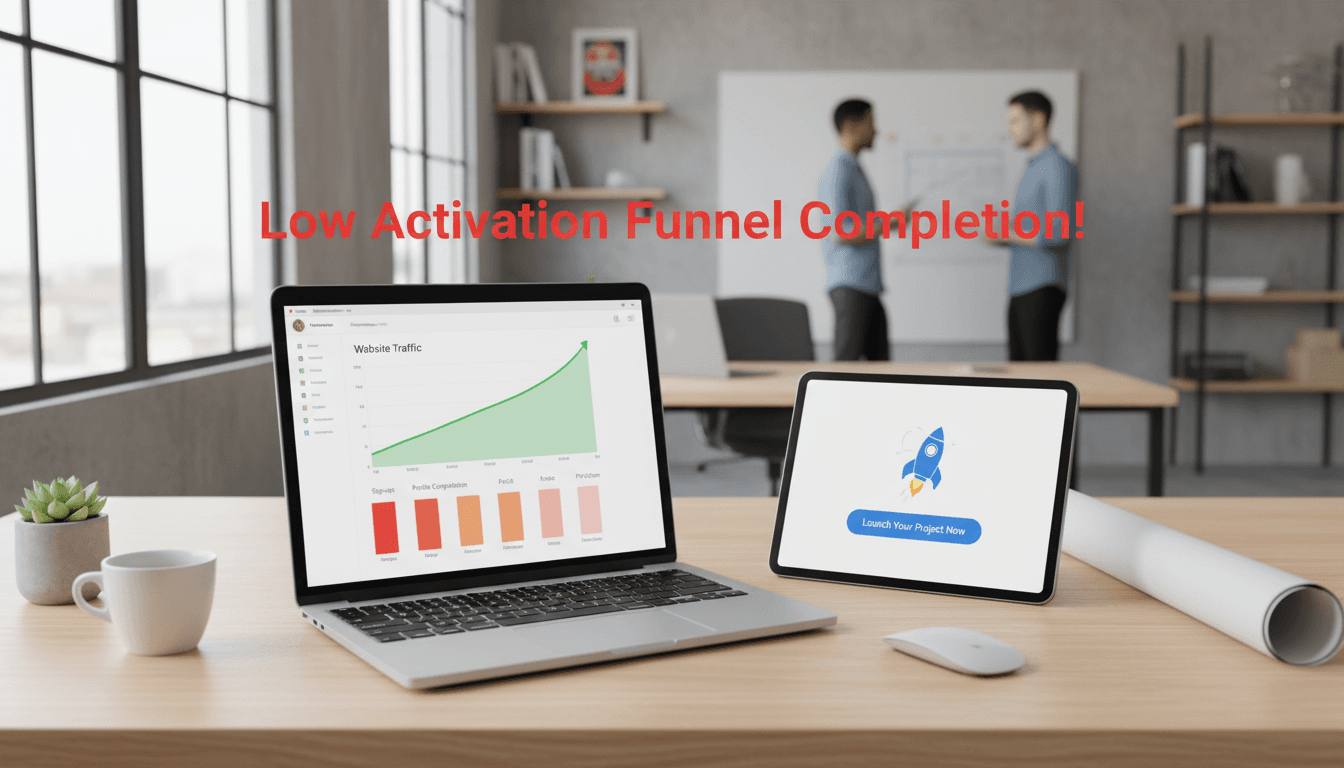
160 visitors from LinkedIn outreach feels like momentum—until you open analytics and realize almost nobody did the thing.
That “traffic came, activation didn’t” moment is one of the most useful wake-up calls a bootstrapped founder can get. In the US Startup Marketing Without VC world, you don’t have the luxury of buying your way out of an activation problem. If your onboarding doesn’t create a fast, obvious win, every new click is just another expensive distraction.
Here’s a practical way to think about activation (and fix it) based on a recent Indie Hackers post-launch lesson: traffic proved curiosity, but activation proved comprehension. The gap isn’t solved with more content, more outreach, or a prettier homepage. It’s solved by engineering a first experience that makes people say: “Oh—this is for me.”
Traffic is a weak signal; activation is the real one
Traffic measures interest in your hook. Activation measures whether your product makes sense. Those are different problems.
A lot of bootstrapped startup marketing advice quietly assumes the product is already self-explanatory. In reality, most early SaaS products aren’t. They’re new, a little sharp, and often described with vague positioning (“AI-powered”) that sounds impressive but doesn’t tell a user what they should do next.
Here’s the hard stance: If users don’t understand the value in the first 10–30 seconds, your marketing is doing its job and your product isn’t.
What makes this worse in January 2026 is the current market condition: “AI-powered” has become background noise. People have seen too many tools promise magic and deliver prompts. So users arrive skeptical, scan quickly, and leave faster than you think.
Curiosity vs. comprehension (why visitors bounce)
A useful mental model:
- Curiosity gets the click (your LinkedIn message, your tweet, your SEO page).
- Comprehension creates activation (the visitor immediately knows what to do and why it matters).
- Commitment creates retention (they take an output outside the product: export, publish, reuse).
Most founders over-invest in the first part because it’s visible and feels like progress.
Define activation as a “decision,” not a session
The most predictive activation events force a decision. That showed up clearly in the thread: users who exported/published/reused output outside the product behaved differently than users who just clicked around.
That’s a big deal for product-led growth because it tells you what to optimize:
- “Generated something” can be passive.
- “Reacted / exported / published” is deliberate.
A snippet-worthy rule:
Passive consumption doesn’t predict retention. Small commitments do.
Examples of strong activation metrics for bootstrapped SaaS
Pick one primary activation metric for a given stage:
- First publish/export (content tools, reporting tools)
- First share/invite (collaboration tools)
- First integration connected (B2B workflow tools)
- First file created + saved (creator tools)
- 3 meaningful interactions (news/curation tools where “reaction” predicts return)
If you’re marketing without VC, don’t track 12 activation events early. Track one that correlates with return sessions.
Engineer a first win in under 60 seconds (without fake hype)
Activation improves when the first experience produces a visible result quickly. Not a tour. Not a checklist. A result.
In the Indie Hackers discussion, multiple founders converged on the same fix:
- Show output before asking for setup.
- Pre-populate examples to avoid the empty dashboard.
- Reduce choices at the start.
- Use a single CTA tied to an outcome.
Fix the “empty state → exit state” problem
Blank dashboards are polite, but they’re deadly. They create uncertainty:
- “Did I sign up correctly?”
- “What am I supposed to type?”
- “What does ‘good’ look like?”
Better options:
- Pre-filled example project (high trust, lowest friction)
- Sandbox mode (lets users play without commitment)
- Template-first onboarding (choose 1 default template, not 12)
- Tease mode (show partial output, blur the rest until a tiny action)
“Tease mode” works because it flips the user’s mental state from skepticism (“does it work?”) to desire (“I want the rest of that”). If you use it, be honest—don’t blur things that don’t exist.
Use “Edit-to-Claim” to create ownership
A smart trick mentioned in the thread is Edit-to-Claim:
- You show a high-quality, pre-generated output.
- The user must make a tiny edit (rename, pick a goal, tweak a parameter) to unlock export/publish.
This isn’t gimmicky when done right. It’s a way to reduce anxiety while still creating participation.
The real activation killer: uncertainty after the output
A surprising pattern in the conversation: users often didn’t leave immediately. They paused.
They scrolled. They hovered. They generated again.
That usually means the output was fine, but the user didn’t know what to do next.
Here’s the thing about bootstrapped startup marketing: you can’t assume your users are marketers. Even if your SaaS generates “publish-ready” content, many users still need decision guidance:
- Where should I publish this first?
- What’s the fastest win?
- What does success look like in week one?
Add post-output guidance (not mid-flow interruptions)
A high-leverage approach discussed in the thread is idle-based prompts after value appears.
Mechanism:
- User generates output.
- You show a micro-confirmation: “This is publish-ready.”
- If they go “stuck-idle” for ~8–10 seconds, you prompt a next step.
This matters: don’t trigger guidance when they’re reading. Trigger it when they’re uncertain.
Reading-idle vs. stuck-idle (practical definition):
- Reading: scrolling, selecting text, copying, highlighting.
- Stuck: cursor static, no interaction, repeated hover patterns.
Treat onboarding like a sales conversation: you speak when the other person hesitates, not when they walk in the room.
A simple publish → repurpose loop (works for content SaaS)
If your product outputs content (SEO/AEO, local posts, FAQs, social snippets), a clean “first win” loop is:
- Publish one thing today (lowest effort, fastest gratification)
- Repurpose into 2 formats (turn one output into multiple placements)
- Reuse the best snippet (carry it into the next session)
A concrete example of outcome guidance:
- “Post this Google Business update today.”
- “Add this FAQ to your services page next.”
- “Reuse this snippet as a LinkedIn post tomorrow.”
Notice what’s missing: feature explanations.
Message clarity: stop leading with “AI-powered”
Most companies get this wrong. They describe technology instead of outcome.
“AI-powered” tells me how you built it. It doesn’t tell me why I should care.
Outcome-first copy that doesn’t sound like marketing
Instead of:
- “AI-powered content generation for modern teams.”
Try:
- “Generate a publish-ready FAQ for your service page in 60 seconds.”
- “Turn one idea into a blog post + 5 social posts, ready to paste.”
- “Create a client-ready report you can export in one click.”
And then prove it with a raw demo GIF/video above the fold. Founders in the thread were blunt about this: people have marketing fatigue. They trust what they can see.
A 7-day activation sprint (bootstrapped-friendly)
If you’re a US startup marketing without VC, you want changes you can ship fast and measure clearly. Here’s a tight sprint that maps to what worked in the discussion.
Day 1–2: instrument behavior (so you stop guessing)
- Add GA4 events for your activation metric (export/publish/share)
- Add session recordings/heatmaps (e.g., Microsoft Clarity-style tooling)
- Identify top 3 drop-off points
Day 3–4: rebuild the first screen around one job
- Replace feature lists with one outcome
- Add a demo GIF/video above the fold
- Remove extra CTAs (one primary action)
Day 5–6: remove empty states
- Pre-populate a real example
- Or add sandbox mode
- Or add template-first onboarding (one default)
Day 7: add post-output next-step guidance
- Micro-confirmation (“publish-ready”)
- Idle trigger at 8–10 seconds (stuck-idle only)
- One next step (“Publish this”) + one secondary (“Repurpose this”)
A measurable target for early-stage SaaS:
Cut time-to-first-win to under 60 seconds, and increase first value action completion by 20–30% before spending on more traffic.
Even if you don’t hit those numbers immediately, that’s a sane benchmark to work toward.
People also ask: “Should I drive traffic if activation is low?”
Yes, but only in controlled bursts.
If activation is weak, small traffic pushes are still useful because they create learning cycles. The mistake is scaling acquisition before onboarding makes sense.
A practical rule:
- If you can’t explain why users churn after session one, don’t scale traffic.
- If you have a clear hypothesis (e.g., “users stall after output”), run small bursts to validate fixes.
That’s how bootstrapped startup marketing stays efficient.
Where this fits in US Startup Marketing Without VC
This whole lesson is a reminder that organic growth isn’t just “get more visitors.” Organic growth is get more visitors who become users.
If you’re building without venture capital, activation is your force multiplier:
- Better activation makes every channel cheaper.
- Better activation makes content marketing compound faster.
- Better activation gives you cleaner customer feedback.
Traffic is attention. Activation is understanding. Retention is habit.
If your analytics are telling you “traffic came, activation didn’t,” you’re not failing. You’re being handed your next sprint.
What’s the single “decision action” in your product that proves a user got value—and how fast can you get them there?