AI-powered digital twins are quietly slashing waste, downtime, and emissions in factories. Here’s how they turn existing plants into powerful green technology engines.
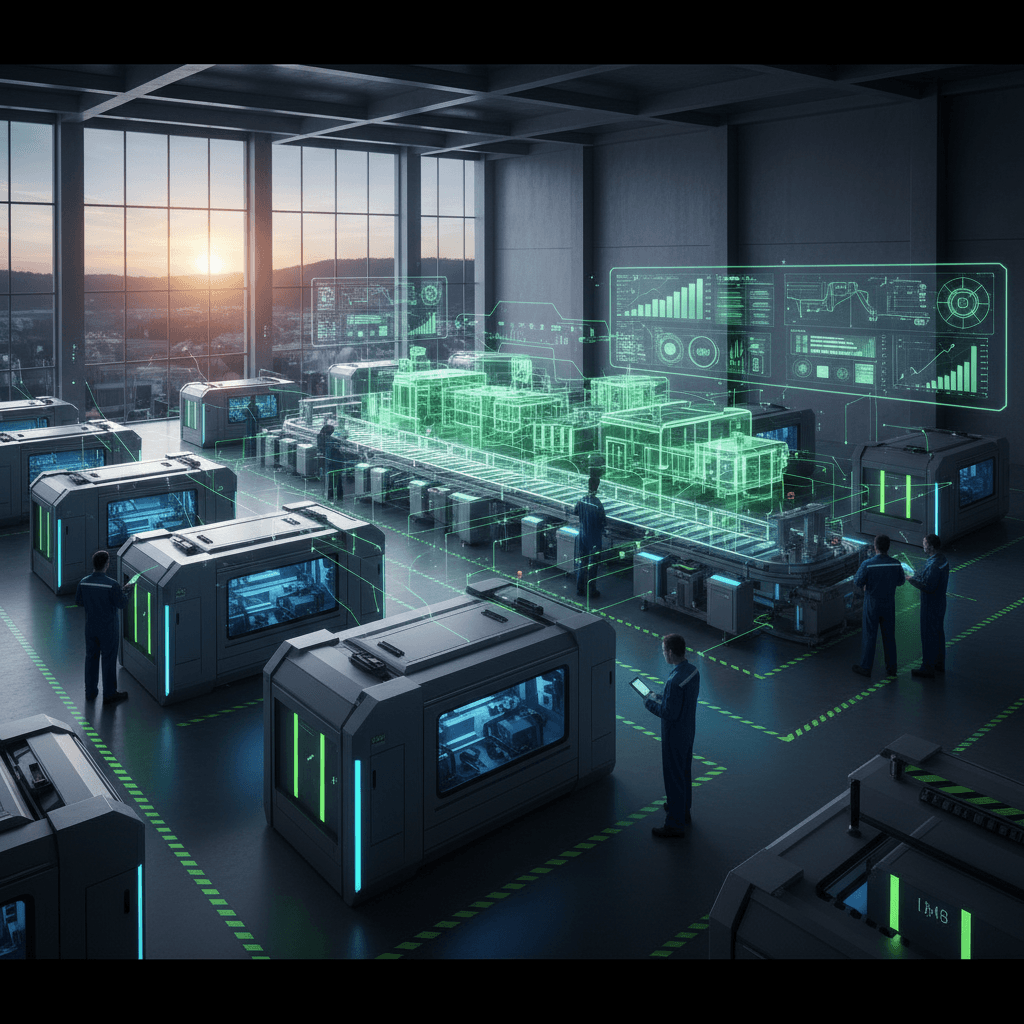
Most factories waste between 20% and 40% of their potential output through downtime, scrap, and inefficient changeovers. That isn’t just bad for margins; it’s brutal for the planet.
Every unnecessary machine start‑up, every rejected batch, every hour of idling equipment burns energy, materials, and money. The good news: AI-powered manufacturing is one of the fastest ways to cut industrial emissions while boosting profit—not a future fantasy, but something large plants are already doing at scale.
This article looks at how AI, digital twins, and real‑time data are transforming factories into green technology platforms: cleaner, leaner, and far more resilient.
AI in manufacturing is a climate strategy, not just an efficiency play
AI in manufacturing isn’t only about speed or automation. The same tools that remove bottlenecks and reduce downtime also shrink your carbon footprint:
- Fewer defects = less scrap, rework, and wasted materials
- Shorter changeovers = fewer energy-intensive warmups and restarts
- Predictive maintenance = fewer catastrophic failures and emergency production
- Optimized process settings = lower energy use per unit produced
Reports from industry and early adopters show that around 50% of manufacturers now deploy AI in production, with large companies (over $10B in revenue) leading the pack. I’d argue those numbers will climb quickly—not just because AI works, but because sustainability targets and regulatory pressure leave very little alternative.
Here’s the thing about “green tech” in heavy industry: installing solar panels on the roof helps, but optimizing how every motor, oven, conveyor, and compressor runs helps far more, and at scale.
Digital twins: the missing link between data and decarbonization
Digital twins are becoming the control room for sustainable manufacturing.
A digital twin is a high‑fidelity virtual model of a machine, line, process, or even an entire factory. When it’s paired with AI, that twin doesn’t just show what’s happening—it predicts what will happen and recommends changes.
What an AI manufacturing twin actually looks like
A mature digital twin pulls together three layers of data into a single operational view:
- 1D telemetry: sensor readings from the shop floor (temperature, vibration, speed, torque, flow, etc.)
- 2D business data: orders, schedules, energy prices, maintenance history, quality results
- 3D spatial context: a virtual representation of machines, conveyors, operators, and flows across the line or factory
In practice, that means a supervisor can see:
- Which filler valve on a bottling line is causing micro‑stops every 12 minutes
- How those stops affect throughput, energy usage, and on‑time delivery
- What would happen to output and energy per unit if they adjust speed, temperature, or maintenance intervals
As one manufacturing CTO put it, AI-powered digital twins move plants from isolated monitoring to system‑wide insight. Instead of chasing alarms on individual machines, teams see the whole system in context.
How digital twins cut waste and emissions in real factories
A bottling plant is a great example. Many high‑speed operations can experience effective downtime rates of up to 40%, once you factor micro‑stops, speed losses, quality issues, and changeovers.
With a digital twin of the line:
- AI tracks micro‑stops down to fractions of a second
- Quality metrics are tied directly to process conditions at the time of fill or cap
- Energy meters feed into the model to calculate kWh per good bottle, not just per hour
From there, the twin can recommend or simulate:
- Running at a slightly lower speed that reduces micro‑stops but improves total output
- Adjusting temperature or pressure to widen the process “sweet spot” with fewer rejects
- Re‑sequencing jobs to reduce product changeovers and cleaning cycles
Every one of those improvements has a direct decarbonization effect:
- Fewer stops and restarts mean lower peak loads and fewer energy spikes
- Less scrap means reduced embodied carbon in wasted materials and packaging
- Smarter changeovers mean less water and chemical use for cleaning
The reality? Most plants don’t need more hardware to start this journey. They need to use their existing data with an AI layer that focuses on energy and yield, not just maintenance.
From reactive firefighting to proactive, low‑carbon operations
Traditional factory operations are reactive. Something breaks or quality drifts, alarms go off, and teams scramble. That mode of working guarantees unnecessary waste.
AI changes the operating model by shifting factories to predictive, system‑level decisions.
Predictive maintenance that actually saves emissions
Predictive maintenance is often sold as a reliability or cost play, but it’s also a sustainability tool.
When AI models detect early signs of failure—say, a motor drawing a few extra amps or a compressor running hotter than baseline—you can:
- Schedule interventions during planned downtime, avoiding emergency restarts
- Replace components before they degrade efficiency (e.g., worn bearings, fouled heat exchangers)
- Avoid running equipment far outside optimal ranges that burn excess energy
An emergency line crash is usually the dirtiest way to run a factory: scrap builds up, rework piles, and backup lines start and stop repeatedly.
System‑wide optimization beats local tweaks
Most companies get this wrong. They optimize individual machines—“make press #3 faster”—without checking what that does to the whole line.
AI-powered twins take a different view:
- They calculate true bottlenecks across machines and processes
- They quantify trade‑offs between speed, energy, and quality
- They surface changes that improve the total system, not just one asset
For example, slowing one machine by 5% might:
- Reduce jams and micro‑stops downstream
- Cut compressed air consumption by 10%
- Improve yield so much that total output and total emissions per unit both improve
This is why I see AI in manufacturing as core green technology, not a side project. It forces decisions at the system level, where sustainability and productivity finally align.
Practical roadmap: how manufacturers can start using AI for greener operations
There’s a better way to approach AI in manufacturing than “let’s install some algorithms and see what happens.” The plants that are winning on both cost and carbon tend to follow a clear path.
1. Start with one line, one objective, and real numbers
Pick a single line or process and choose one measurable objective that has both business and sustainability impact, such as:
- Reduce scrap rate by 20%
- Cut unplanned downtime by 30%
- Lower kWh per good unit by 10%
Then:
- Map available sensors, PLC data, MES/ERP data, and energy meters
- Build a basic digital twin focused on that line (even a partial model is fine early on)
- Train AI models on historical and live data to detect patterns related to your objective
The goal is to prove value quickly—ideally within a quarter—so you can unlock investment and internal support for a broader rollout.
2. Integrate energy and emissions from day one
If you only optimize for speed, you’ll get speed.
Build energy and emissions metrics into the twin and dashboards from the start:
- Track kWh, gas, steam, compressed air use by line and product
- Convert those into CO₂e per good unit using your utility emissions factors
- Display cost and carbon side by side with throughput and OEE
Once operators and managers see how process changes affect both cost and carbon, decisions start to shift. People hate waste. You simply need to show them what waste looks like in energy and emissions terms.
3. Scale from pilot to factory, then to network
After you’ve proven gains on one line, you can:
- Extend the digital twin to adjacent lines and shared utilities
- Reuse AI models and best‑practice logic on similar equipment
- Standardize playbooks: “If we see X pattern, we do Y intervention”
For multi‑site manufacturers, the real upside comes when you:
- Benchmark lines and plants on energy per unit and yield, not just volume
- Share models and settings between plants making similar products
- Use AI at the enterprise level to plan production where it’s most efficient and least carbon‑intensive
At that point, your manufacturing network becomes a distributed green technology platform: you’re continuously shifting work to the cleanest, most efficient configurations.
Common pitfalls—and how to avoid wasting time and budget
Not every AI project in manufacturing translates into greener operations. Some end up as expensive dashboards nobody uses. Here’s what usually goes wrong.
Mistake 1: Starting with tech, not problems
If the brief sounds like “We need AI and digital twins,” the project’s already in trouble.
Better framing:
- “We lose $12M a year in scrap on these three lines and want to cut that in half.”
- “We want to reduce our Scope 1 and 2 emissions by 25% by 2030; what can we do inside the plant?”
Then you let AI, digital twins, and IIoT be tools, not the goal.
Mistake 2: Ignoring operators and maintenance teams
I’ve seen technically brilliant solutions die because the people on the floor didn’t trust them or couldn’t act on them. If AI spits out recommendations that don’t fit how the plant runs, they’ll be ignored.
Involve:
- Operators in validating what the model calls a “bottleneck” or “anomaly”
- Maintenance teams in setting thresholds and recommended interventions
- Process engineers in tuning optimization targets so quality and safety never get compromised
The best AI systems in factories feel like augmented intuition for the people who already know the line inside out.
Mistake 3: Treating sustainability as a separate project
Sustainability teams sitting in a different building, working in Excel, can’t fix plant performance alone.
Instead, connect the dots:
- Include CO₂e per unit and energy intensity in KPIs for manufacturing leadership
- Tie part of performance bonuses to both cost and emissions reductions
- Ensure AI projects report results in dollars and tons of CO₂e saved
When sustainability shows up in the same charts and meetings as throughput and OEE, it stops being a side conversation.
Why AI‑driven factories belong at the center of your green tech strategy
If your organization has climate targets, AI‑enabled manufacturing shouldn’t be a “nice to have.” It should sit right beside renewable energy, electrification, and circular design as a core pillar.
Here’s why:
- Manufacturing is data‑rich and under‑optimized—perfect for AI
- Every 1% gain in yield or uptime often translates to direct CO₂e reductions
- Digital twins and IIoT infrastructure create a foundation for future green tech, from flexible production for low‑carbon materials to demand‑response energy management
Factories don’t become sustainable by accident. They get there by making thousands of smarter micro‑decisions every week. AI, digital twins, and real‑time analytics make those decisions visible, comparable, and repeatable.
If your plants are already capturing data but mostly using it for reports and alarms, you’re sitting on untapped green technology. The next step is straightforward:
- Pick one line, one objective, and a short time horizon
- Build a simple AI‑informed twin around it
- Measure improvements in both cost and carbon, then scale what works
The manufacturers that move first will hit their climate targets and outcompete on cost. Those that wait will end up buying carbon credits while running inefficient plants. Which side your company lands on is a choice you can start changing this quarter.