FIRST Global’s robotics challenge shows how AI talent is built: teamwork, reliability, sustainability themes, and mentorship under real constraints.
Global Robotics Challenge: Where AI Talent Is Made
A robotics match lasts 2 minutes and 30 seconds at FIRST Global—and that’s long enough for a team’s strategy, engineering choices, and calm under pressure to show up in public.
In October, students from 191 countries gathered in Panama City for the FIRST Global Robotics Challenge. On paper, it’s a competition: ranking matches, playoffs, alliances, medals. In practice, it’s a live demo of how the future of AI and robotics will actually be built: internationally, under real constraints, with people who can collaborate across teams and time zones.
This matters for anyone following our Artificial Intelligence & Robotics: Transforming Industries Worldwide series because the same patterns that win student robotics matches—tight iteration cycles, human-machine teamwork, reliability engineering, and mentor-driven skill transfer—are the patterns that scale robotics in manufacturing, logistics, healthcare, energy, and environmental monitoring.
FIRST Global shows how robotics really works: teamwork under constraints
The quickest way to understand industry robotics is to stop thinking of robots as standalone machines. Think of them as systems: hardware, software, operators, workflows, spare parts, safety rules, and fast decision-making.
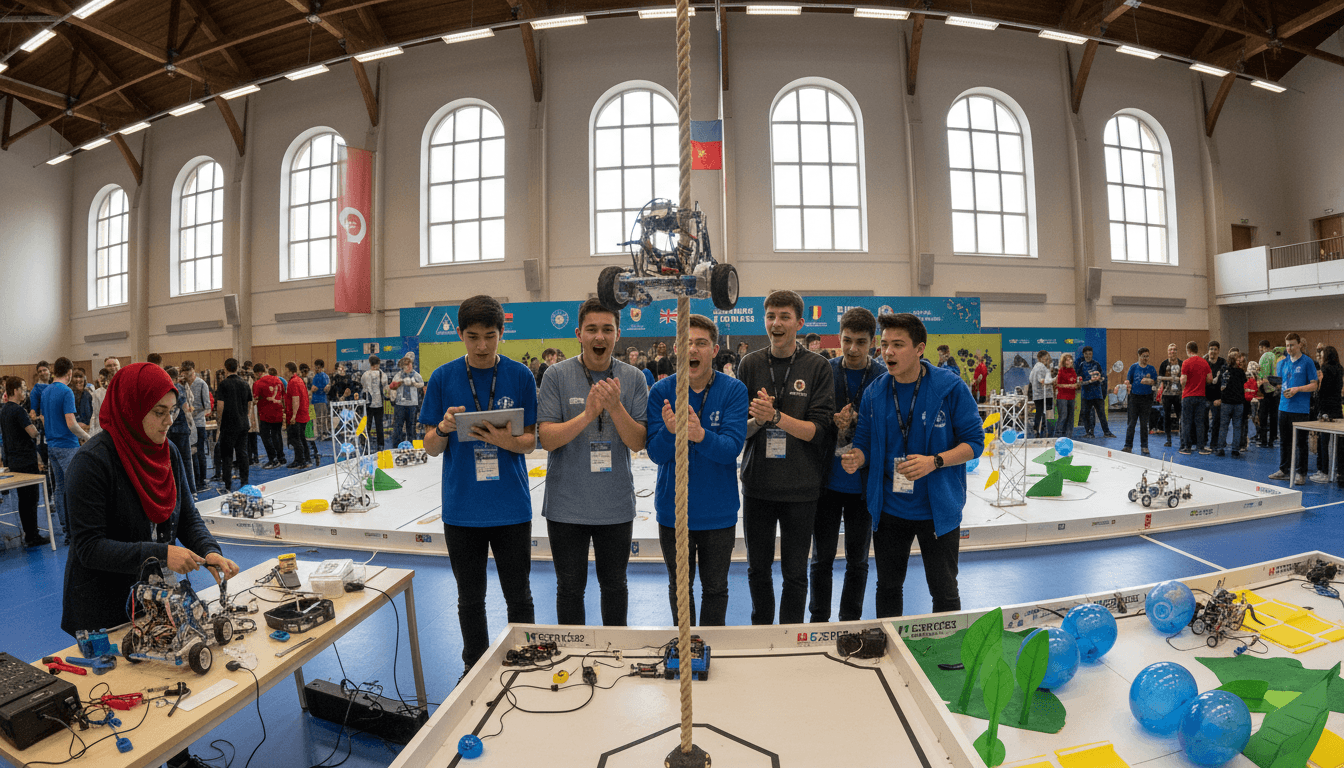
FIRST Global is built around that reality. Each match includes multiple simultaneous objectives: robots collect “biodiversity units” (multicolored balls), clear “barriers” (large gray balls), coordinate with humans to score, and finish by climbing a 1.5-meter rope. Even if a robot is mechanically sound, a weak handoff, a confusing control scheme, or a brittle mechanism can sink the run.
The collaboration model is the most instructive part. Matches place students into two groups, each made up of three teams controlling three separate robots, and they must coordinate to maximize points. There’s even an explicit incentive: if all six robots climb, each team’s score is multiplied by 1.5.
That score multiplier is more than a rule—it’s a lesson. In real deployments, your “score” goes up when the whole cell works: robots, sensors, conveyors, operators, and software. A single subsystem failure drags down throughput.
What business leaders should steal from this format
If you’re building or buying AI-powered robotics for your organization, FIRST Global’s structure offers a blueprint:
- Reward shared outcomes, not local optimization. In warehouses, picking speed means nothing if packing or replenishment bottlenecks.
- Design for interoperability. Teams must coordinate behavior in tight windows—just like mixed fleets of robots and legacy equipment.
- Treat remote operation as a first-class skill. Students remotely operate robots; industry increasingly relies on remote monitoring and teleoperation for edge cases.
In my experience, most robotics programs struggle not because the robot is “bad,” but because the project under-invests in coordination: who intervenes when the robot gets stuck, how exceptions are handled, and how the system recovers.
“Eco-equilibrium” is a preview of sustainability robotics use cases
This year’s theme—“Eco-equilibrium”—centered on preserving ecosystems and protecting vulnerable species. It’s easy to dismiss competition themes as window dressing. I don’t.
Environmental sustainability is becoming a practical driver for robotics adoption. The reason is simple: ecosystems are messy, data is sparse, and labor is expensive or unsafe. Robots (often paired with AI) can collect data consistently, operate in hazardous locations, and scale monitoring across large areas.
Here are sustainability-aligned robotics patterns that map cleanly to what students practiced:
1) Multi-step task chains (like clearing barriers, then scoring)
In conservation and environmental operations, tasks often come in sequences:
- inspect → classify → remove debris
- detect invasive species → confirm → treat
- sample water → analyze → flag anomalies
Robots that can’t handle handoffs between steps don’t deliver outcomes. FIRST Global’s match design forces teams to plan those transitions.
2) Operating in constrained, unpredictable environments
Field robotics—drones over wetlands, rovers in forests, underwater vehicles near reefs—faces uncertainty: wind, water currents, uneven terrain, poor connectivity. Student robots don’t face the same extremes, but they do face real-time unpredictability: collisions, dropped game pieces, mechanical wear, and time pressure.
3) Human-in-the-loop AI is the norm
For high-stakes sustainability work, fully autonomous systems are still the exception. More common is human-in-the-loop autonomy: AI proposes, a human approves; AI navigates, a human intervenes in edge cases. FIRST Global’s remote operation model reinforces the reality that people remain part of the control loop.
“It’s not about winning, it’s not about losing, it’s about learning from others.” — Clyde Snyders, South Africa team
That mindset is exactly what sustainability robotics needs: shared playbooks and open collaboration, because environmental problems don’t respect borders.
The “robot hospital” is the real lesson in reliability engineering
If you want to know whether someone is ready for real robotics work, don’t ask them to build a demo. Ask them to keep a robot running across repeated cycles, under time constraints, when parts fail.
FIRST Global’s robot hospital—where teams debug, swap parts, and get volunteer support—is basically a miniaturized version of field service operations:
- Diagnose the fault quickly
- Decide whether to patch or redesign
- Validate the fix
- Return to operations with minimal downtime
Teams were constantly adding features and fixing issues. One team’s robot was delayed in transit; they used parts from the hospital to build a new robot on-site so they could compete. Others struggled with the rope climb mechanism—an intentionally stressful subsystem, because climbing exposes control, torque, friction, and structural weaknesses.
Industry parallels are direct:
- A factory robotics cell needs spare parts strategy and tooling access.
- A hospital robot fleet needs maintenance windows and predictable recovery.
- A warehouse automation team needs incident response and clear ownership.
Reliability isn’t glamorous, but it’s where robotics ROI lives or dies.
Practical takeaways for companies adopting robotics
If your organization is serious about AI robotics in production, borrow these operational habits from the robot hospital:
- Create a “pit crew” process. Define roles, triage steps, and escalation paths before launch.
- Standardize components where possible. The more unique your robot, the harder the spare parts story becomes.
- Instrument everything. Logs, fault codes, battery health, motor current, temperature—diagnostics reduce downtime.
- Measure mean time to recovery (MTTR). Fast recovery matters as much as mean time between failures.
These are the unsexy basics that separate a pilot from a scalable robotics program.
Mentorship is the missing infrastructure in the AI robotics talent pipeline
Robotics competitions create excitement, but excitement alone doesn’t produce a workforce. The bridge is mentorship.
FIRST Global teams are backed by mentors and coaches—often former participants—who teach students to think critically and solve problems. One mentor described staying intentionally hands-off so the robot remains student-built.
That’s an important stance. In industry, the goal isn’t to show that experts can build robots. The goal is to create teams that can learn, iterate, and own systems over time.
A recurring bottleneck in robotics education is simple: not enough mentors. And when mentorship is missing, the skills gap shows up later as:
- poor systems thinking (hardware/software integration)
- weak testing discipline
- shaky troubleshooting
- limited safety awareness
Mentoring also has a lead-generation implication for companies in AI and robotics: the organizations that invest early in community robotics ecosystems tend to become the employers, partners, and vendors that local talent trusts.
How to support robotics talent—without starting a huge program
You don’t need to sponsor a national initiative to make a difference. Here are high-impact, realistic moves:
- Offer 2 hours/week as a technical mentor (controls, CAD, wiring, Python, testing). Consistency beats intensity.
- Run a “design review night” where students present and get feedback—mirrors real engineering practice.
- Donate practical tools and consumables (fasteners, wire, connectors, battery testers), not just flashy parts.
- Host a facility tour so students can see industrial robotics, PLCs, vision systems, and safety cages in context.
In December, a lot of teams are planning spring build seasons. This is a perfect time to step in.
A real-world case study: resilience when Jamaica almost couldn’t arrive
The most memorable engineering lesson sometimes isn’t technical—it’s operational resilience.
This year, Team Jamaica faced severe disruption after Hurricane Melissa struck on 28 October, one day before the competition began. Flights were cancelled, travel was delayed, and the team nearly missed the event. Organizers covered travel costs, and the students arrived on day two—still in time to compete in enough matches to avoid disqualification. They won a bronze medal.
That story lands with business leaders because it mirrors how robotics projects fail in the real world: not due to algorithm quality, but due to logistics, supply chains, and deployment friction.
If you’re deploying robots across sites (or countries), design your plan as if disruption is guaranteed:
- Build contingency inventory
- Qualify multiple suppliers
- Document assembly and calibration steps
- Train for “operate degraded” modes
The students showed up and performed anyway. That’s the kind of talent you want running a robotics rollout.
Why this competition format maps to AI and robotics in industry
FIRST Global isn’t teaching students one narrow skill. It’s teaching the bundle that modern AI robotics requires:
- Systems integration: mechanical + electrical + software under constraints
- Human-robot interaction: remote operation, handoffs, teamwork
- Iterative engineering: fast debugging, incremental improvements, test discipline
- Global collaboration: learning across languages, cultures, and approaches
The playoffs model makes this even clearer. The top 24 teams form six alliances of four teams, and the winning alliance this year included Cameroon, Mexico, Panama, and Venezuela—a cross-border coalition winning as one unit.
That’s also how enterprise robotics is trending: partnerships between integrators, hardware OEMs, AI software vendors, and on-site operations teams. The winners are rarely “solo geniuses.” They’re teams that coordinate.
What to do next if you’re building an AI robotics program
If you’re a company leader, educator, or engineer, treat youth robotics competitions as early signals of where the AI robotics workforce is heading—and as a practical recruiting and partnership channel.
Here’s a simple next-step checklist you can act on in the next 30 days:
- Find or start a local robotics team mentorship connection. If there’s no team, help a school form one.
- Offer a real problem statement. “Reduce downtime,” “improve grasp reliability,” “optimize teleop controls.” Students learn faster with concrete goals.
- Build a reliability-first culture. Celebrate fast recovery and solid testing, not just flashy features.
- Create pathways: internships, job shadowing, project sponsorships, and capstone collaboration.
Our broader series is about how AI and robotics are transforming industries worldwide. FIRST Global shows the human side of that transformation: the engineers are being trained right now, and they’re learning that cooperation is not charity—it’s a performance advantage.
What would change in your robotics roadmap if you treated collaboration, mentoring, and maintainability as core requirements—not optional extras?