AI-powered robots are learning skills faster—through VLA models, RL locomotion, and production humanoids. Here’s what it means for real deployments.
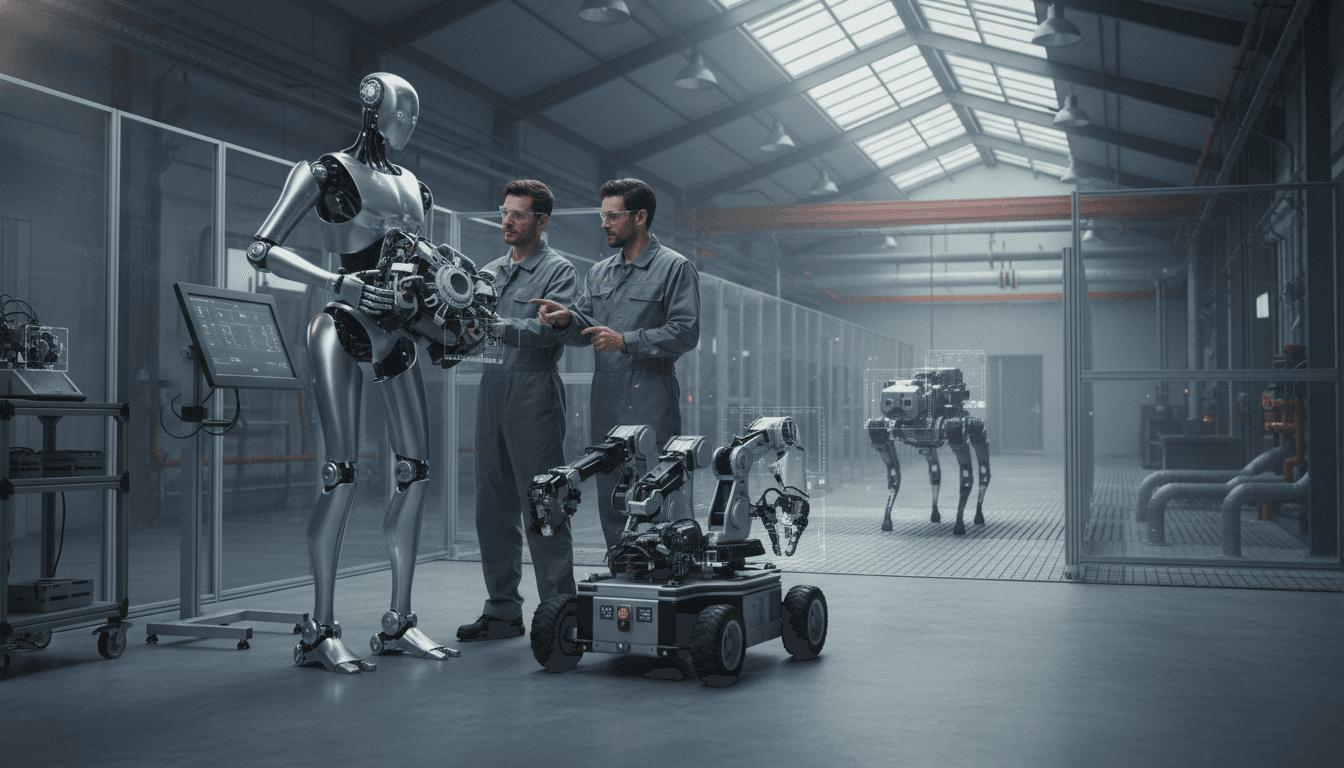
AI Robots Are Learning Skills Faster Than We’re Ready For
Robots used to get “better” the slow way: new motors, stiffer frames, tighter tolerances, more careful programming. Now they’re improving like software improves—weekly, sometimes daily—because the intelligence layer is doing more of the heavy lifting.
That shift is the real story behind this week’s wave of robotics demos: vision-language-action models that turn plain instructions into motion, humanoids that can recover from falls, soft robots that climb walls, and wearable haptics that deliver serious force while staying lightweight. If you’re leading operations, innovation, or product in manufacturing, healthcare, logistics, or field service, this matters for one reason: robot capability is starting to scale faster than robot deployment plans.
This post is part of our “Artificial Intelligence & Robotics: Transforming Industries Worldwide” series. I’ll translate the demos into what they signal for real deployments—what’s ready, what’s close, and what you should do next if your goal is productivity (and not a lab-only science project).
Vision-language-action models are turning “instructions” into work
Answer first: Vision-language-action (VLA) models are shrinking the gap between what you want a robot to do and what it can physically execute, which is the biggest constraint in deploying AI-driven robotics at scale.
Google DeepMind’s Gemini Robotics 1.5 is positioned as a VLA model that takes visual input plus natural-language instructions and outputs motor commands. Two details are especially relevant for industry:
- It “thinks before taking action” and shows its process. That’s not a cute UI feature—it’s a path to safer human-robot collaboration. When a robot can expose intermediate reasoning (what object it recognized, what grasp it intends, what constraint it’s respecting), you get better supervision, faster debugging, and clearer safety validation.
- It “learns across embodiments.” Translation: skills are less tied to a specific robot model. If that holds up in the field, it reduces the re-training tax that has kept many robotics programs small.
Where VLA helps first: the last 20% of automation
Most factories already automated the easy stuff: repetitive, tightly constrained tasks. The remaining value is in messy, variable work—kitting, changeovers, rework, inspection exceptions, and mixed-SKU handling.
VLA approaches are promising because they blend:
- Perception (what’s in front of the robot)
- Language (what humans mean when they give instructions)
- Action (how to move in a physically feasible way)
That trio is exactly what you need for:
- Warehouse exception handling: “Pick the damaged box, set it aside, and re-label the rest.”
- Healthcare support tasks: “Bring the patient’s kit, but don’t disturb the sterile field.”
- Light manufacturing & assembly assistance: “Hold this part steady while I fasten it.”
My stance: the winners won’t be the teams that chase general intelligence. They’ll be the teams that constrain the problem—define allowed tools, define safe zones, define acceptable uncertainty—and then let VLA fill in the variability.
A practical checklist for deploying VLA robots safely
If you’re evaluating AI robotics platforms that promise “instruction following,” use these questions to separate demos from deployable systems:
- What happens when confidence is low? Does the robot pause, ask for clarification, or guess?
- Can it explain its intent in plain language? Operators need to understand what it plans to do.
- How are safety constraints enforced? Model output should be filtered by hard safety layers (speed limits, forbidden zones, force thresholds).
- How quickly can you add a new task? If it still takes weeks of engineering, you’re not getting the real benefit.
Intuitive human-robot interaction is a deployment multiplier
Answer first: The fastest route to ROI in service robotics is often better interaction design, not better hardware.
A short clip described as a simple “force pull” gesture bringing a robot (Carter) directly into someone’s hand is a perfect illustration of an underrated truth: operators adopt robots when the robot feels like an extension of intent.
In the real world, you don’t get to script every situation. A nurse has one free hand. A warehouse associate is moving quickly and can’t tap through menus. A technician is wearing gloves and hearing protection.
Good interaction design for AI-powered robotics tends to share a few traits:
- Low cognitive load: simple gestures, obvious confirmation signals
- Fast correction: the human can interrupt or redirect immediately
- Shared control: robot autonomy when it’s confident; human guidance when it’s not
What this means for logistics, retail, and hospitals
If you’re deploying mobile robots, collaborative arms, or humanoids in human spaces, treat interaction like a core spec.
A good internal requirement looks like:
- “A new operator can become productive in 30 minutes.”
- “Any action must be interruptible in <250 ms with a physical cue.”
- “Robot intent is visible from 5 meters away via posture/lights/motion, not a tablet screen.”
That’s how you avoid the common failure mode: a robot that technically works, but only when the one trained specialist is on shift.
Mobility is splitting into two futures: humanoids and soft robots
Answer first: The most useful robots in unstructured environments will come from two directions—humanoids that use human spaces as-is, and soft/bioinspired machines that go where rigid robots can’t.
This week’s clips show both trajectories.
Humanoids: recovery, stability, and production readiness
Unitree’s G1 “antigravity” mode—described as improved stability under any action sequence and quicker get-up after falling—points at a key requirement for real deployments: resilience beats elegance.
A humanoid in a warehouse or facility will eventually:
- get bumped
- slip on debris
- misstep on a threshold
- experience payload shifts
The question is not “will it fall?” but “how safely does it fail, and how quickly does it recover?” Fast, controlled recovery reduces downtime and reduces the need for human intervention.
Kepler Robotics’ K2 Bumblebee being described as entering mass production is another signal worth watching. Whether or not any one vendor’s architecture dominates, the important industry change is this: humanoids are moving from prototype scarcity to unit economics. When availability rises, pilots proliferate, and the market gets honest about what humanoids are actually good at.
Here’s where I think humanoids make sense first:
- Material handling in human-built spaces: tote movement, cart pushing, simple pick-and-place
- Night shift facility tasks: patrol, basic checks, moving supplies
- Highly variable sites: contract logistics, pop-up operations, retrofit-heavy plants
And where they’re still a stretch:
- high-speed precision assembly
- tasks requiring sustained high force without external tooling
- environments with strict cleanliness requirements unless specifically designed for it
Soft robots: origami locomotion for walls and tight spaces
A soft robot developed by researchers at the University of Michigan and Shanghai Jiao Tong University uses an origami structure to crawl and climb vertical surfaces, while maintaining accuracy usually associated with rigid robots.
Soft robotics is often dismissed as “cool but weak.” That’s outdated. The value proposition is clear:
- Conform to the environment instead of forcing the environment to conform to the robot
- Safer contact with people and delicate objects
- Access to tight, cluttered, or irregular spaces
In industrial terms, think:
- inspection inside ducts, tanks, or ship hulls
- infrastructure maintenance where magnets/suction aren’t reliable
- disaster response where surfaces are unpredictable
Soft robots won’t replace humanoids. They’ll fill the gap where legs and wheels fail.
Reinforcement learning is finally earning its keep outside the lab
Answer first: Reinforcement learning (RL) is shifting from brittle, reward-tuned demos to more general controllers by using priors from imitation—an approach that’s much more deployable.
ETH Zurich’s RSL group describes a hierarchical RL framework where a low-level policy is pretrained to imitate animal motions on flat ground, creating motion priors. Then the system generalizes to complex terrains on a real ANYmal-D quadruped.
This matters because classic RL in robotics has had two practical problems:
- Reward tuning is labor-intensive. You end up “teaching to the test,” and the robot learns weird tricks.
- Generalization breaks. It performs well in the lab and struggles in the messy world.
Animal-motion priors are a smart compromise: you’re not hand-coding every behavior, but you’re also not letting the policy wander into unsafe or inefficient movement patterns.
Where legged robots become economically rational
Quadrupeds like ANYmal aren’t for every site. But there are domains where wheels can’t compete:
- Energy and utilities: stairwells, grated floors, uneven terrain
- Construction: temporary structures, rubble, rebar, mud
- Large facilities: outdoor-to-indoor transitions, curbs, drainage channels
If you can reduce falls, reduce teleoperation, and improve navigation reliability, the economics flip. The robot becomes a predictable labor unit, not an R&D project.
Wearable haptics and “novelty” consumer robots signal a bigger trend
Answer first: Human augmentation and consumer experimentation are pressure-testing interfaces and mechanics that enterprise robotics will borrow next.
Two quick but meaningful signals:
- Kinethreads, a full-body haptic exosuit design using string-based motor-pulley mechanisms, is described as under 5 kg, quick to wear (under 30 seconds), relatively low cost (about $400), and capable of up to 120 newtons of forceful effects. That combination—lightweight, fast don/doff, and meaningful force—points to near-term applications in training, teleoperation feedback, rehabilitation, and human-in-the-loop robot control.
- Robot vacuums entering a “differentiation through novelty” phase is funny, but instructive. Consumer robotics is a ruthless product arena: if a feature doesn’t translate into daily value, it dies. The survivors—better mapping, better obstacle handling, better self-maintenance—often become expectations in enterprise mobile robots later.
A quick “People also ask” reality check
Are humanoid robots ready for factories in 2026? For select tasks, yes—especially material movement and simple manipulation in human spaces. For high-speed precision lines, dedicated automation is still more reliable.
Will VLA models replace robot programming? They’ll reduce it, not remove it. The winning setup is natural-language tasking plus strong guardrails: fixtures, constrained workspaces, and safety policies.
What’s the biggest risk with AI-driven robotics deployments? Mismatch between demo conditions and real operations: lighting, clutter, shift variability, maintenance, and operator turnover. Pilots need to be designed to expose those issues early.
What to do next if you’re buying, building, or piloting
Answer first: Treat AI robotics like an operations change program, not a gadget purchase.
If your organization wants leads, savings, or measurable throughput improvements from robotics automation, here’s what works in practice:
- Start with a “task cluster,” not a single task. Example: receiving → pallet breakdown → put-away exceptions. Robots earn ROI when utilization stays high.
- Instrument the environment. Add fiducials, lighting control, standardized totes, or simple fixtures. A small capex here beats months of model tweaking.
- Demand recovery behaviors. “What does the robot do when it drops an item, loses localization, or meets an unexpected obstacle?” is the question that matters.
- Plan for Robotics as a Service (RaaS). If you can treat robots like an operating expense with service-level commitments, adoption speeds up—especially for multi-site companies.
- Build operator trust intentionally. Train on “interrupts,” “safe stops,” and “handoffs” more than on happy-path operation.
The companies that win with AI-powered robotics don’t chase full autonomy. They engineer reliability—and let autonomy expand inside that box.
Robotics is getting better at learning skills on the fly, but industry adoption will still come down to basics: safety, uptime, maintainability, and whether humans actually like working with the machine.
If you’re planning your 2026 roadmap, the most productive question isn’t “Which robot is most advanced?” It’s this: Which workflow will benefit the most from a robot that can perceive, understand instructions, and recover from mistakes without calling an engineer?
Featured events worth tracking in 2025 (for serious buyers)
Robotics progress is often easiest to evaluate in person. If you’re building a pipeline of vendors and research partners, these conferences and competitions are where capabilities show up first:
- CoRL 2025 (Seoul)
- IEEE Humanoids 2025 (Seoul)
- World Robot Summit (Osaka)
- IROS 2025 (Hangzhou)
The strongest teams bring more than flashy locomotion videos. They bring failure cases, metrics, and deployment stories. That’s the bar to use.