Inside Hyundai’s EV Metaplant: how AI logistics, robots, and human craftsmanship combine to cut cost and boost quality in modern manufacturing.
AI and Robotics Inside Hyundai’s EV Metaplant
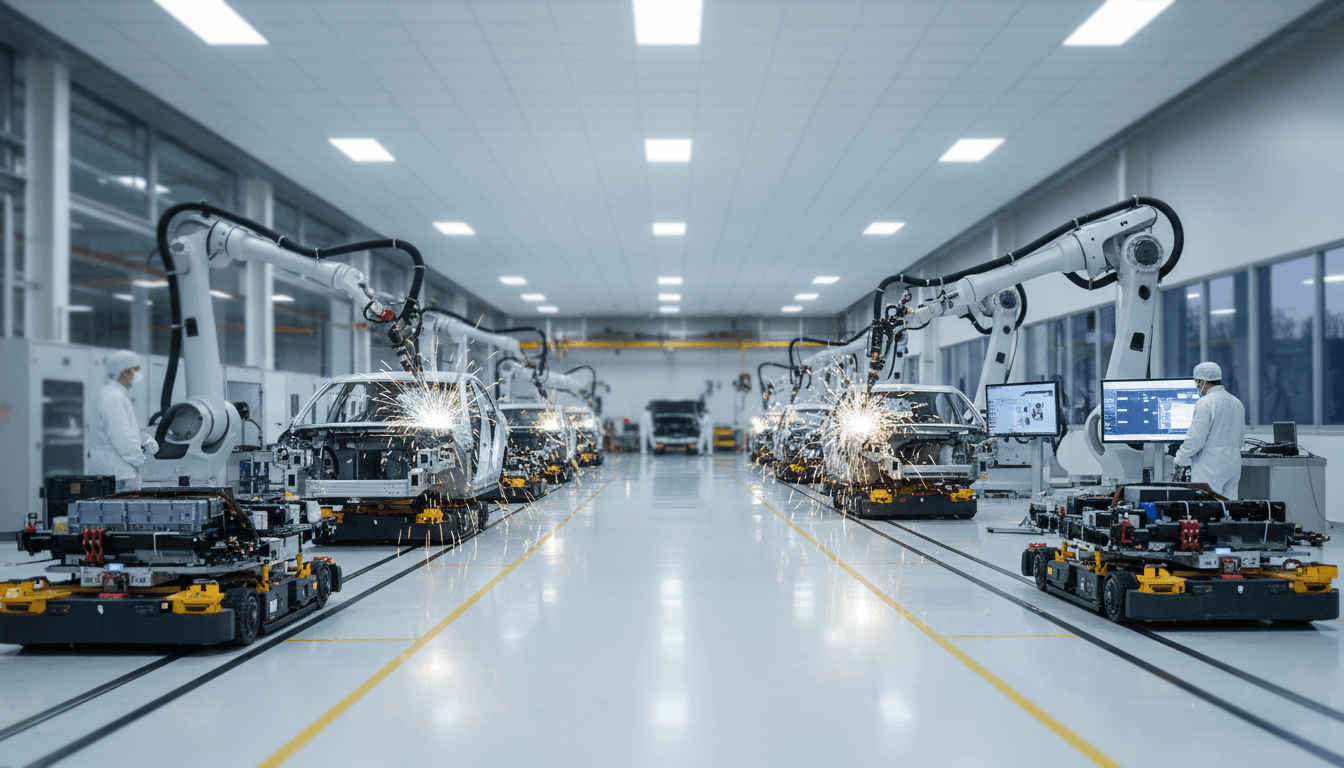
A modern auto plant doesn’t look like the factories many people still picture. At Hyundai Motor Group’s Metaplant in Ellabell, Georgia, you can walk through massive production halls and see surprisingly few people—because hundreds of robots and automated guided vehicles (AGVs) are doing the hauling, welding, measuring, and moving.
Hyundai’s bet is straightforward: if EV demand is choppy, incentives are shrinking, and trade policy is unpredictable, then manufacturing has to get dramatically more efficient. The Metaplant is a case study in what that efficiency looks like when you commit to AI-driven automation end-to-end: parts arrive, get unloaded, routed, staged, installed, validated, and tested with minimal human touch.
This post is part of our “Artificial Intelligence & Robotics: Transforming Industries Worldwide” series, and I’m using Hyundai’s facility as a practical lens for a bigger question manufacturing leaders are dealing with in late 2025: How do you scale automation responsibly—without betting the company on hype or hollow ROI?
Why Hyundai’s Metaplant matters for AI-powered manufacturing
Hyundai’s Metaplant matters because it shows what happens when AI and robotics aren’t treated as a pilot project, but as the operating system for a factory. The plant is positioned as Hyundai’s most automated in North America and among its most advanced globally.
The numbers alone tell you what kind of operating model Hyundai is building:
- $12.6 billion total Hyundai investment in Georgia (including EVs and batteries)
- $4.3 billion battery joint venture with LG Energy Solution, targeting cell production in 2026
- 500,000 vehicles per year potential capacity
- 8,500 direct jobs projected (plus 7,000 satellite workers)
- Roughly 1,340 workers were enough to keep two EV models flowing down the line during early operations
- Average pay reported around $58,100, about 35% higher than the local county average
This matters for anyone tracking industrial automation trends because it’s a real-world example of a shift that’s already underway across sectors: the constraint isn’t “Can we automate?”—it’s “Can we automate fast enough to stay cost-competitive?”
The real backbone: AI logistics, AGVs, and “no-wait” material flow
The most underrated application of AI in manufacturing isn’t a humanoid robot. It’s logistics orchestration.
At the Metaplant, a large fleet of AGVs moves parts across the factory floor without tracks, coordinating with an AI-based procurement and logistics system designed for just-in-time delivery. In plain terms, that means the factory spends less time (and floor space) storing inventory and more time building cars.
What’s actually happening on the floor
From the RSS description, the flow is striking:
- Trucks arrive at docks.
- Robots unload parts.
- AGVs pick, stage, and deliver components to the right workstation.
- Vehicles themselves can be lifted and moved by AGVs that grip the wheels and ferry cars to the next step.
This kind of system changes the economics of throughput. You’re reducing:
- Line starvation (stations waiting for parts)
- Excess staging inventory (parts sitting around “just in case”)
- Manual dispatching (people making constant routing decisions)
A useful way to think about it: AGVs turn the factory into a routing problem. AI turns routing into a continuous optimization loop.
Practical takeaway: start with “material travel” before you automate craftsmanship
If you’re planning your own AI-powered factory upgrade, don’t start by replacing the hardest human tasks. Start by measuring and minimizing material movement:
- Map how far high-volume parts travel from dock to install.
- Identify “traffic jams” (shared aisles, narrow intersections, staging bottlenecks).
- Automate repeatable transport first (AGVs/AMRs), then add AI scheduling once the data is reliable.
This approach typically generates faster ROI than trying to automate complex manual assembly on day one.
Industrial robots plus cobots: where automation is already paying off
The Metaplant’s welding halls reportedly run with hundreds of robots assembling chassis in a highly controlled environment. That’s not surprising—welding has been robot-friendly for decades. What’s more interesting is Hyundai’s focus on robots that handle tasks that used to be “too delicate” or too variable.
Precision installation: doors as the poster child
Hyundai highlights a collaborative robot installing heavy doors—an operation that’s deceptively difficult to do perfectly at high speed without damaging paint or misaligning hinges.
That one task captures why modern robotics is advancing in manufacturing:
- Machine vision verifies position.
- Force/torque control manages contact without scratching or over-tightening.
- Repeatability reduces rework and scrap.
In high-volume production, quality variation is expensive. Robots don’t just reduce labor; they reduce variance, which is often where the real money goes.
“Answer first”: robots win at repeatability; humans win at judgment
Here’s the stance I’ll take: the best plants won’t be fully automated, and they shouldn’t try to be.
Hyundai’s assembly leadership frames it as putting humans on craftsmanship while robots handle repetitive and physically taxing work. That’s the right split because it aligns with how error actually happens:
- People get fatigued doing repetition.
- Robots struggle with edge cases, improvisation, and nuanced fit/finish decisions.
The winning model is human-robot collaboration with clear boundaries: robots do what must be consistent; humans do what must be understood.
“Robot dogs” and the rise of automated quality inspection
Quality inspection is undergoing a quiet shift across manufacturing: moving from end-of-line detection to in-line, sensor-based prevention.
Hyundai’s use of Boston Dynamics’ Spot robots to inspect welds points to a broader pattern: mobile robots collecting inspection data where fixed cameras can’t easily reach.
Why inspection robotics is a big deal
Inspection is a cost center until it isn’t. Once you connect inspection to closed-loop process improvements, it becomes a profit driver:
- Catching weld defects earlier reduces downstream rework.
- Consistent inspection data helps isolate root causes (tool wear, misalignment, inconsistent material batches).
- Automated inspection supports higher uptime because problems are found before they become stoppages.
People also ask: does inspection AI replace quality teams?
No—and plants that try to “AI away” quality usually regret it.
A better operating model is:
- AI flags anomalies (out-of-tolerance patterns, defect clusters, drift over time).
- Quality engineers decide action (adjust parameters, take equipment offline, quarantine lots).
- Maintenance teams execute fixes based on prioritized, data-backed alerts.
AI improves the signal. Humans decide what to do with it.
Humanoid robots in factories: useful, but not for the reasons people think
The Metaplant story also includes Boston Dynamics’ Atlas, a humanoid robot being prepared for factory work.
Humanoids trigger dramatic “job apocalypse” takes, but the practical value proposition is simpler: humanoids matter when you want a robot that can use human-designed tools and navigate human-designed spaces.
If your facility has:
- standard ladders,
- carts,
- bins,
- doorways,
- stairs,
- mixed-use work cells,
…a biped robot can, in theory, do more without forcing a complete redesign of your plant layout.
My view: humanoids will arrive first in “in-between” work—material handling, kitting, tending, light assembly—especially in areas where you can’t justify dedicated automation but still need labor stability.
The messy reality: geopolitics, incentives, and workforce friction
The RSS summary doesn’t pretend this is a frictionless story, and neither should we.
Hyundai’s timing looked defensible: tariffs and onshoring pressure made U.S.-based production attractive. Then the market shifted again—EV adoption slowed and the $7,500 federal clean-vehicle tax credit started phasing out. Add to that the September workplace raid at the battery facility site that reportedly led to the detention and deportation of 300+ South Korean workers, and you get a reminder that “global manufacturing” is always also “global politics.”
What manufacturers should learn from the tension
AI and robotics reduce certain dependencies—especially on scarce labor for repetitive roles. But automation doesn’t erase risk; it moves it:
- Less dependence on repetitive labor can mean more dependence on automation uptime.
- More software-driven operations can mean more cybersecurity exposure.
- Global supply chains plus local subsidies can mean more political scrutiny.
If you’re investing in industrial automation in 2026 planning cycles, build a risk register that treats policy, labor availability, and compliance as first-class constraints—not footnotes.
What to copy from Hyundai (and what not to)
Hyundai’s Metaplant is impressive, but the goal isn’t to copy a $12.6B footprint. It’s to copy the principles.
Five principles worth borrowing
- Automate material flow before you automate everything else. If parts don’t arrive on time, nothing downstream matters.
- Design for flexibility. Lines that can adapt to shifting model mix are insurance when demand is uncertain.
- Build human-robot roles intentionally. Put people where judgment and dexterity matter; put robots where repetition and force dominate.
- Treat quality as a data problem. Mobile inspection robots are a signal that quality is becoming continuous, not episodic.
- Tie energy and operations together. Solar roofs and hydrogen trucks won’t run the plant alone, but they can reduce exposure to future regulation and energy price shocks.
One thing not to copy: automation without “escape hatches”
The RSS mentions backup stations that keep production moving if automated systems need servicing. That’s not optional. Highly automated plants require:
- manual bypass paths,
- redundant validation steps,
- spare capacity on critical tools,
- and rapid maintenance workflows.
Automation that can’t fail gracefully is just a more expensive kind of downtime.
Where this fits in the bigger AI & robotics transformation story
Across this series, we keep coming back to a theme: AI and robotics win when they’re embedded in operations, not showcased in demos. Hyundai’s Metaplant is a visible example—AGVs coordinating logistics, robots doing heavy and repetitive work, inspection bots capturing quality signals, and humans focusing on tasks that still demand real craftsmanship.
If you’re a manufacturing, operations, or supply-chain leader, the question worth asking isn’t whether your industry will adopt AI-powered robotics. It’s whether your organization is building the capabilities—data, safety, maintenance, workforce design, and governance—to run them at scale.
If your factory had to handle a sudden model-mix change, a labor shortage, and a supplier disruption all in the same quarter, would your automation help—or would it become the bottleneck?
Want more practical case studies like this? In the next posts in this series, we’ll look at how AI robotics is reshaping warehouse operations, healthcare logistics, and last-mile delivery—and what to measure before you invest.