AI hearing assistants can now auto-detect your conversation partner and amplify only their voice in real time. Learn how it works and where it fits in wearables.
AI Hearing Assistants That Lock Onto the Right Voice
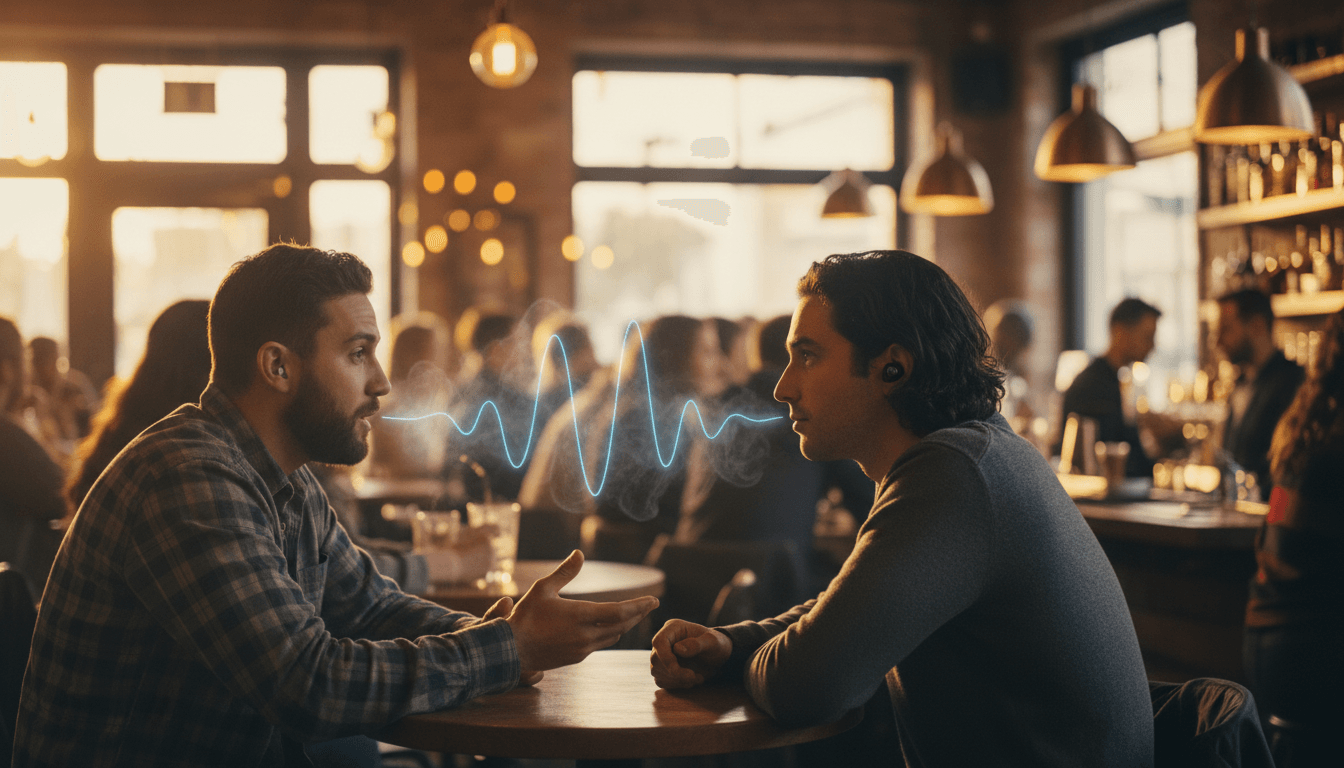
A crowded bar is a brutal audio test: clinking glasses, music bleeding from a ceiling speaker, three conversations behind you, and the one person you actually want to hear sitting right across the table. Traditional noise cancellation can’t solve this because it treats the world like a binary switch—either reduce everything or let everything through.
The more interesting problem is selective hearing: amplifying the voice that matters while leaving the rest alone. Researchers at the University of Washington recently described a “proactive hearing assistant” that does exactly that—it automatically detects who you’re talking to and enhances only those voices in real time, without taps, gestures, or manually choosing a speaker.
For our “Artificial Intelligence & Robotics: Transforming Industries Worldwide” series, this is a perfect example of the direction wearables are heading: AI systems that understand human intent, operate hands-free, and deliver outcomes fast enough to feel natural. The standout detail here isn’t just accuracy—it’s latency under 10 milliseconds, which is the difference between “helpful” and “unusable” in live conversation.
Why “hearing in noise” is still a top unsolved UX problem
Answer first: Most hearing tech fails in crowds because it amplifies sound, not social context.
Hearing aids and many “transparency mode” earbuds are great at making audio louder and sometimes cleaner. But in a noisy environment, loudness is the wrong goal. What people want is closer to what your brain already does: prioritize the conversational partner, down-rank everything else.
This matters beyond nightlife. The same problem shows up in:
- Open-plan offices where side conversations and keyboard noise mask speech
- Hospitals and clinics where clear communication is safety-critical
- Warehouses and factories where hearing protection + instructions must coexist
- Retail floors where staff need to hear customers without being overwhelmed
If you’re building AI products, this is also a lesson in product design: users don’t want more controls. They want fewer. Hands-free interaction isn’t a nice-to-have for accessibility tech; it’s the whole point.
The core idea: AI uses turn-taking to identify “your conversation”
Answer first: The system decides who you’re talking to by detecting conversational rhythm, not by guessing who’s closest or loudest.
The University of Washington team’s key insight is refreshingly human: in most conversations, people naturally alternate speaking turns with minimal overlap. If a voice tends to start when you stop (and vice versa), it’s probably part of your conversation. If it constantly overlaps with your speech, it’s more likely background chatter.
“If I’m having a conversation with you, we aren’t talking over each other as much as people who are not part of the conversation.”
That framing is important because many audio systems rely on proxies that break in the real world:
- Directionality: you might be looking away, or a speaker is off to the side
- Proximity: the person you’re talking to might not be the closest voice
- Loudness: the loudest voice is often not the relevant one
- Pitch/voiceprint: requires enrollment, raises privacy concerns, and fails with similar voices
Instead, this approach uses audio-only signals and a behavioral cue that’s surprisingly stable: the timing patterns of conversation.
How it anchors on you (the wearer)
The prototype uses microphones on both ears plus a directional audio filter pointed toward the wearer’s mouth to isolate the user’s speech. Your own speech becomes the anchor signal. Then the model looks for external voices that “fit” the turn-taking pattern with that anchor.
That’s clever for a practical reason: in a crowd, knowing when you spoke helps the system infer which other voice is responding to you.
The engineering breakthrough: brain-inspired dual-speed models
Answer first: The system separates “slow understanding” from “fast audio output” to hit sub-10 ms latency.
Here’s the constraint that makes this hard:
- To sound natural, enhanced audio must be processed in under ~10 milliseconds (otherwise lip-sync feels off and conversation becomes tiring).
- But to detect turn-taking patterns reliably, you often need 1–2 seconds of context.
Those timelines conflict. The UW design resolves it with a split architecture:
- Slow model (updates ~once per second): infers conversational dynamics and produces a “conversational embedding” (a compact representation of who seems engaged with you).
- Fast model (runs every 10–12 ms): uses that embedding to extract and enhance the partner voices while suppressing others.
This is exactly the kind of pattern we’re seeing across AI + robotics and real-time systems: a slower reasoning loop guiding a faster control loop. In robotics, it’s “planning vs. control.” In wearables, it’s “context inference vs. signal rendering.”
And from an industry standpoint, low latency is the gating factor for scaling to consumer devices. One expert quoted in the source notes that even 100 milliseconds is unacceptable for mass deployment; you need something close to 10 milliseconds.
What the results say (and what they don’t)
Answer first: In controlled settings, the prototype identifies conversation partners with 80–92% accuracy, low confusion, and meaningful clarity gains.
Reported performance highlights include:
- Conversation partner identification accuracy: 80–92%
- Confusion rate (wrongly tagging an outside voice as “in conversation”): 1.5–2.2%
- Speech clarity improvement: up to 14.6 dB
- Latency: < 10 ms
Those are strong numbers for a research prototype—especially the latency and clarity improvement. A 14.6 dB gain is the kind of delta users can actually feel, not just measure.
But it’s equally important to read the boundaries carefully.
Where this approach is likely to struggle
A CEO from an AI glasses company (working on related commercial tech) points out the messy truth: real environments don’t always feature neat turn-taking. People interrupt. Music competes. Multiple partners talk at once.
The approach also has inherent assumptions:
- It depends on self-speech. Long silences can confuse the system.
- It’s not for passive listening. If you’re just listening to a panel or a lecture, turn-taking cues may be weak.
- Overlapping speech remains hard. Simultaneous turn changes and interruptions can degrade performance.
- Cultural variability matters. The team trained on English and Mandarin; it generalized to Japanese without training, which is promising—but real-world deployment will still need broad cultural testing.
My take: these limitations don’t make it a dead end. They define the product category. This is an “interactive conversation enhancer,” not a universal sound separator.
Why this matters for accessibility—and for enterprise wearables
Answer first: Automatic speaker selection is a major accessibility upgrade because it removes the burden of “operating” your hearing tech.
Traditional hearing aids amplify broadly, and even the best modern ones can leave users fighting the environment—constantly adjusting settings, changing programs, or simply enduring the noise. A proactive hearing assistant changes the labor model: instead of the user managing the device, the device manages the scene.
That’s huge for:
- People with hearing loss who avoid social spaces because they’re exhausting
- Older adults who may struggle with tiny controls or app-based speaker selection
- Neurodivergent users for whom auditory overload is a daily obstacle
Now zoom out to industry. Wearable AI is becoming a standard layer in frontline work—think smart glasses, headsets, and assisted-audio PPE. A system that can enhance only the relevant voice could reduce errors in settings where mishearing is expensive:
- Manufacturing/maintenance: technician hears the supervisor over machinery
- Logistics: picker hears instructions without blasting overall volume
- Healthcare: clinician hears patient/family even amid alarms and corridor noise
- Field service: remote expert coaching becomes intelligible on noisy sites
In other words, this isn’t just hearing health. It’s communication infrastructure.
The next step: adding language understanding (and why that’s risky)
Answer first: Adding large language models could make hearing assistants more flexible—but it introduces privacy, bias, and “who decides what matters?” questions.
The researchers suggest incorporating semantic understanding via large language models so future systems can infer not only who is speaking, but who is contributing meaningfully.
That sounds great until you operationalize it.
What LLMs could improve
- Disambiguation in messy overlaps: if two people respond, semantics may help pick the relevant one
- Meeting scenarios: amplify whoever is addressing you, not whoever is loudest
- Error recovery: if the model amplifies the wrong person, language cues could correct faster
What LLMs could complicate
- Privacy: semantics implies deeper processing of speech content, not just acoustic patterns
- Misclassification risk: “meaningful” can encode bias (accent, speech style, disability-related differences)
- User agency: people will want an override—because sometimes the “meaningful” voice is the one you didn’t expect
A practical compromise I expect to win in products: keep semantic processing on-device, minimize retention, and provide transparent controls like:
- “Conversation mode: 1 person / 2–3 people / group”
- “Prioritize the last person who asked me a question”
- “Don’t amplify unknown voices” (useful in public)
If you’re building with AI wearables: product lessons worth stealing
Answer first: The real lesson is intent detection + low latency + graceful failure.
Whether you’re working on audio, robotics, or smart devices, there are three transferable principles here:
- Detect intent from natural behavior. Turn-taking is a behavioral signal. In robotics, it’s gaze, posture, and reach. In enterprise apps, it’s workflow timing. If you can infer intent without asking for a button press, you win.
- Engineer for real-time constraints early. Sub-10 ms isn’t a nice spec; it’s the product boundary. Many AI proofs-of-concept die when they meet latency budgets.
- Design for “safe wrong.” When the system guesses wrong, the user experience should degrade gently—not dangerously. For hearing tech, that means quick recovery, easy overrides, and conservative amplification policies.
If your goal is leads (and you’re evaluating AI initiatives), this is also a clean diagnostic question to ask vendors: What’s the end-to-end latency from sensor input to user output, and how does performance degrade in chaotic environments?
Where proactive hearing assistants are headed in 2026
Answer first: Expect AI hearing assistants to converge with smart glasses and enterprise headsets as “context-aware communication tools.”
The direction is clear: hearing assistance is becoming an AI problem, not just an audio amplification problem. As more compute moves on-device and wearables mature, we’ll see products that understand who you’re interacting with—and adapt automatically.
If you’re tracking how AI and robotics are transforming industries, watch for two indicators:
- Integration: earbuds, hearing aids, AR glasses, and workplace headsets will share similar AI stacks.
- Policy + trust: the winners won’t only be the models with the highest scores; they’ll be the ones that handle privacy, consent, and user control in a way people accept.
The bigger question to sit with is simple: when your wearable can decide which voices you hear, how do we keep the human in charge—without putting them back in a settings menu?